- PDP Tipped to Win in Bayelsa
- Imo May Likely Go APC, LP Seeks Upset as PDP Crisis Hurts Party’s Bid
- Too Close to Call in Kogi as APC, SDP Split Voters
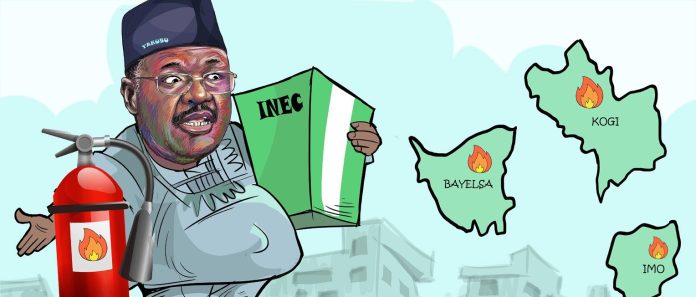
- INEC Looks to Restore People’s Faith in Polls After Controversial 2023 Elections
- By AMOS ESELE, with DAVID OWEI and CHUKS OHUEGBU
November 05, (THEWILL) – Technically, about 16 or 18 political parties are fielding candidates in the forthcoming off-cycle Governorship Elections in Bayelsa, Imo and Kogi States on November 11, 2023, but only three are actively campaigning.
THEWILL investigation, however, shows that for Bayelsa’s Creek House, the race is between the governing Peoples Democratic Party (PDP) and the main opposition All Progressives Congress (APC), with Labour Party (LP) waiting in the wings.
In Imo state, the battle for Douglas House is a three-horse race between the APC, PDP and LP, with the All Progressives Grand Alliance (APGA) making an appearance.

The race for Lugard House in Kogi is between the governing APC, the main opposition PDP and the Social Democratic Party (SDP). Of these political parties, the APC, PDP and LP are the frontrunners. LP is making its strongest showing in Imo state, less so in Bayelsa. Nevertheless, the APC/PDP dominate. The SDP is solidly on the ground in Kogi.
In the states where they are making appearances, these parties have the political structure, the foot soldiers and the money to burn, all of which will enable each of them to lay claim to the governorship of the states through the determining factors of zoning, incumbency and fitness of the Independent National Electoral Commission (INEC).
In all three states, the four major parties involved in this election, the APC, PDP, LP and SDP have managed to grab national news headlines through violence, which dimension is hard to guess. Already, the Nigeria Labour Congress (NLC) has threatened to declare a nationwide strike on Wednesday, November 8, in solidarity with its president, Mr Joe Ajaero, who was brutalised by thugs and security personnel during a workers’ planned protest over a 22-month pension arrears owed by the Imo State Government.
While the bloody NLC strike was a culmination of violence by “unknown gunmen” in Imo over several months, the thuggery in Bayelsa and Kogi peaked with the entrance of formidable rivals in the election.
In Kogi, Senator Dino Melaye of the PDP and Murtala Ajaka of the SDP, as well as the recent Appeal Court victory of PDP’s Natasha Akpoti-Uduaghan have significantly posed a serious threat to the governing APC in the state.
In Bayelsa, the candidacy of former Minister of State for Petroleum, Timipreye Sylva, especially after the Appeal Court affirmed his suitability for the election has drawn the battle line between the ruling PDP and APC.
ADDRESSING SECURITY ISSUES
“The governorship elections in Imo, Kogi and Bayelsa States are three out of the eight off-cycle elections to be held in the country. None of these states’ off-cycle elections is easy,” the National Chairman of INEC, Professor Mahmood Yakubu, said last week in Yenagoa, the Bayelsa State capital, during a tour of the state to address issues of security, terrain and negative mobilisation by politicians, adding that the essence of his meeting was to exchange ideas with security agencies towards the conduct of a peaceful election.
THEWILL has learnt that the National Chairman is worried about the negative impact of insecurity on the November polls. That is why he is touring each of the three states to get assurances from security personnel for the security of electoral materials, staff and voters.
The Chief Press Secretary to the INEC Chairman, Rotimi Oyekanmi told THEWILL that after the Bayelsa meeting on Thursday, Professor Yakubu would go to Imo. He had already visited Kogi.
On the issue of insecurity tour, Oyekanmi said, “With regard to your question, the INEC Chairman has already visited Kogi State. We were in Bayelsa yesterday, (Thursday) and we are currently in Imo State.”
Yakubu, who is also the National Chairman of Inter-Agency Consultative Committee on Election Security (ICCES) and had previously held an expanded security meeting with security chiefs and other agencies in Abuja, deemed it necessary to take the security message down to the states to ensure that electoral materials and personnel are given adequate protection during and after the elections.
Addressing the potential threat posed by insecurity to the conduct of the polls, against the backdrop of Wednesday’s strike by NLC, the Chief of Defence Staff, Maj-Gen. Christopher Musa and the Inspector-General of Police, Kayode Egbetokun, have warned those planning to disrupt the Nov.11 governorship elections in Bayelsa, Imo and Kogi to keep off the states.
The CDS gave the assurance that the Armed Forces would collaborate with the police to ensure that the elections are free and fair.
He said, “The Armed Forces, the police and other security agencies will be on the ground. Every Nigerian, we are sure, is tired of elections with violence and this will make a difference.
“At the end of the day, we want every Nigerian to be proud of, first, being a Nigerian and to understand that elections are now free and fair.
“We want everybody who wins our elections to be happy that he won very well without intimidation.’’
Also, Egbetokun said that those planning any form of violence in the states would only have themselves to blame.
”We are aware of negative mobilisations by supporters of some candidates and we are already monitoring them. We are ready for them in these elections. I appeal to them to stay away from this election.
“I also appeal to the electorate to come out en masse to cast their votes during this election. We are committed to peaceful elections and there is no going back.
“We have received all necessary information from INEC, which told us where to deploy security personnel during these elections.
“We have carried out a threat assessment and that has informed us, in respect of the allocation of our resources and the deployment of our men,” he said.
HOW THE MAJOR PARTIES STAND IN THE STATES
IMO STATE
There are 18 candidates representing 18 political parties in the November 11 governorship election in Imo, but in reality, there are five contenders, although surprises are usually common in all forms of election, particularly in the southeastern heartland.
One contending issue that has remained very central in the build-up to the governorship election is zoning. There are three zones in Imo, namely Orlu, Okigwe and Owerri. For the past 24 years since the birth of democratic rule in 1999, Orlu Zone has ruled for almost 20 years, while Okigwe and Owerri Zones have reigned for four years and seven months, respectively.
This made the Owerri Zone to start claiming that it is its “turn” to govern the state. To tackle this challenge, Governor Hope Uzodinma promised to work it out in 2027, thus setting the stage for a second term in office.
The Okigwe Zone believes that its tenure was forcefully terminated in 2011 when the combined forces of Owerri and Orlu Zones denied then Governor of the state, Ikedi Ohakim (from Okigwe Zone), the opportunity of a second term.
APC’s Uzodimma
Governor Hope Uzodimma of Imo State is not really loved by the masses. Perhaps, this is because of the circumstances surrounding his emergence as governor on January 14, 2020. THEWILL recalls that the Supreme Court controversially sacked PDP’s Emeka Ihedioha whom INEC had declared winner of the 2019 governorship election in the state and gave victory to Uzodimma who finished a distant fourth in that election.
In view of this, the majority of Imo citizens coined the derogatory name, ‘supreme court governor’ for Uzodimma to hammer home their misgivings with the apex court verdict.
Meantime, PDP was engulfed in a leadership crisis, following supremacy battle between Ihedioha and the National Secretary of the party, Senator Samuel Anyanwu, otherwise known as Samdaddy. The crisis lingered, forcing many supporters of the party to defect to the APC.
In an unprecedented move, seven members of the PDP’s State Working Committee, SWC, resigned from the party and joined Uzodimma’s APC.
Also, the entire Imo PDP Elders Council and National Assembly members, 2019-2023, resigned and also headed for the governing APC.
This scenario has given the APC and Uzodimma a huge advantage, no doubt, going into the November 11 elections. Again, the disputed APC victory in the February 25 presidential election and March 18, 2023 House of Assembly election, is another factor that counts in favour of the APC. This is so because many voters registered regrets about what they described as “electoral fraud” in the last election.
There are other factors, such as the issue of “two strong opposition parties and one weak contender”. This theory is that in an election where you have two strong oppositions and one weak contender, the former will certainly divide the voters into two factions, consequent upon which each of the opposition parties will secure 30 or 35 percent of the vote cast. This represents about 65/ 70 percent of the registered votes. On the other hand, the weak candidate will eventually garner 40 percent of the votes and will be declared winner.
The opposition here are the LP and PDP who ought to have worked together to oust the APC. The combined forces of LP and PDP would have been strong enough to sack the APC and Uzodimma-led administration. But a situation where both opposition parties are working at cross purposes will only ensure victory for the APC that looks like the weaker party.
What actually counts against the APC and Uzodimma is the worsening insecurity in the state. Before now, the insecurity only raged in the Orlu Zone (Imo West Senatorial District) area. Now there is insecurity in all the nooks and crannies of Imo State. It is now worse in Okigwe Zone (Imo North). Insecurity has caused severe damage to the Imo economy and all the blame is laid at Uzodimma’s doorstep.
Besides insecurity, joblessness and poverty, lack of pension payment and extreme lack of governance in the state have combined to make Uzodimma’s re – election bid a difficult task. Still, it appears he will win a re – election.
To this end, the governor’s media aides led by the Commissioner of Information, Declean Emelunba, claim that the APC and Uzodimma have been doing marvellously well, leading to the party’s election victories in re-run elections into Okigwe Zone Senatorial and Ngor Okpala LGA House of Assembly. They also pointed out some of the road projects the governor had completed in less than four years.
PDP’s Sam Anyanwu
The PDP has been the party to beat in virtually all the governorship elections held in the state since 1999. Even in two instances of 2007 and 2011 when the opposition parties, Progressive Peoples Alliance (PPA) and APGA, won the governorship elections, respectively, it was PDP’s structure (in 2007) and the party’s estranged supporters (in 2011) that ensured victory in both instances.
However, the PDP is currently a shadow of itself. The party is in tatters. The deplorable condition of the party is shown by the tussle for power between Ihedioha and the just sacked national secretary of PDP who also doubles as the party’s governorship candidate, Senator Sam Anyanwu.
It is alleged that Anyanwu, otherwise known as Samdaddy, was used by the ruling APC and Uzodimma to destroy PDP in the state. The idea of Samddady taking the party up to the Supreme Court in order to dissolve the executive did not go down well with party stakeholders, who saw the move as anti -party activity.
Samddady is accused of using his position as the National Secretary of PDP to cause trouble for the party as he controversially picked the governorship ticket for the November 11 election.
Based on the foregoing, Ihedioha withdrew from the governorship primary election. The result was the division of the party into two factions led by Ihedioha and Samdaddy, with the former having more than 75 percent of PDP members in the state.
Going into the election, most of the PDP’s leaders and followers are campaigning for APC, LP, APGA or AA. And the news of Samdaddy’s sack as the national secretary of the PDP is another blow to him and the party. The PDP is not likely to finish as runner-up in the governorship election on November 11.
Still, Samdaddy’s media coordinator, Comrade Ikenna Onuoha, says his principal has the brightest chances of winning the election in view of his antecedents, which are people-oriented.
Athan Achonu of LP
The structure of the “Obidient Movement” in Imo State is actually what is firing up the Senator Athan Achonu’s LP Campaign Organisation as the November 11 governorship election draws nearer.
Achonu, according to political pundits, is the one campaigning massively and vigorously across the state. Unlike others who are only seen on the pages of local newspapers in the state, Achonu has almost visited all the 27 LGAs in the state, re – echoing Peter Obi’s philosophies of economic recovery based on production and fiscal prudence.
However, Achonu, popularly known as Agu Otuaka (The Lion with one hand/ One Arm General), is being alleged to have been aided and sponsored by Uzodimma during the LP governorship primary election. This dust generated by this story is yet to settle down. Again, Achonu is seen as a part of the old order that destroyed the system.
Another point that counts against Achonu is that the “Obidient Movement” that went agog for Obi during the presidential electioneering is lukewarm towards his governorship ambition.
Taken together, Achonu is however a threat to the ruling APC and Uzodimma.
“The fact remains that Senator Achonu, based on popular rating, will emerge victorious in the forthcoming governorship election because he has been having a robust campaign and his message is very clear to the people,” Barrister Emeka, a member of LP’s legal team, stated.
APGA’s Tony Ejiogu
The APGA used to be a vibrant party in Imo State until 2018 when Senator Ifeanyi Araraume, using his wealth and influence, intimidated party chiefs to grab the party’s governorship ticket. Many were pissed off and they labelled the party Anambra Cash Cow.
Otherwise, the party’s candidate, Tony Ejiogu, is vibrant, dynamic and hard-working and he has what it takes to emerge the winner of the election.
Yet, many people are of the view that Ejiogu is not doing any serious campaign. Again, his tentacles are grossly limited.
KOGI STATE
Political parties involved in the Kogi governorship race are the governing APC, PDP, SDP, Action, Alliance, AA, Young Peoples Party, YPP and Africa Democratic Congress (ADC).
Nonetheless, the battle for Lugard House is between the APC’s candidate, Usman Ahmed Ododo and the candidate of the Social Democratic Party SDP, Alhaji Yakubu Muritala Ajaka.
APC is relying on incumbency, having established its presence and consolidated as a party in all the 21 local government areas of the state But the declining fortunes of the people, particularly the workers, following what the state NLC Chairman, Gabriel Amari, referred to as percentage payment of salaries. This means that the minimum wage does not operate in the state. In fact, workers, according to THEWILL checks, can earn anything between N10,000 and N15,000 monthly.
According to Amari, public commentators argue that as long as workers in local government areas earn percentage salaries, economic growth at the grassroots will remain a mirage.
“Unfortunately, the percentage payments to workers at Local government gives rise to financial pressure and increase in rural-urban migrations.
“Your Excellency, as your tenor draws to an end, we urge you to compel the authorities in charge of local government to restore payment of complete salaries to workers to bring them at par with their state counterparts. It is bad enough that the state is a hotbed of insecurity, particularly the Lokoja-Abuja area.
”It is a fact that Kogi State is an agrarian society; farmers depend on cropping and other agricultural practices to earn a living. Therefore, the frequent attacks by herdsmen on farmers constitute a huge threat to the social and economic stability of the state,” Amari concluded.
In the midst of these economic and insecurity challenges, the ethnic factor is currently playing out in the election among the three major ethnic groups, namely the Igala of the Eastern Zone, Okun of the Western Zone and Ebira of the Central. Zone,
For now, APC is having the upperhand as it is using incumbency powers and government machinery at its disposal.
The recent Appeal Court victory of Senator Natasha Akpoti-Uduaghan and her subsequent swearing-in at the Senate has consolidated her Central Senatorial Zone for the PDP. She is very popular and liked in the zone and may give the APC and Governor Yahaya Bello a tough time in the zone.
But the problem with the Western Zone where Senator Dino Melaye comes from is that it will in all likelihood share votes between the PDP and the candidate of the ADC, Leke Abejide, who also hails from there. That is why the APC and SDP, from THEWILL investigation, are the likely parties to win the election because the SDP candidate, Yakubu Ajaka, hails from the Eastern Zone that has the majority population and they are throwing everything into the election to reclaim the leadership that was lost, following the demise of the late Prince Abubakar Audu who is from the zone. This is one of the major reasons why the violence witnessed during electioneering has been between supporters of the APC and the SDP.
If the Federal government, INEC and security agencies keep to their promise to give a level playing field in their constitutional duties, surprises will happen irrespective of incumbency factor. So, the election is too close to call.
Senator Melaye failed to answer repeated calls to his phone, neither did the Director of Communication of SDP, Faruk Adejoh-Audu. Allso, the state Commissioner for Information and Director General of APC campaign council, Kingsley Fanwo, did not answer the phone calls made to him.
BAYELSA STATE
Despite being a homogenous Ijaw state, Bayelsa has always been volatile politically and the November 11 governorship election is living up to that expectation. The advent of militancy during the agitation for resource control has increased the tempo of violence in the oil producing state.
Of the 16 political parties participating in the governorship poll in Bayelsa State, the two dominant political parties, the PDP, APC and LP are campaigning, although the battle for votes appears to be a PDP/APC affair.
The major streets and strategic positions within the state capital, Yenagoa, are inundated with billboards, banners and branded cars of both political parties represented by the incumbent Governor Douye Diri of the PDP and his APC challenger, Timipre Sylva, a former Minister of state for Petroleum.
Amid electioneering, both candidates have been trading words, each accusing the other of planning to rig or cause chaos in order to emerge the winner.
The Peoples Democratic Party candidate and incumbent Governor of the state, Senator Douye Diri, had a field day when the INEC published the list of candidates for the November 11 poll without Sylva’s name, following a court judgement. Following his victory at the Appeal Court, the tension has risen again, even though his name is yet to be inserted in the final list.
Confirming the new development to THEWILL, Oyekanmi said, “I am not sure if we have been served yet. We have already released a final list of candidates for all the three off-cycle governorship elections. However, if there is a court order/judgement asking INEC to remove, include or substitute a name, the Commission will comply and indicate “by court order” in the “remarks” column.”
Governorship election petitions usually end at the Supreme Court. So, if the petitioners decide to pursue the case further, there is no telling the fate of Sylva. But the former Minister is campaigning unperturbed, saying he would win the poll.
Bayelsa is a traditional PDP state. While Diri is very sure of his second tenure, the APC governorship candidate, Sylva, who governed the state on the platform of the PDP, (which is the subject of the litigation against him as he would be sworn-in for a third time, though he did not complete his second tenure) is also very sure of a resounding victory come November 11.
Campaigning in the shadows is the LP candidate, Udengs Eradiri, a former leader of the Ijaw Youth Council. He has openly confessed that he lacks the war chest of both the PDP and APC, but with the support of the youths on his side, he is ready to pull a surprise. He is currently embarking on a door-to-door campaign across the eight local government areas of the state and has been able to win followers among the youths who feel disenchanted with the PDP and APC, regarded as the face of corruption and elitism. More important is the support of the “ Obidient Movement”, in the state, which has a strong base in Bayelsa State.
The state Chairman of the PDP, Solomon Aguanana; the Secretary, Gesiye Isowo and the Publicity Secretary, Ebiye Ogoli, and the APC State Publicity Secretary, Mr. Doifie Buokoribo, are always at each other’s throat, accusing one another of violence.
Ogbolomari community in Nembe, Bassambiri-Nembe, Opokuma, Odi and Kaiama in Kolokuma/Opukuma Local Government Council and Sangana in Brass Local Government have been areas of violent confrontation between supporters of the PDP and APC.
But given the capacity of the PDP and APC to outspend rivals, coupled with the violence that both major parties have been engaging in, it is unclear how LP can spring any surprise.
Rising to the occasion, the Resident Electoral Commissioner, REC, Obo Effanga, has said that there will be stakeholders meeting on Tuesday, while on Wednesday, the 16 political parties will sign a peace accord to ensure the peaceful conduct of the governorship election.
Amos Esele is the Editor of THEWILL Newspaper. He has over two decades of experience on the job.