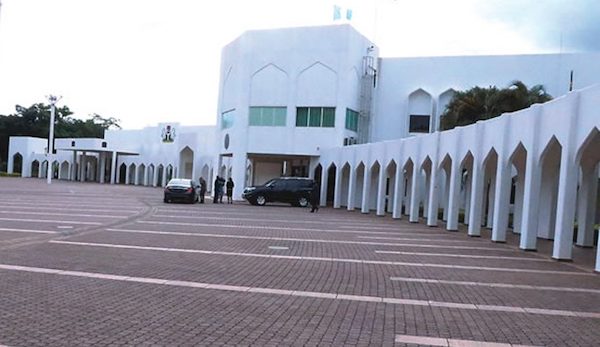
May 17, (THEWILL) – The recent announcement that President Bola Ahmed Tinubu has approved N10 billion for a solar power grid project in the Aso Rock Presidential Villa has provoked widespread outrage — and rightly so. The move, confirmed by Mustapha Abdullahi, Director-General of the Energy Commission of Nigeria, is said to be aimed at cutting down the Villa’s unsustainable N47 billion annual electricity bill.
However, the optics of this decision are troubling. While the President and his inner circle will now enjoy uninterrupted power supply, millions of Nigerians continue to wallow in total darkness, battling epileptic power, outrageous tariffs, and an unreliable electricity grid.
Rather than fix the nation’s decaying power infrastructure, President Tinubu appears more interested in insulating himself from the same challenges that torment ordinary citizens. His justification — that the project aligns with an agenda to diversify energy sources — rings hollow, especially when no detailed plan has been shared on how he intends to extend such innovations to the rest of the country.

This decision has further deepened what can best be described as energy apartheid: a two-tier system where a privileged few enjoy constant, clean energy, while the majority are left with darkness, inflated bills, and broken promises.
Recall Tinubu’s bold 2023 campaign statement:
“If I don’t give you constant electricity in four years, don’t vote for me again in 2027.”
Now, less than two years in, not only is Nigeria still trapped in darkness, the President appears to have turned that promise into a personal privilege—ensuring light for himself, while the nation remains in blackout.
The solar grid project, therefore, smacks of entitlement and self-aggrandizement, rather than visionary leadership. It’s a cruel irony that the man who once campaigned on fixing the national grid now seeks refuge from it—leaving the people he swore to serve at the mercy of a dysfunctional power sector plagued by gas shortages, dilapidated infrastructure, and distribution fraud.
For context, Nigeria’s power sector has undergone significant changes over the years. Since the privatization of NEPA, the government retained full ownership of the Transmission Company of Nigeria (TCN), responsible for managing the country’s 132kV and 330kV transmission system. It also retains stakes in six Generation Companies (Gencos) and 11 Distribution Companies (Discos), though these stakes vary.
Take the Benin Electricity Distribution Company (BEDC), for instance: the federal government owns 40% of it, with four states—Delta, Edo, Ekiti, and Ondo—owning 34.2% of that 40%. That translates to a 13.68% collective stake for the states and roughly 13% for the federal government. Yet, despite this involvement, the government has failed to hold operators accountable or improve service delivery.
Instead of leveraging these existing structures to provide affordable, stable electricity nationwide, Tinubu has chosen to prioritize comfort for Aso Rock — spending billions to ensure a luxurious escape from the very hardship his administration was elected to address.
This N10bn solar grid, as far as Nigerians are concerned, is a slap in the face. It highlights the growing disconnect between the ruling elite and the masses. It exposes a leadership style that appears more invested in optics than in results.
Unless the President redirects his focus to solving the power crisis holistically, rather than shielding himself from it, he risks cementing a legacy of missed opportunities and broken promises.
There’s still time for course correction — but the clock is ticking toward 2027.
Erasmus Ikhide contributed this piece via: ikhideluckyerasmus@gmail.com

Erasmus Ikhide