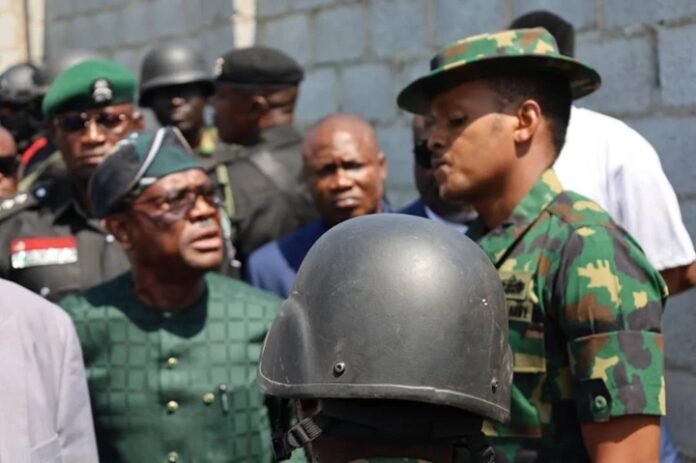
November 14, (THEWILL) — The recent altercation between FCT Minister Barrister Nyesom Wike and Naval Officer A.M. Yerima has exposed the alarming failures of soft governance, constitutional democracy, and constitutionalism in Nigeria, while underscoring the urgent need to demilitarize the country’s political space.
That Officer Yerima blocked Minister Wike from accessing a parcel of land, citing “obeying superior orders,” must be recognized for what it truly is: a brazen assault on Nigeria’s democracy, however fragile it may seem. In legal terms, the Minister was fully within his rights, acting in his capacity as the FCT Minister responsible for land administration in Abuja.
Under section 297(2) of the 1999 Constitution, all lands in the FCT belong to the Federal Republic of Nigeria, and the President has delegated authority over them to the Minister without restriction. The Supreme Court has made it clear that every military or police officer swears to preserve, protect, and defend the Constitution, which supersedes any selective or illegal orders issued by military or paramilitary authorities.

The situation worsens when one considers the disgraceful response from the former Chief of Army Staff, General Tukur Buratai, who was first to stoke the flames of military impunity and arrogance. Since then, Nigeria’s commercialized military leadership has accused Wike of perceived brashness while simultaneously glorifying the audacity of a young Naval officer who should have been on the battlefield combating terrorism spreading across the nation.
Yerima compounded the crisis with his boastful claim: “I’m a two-star General obeying superior orders from above.” But what order was he truly obeying? And is Yerima genuinely a General, or a Lieutenant inflating his rank? This confusion reflects broader weaknesses within the military, a force ill-prepared to protect citizens yet quick to project false authority while Nigeria faces the yoke of Fulani Islamic terrorism.
For context, the retired officer whose property Yerima defended is Vice Admiral Awwal Zubairu Gambo, a former Chief of Naval Staff. The disputed property in Gaduwa, Abuja, was originally allocated to Santos Estate Limited in 2007 for park and recreational purposes. The company later sold it to individuals, including Gambo, without proper authorization.
Was Yerima aware that he was executing “illegal orders” from a corrupt military elite that diverted resources intended to fight terrorism into land acquisition? Records reveal a long history of top military officials misappropriating resources meant for arms procurement to acquire properties in Nigeria and abroad, sometimes even financing criminal activities through illegal channels.
General Buratai’s hasty intervention appears self-serving. His tenure was marred by allegations of corruption, including the purchase of two Dubai houses worth $1.5 million, which he claimed were bought from personal savings. His record also includes human rights abuses and extrajudicial killings, raising serious questions about the professionalism and integrity of military leadership in Nigeria.
How can a military that has repeatedly failed to contain terrorism, banditry, and kidnappings be allowed to usurp civilian authority, undermining the presidency itself? While I do not advocate punitive actions, the military must be subordinated to democratic governance if Nigeria is to progress. Its focus should be strictly on security: combating terrorism, banditry, kidnapping, cattle rustling, and other vices tearing the country along ethnic and religious lines.
The recurring presence of military personnel in political affairs signals disorientation and destabilization. Even though Wike’s engagement with Yerima may have lowered the dignity of the Federal Government, it reflects the challenge of confronting a military culture that lacks respect for lawful authority.
Officer Yerima’s actions constitute a clear breach of the Nigerian Constitution and service laws and warrant court-martial. Glorifying such acts without addressing the structural issues risks unleashing a reign of terror by uniformed personnel against ordinary civilians. Upholding the rule of law and civilian supremacy is non-negotiable.
Any attempt to use military influence to subvert lawful civil authority undermines both the state’s authority and the professionalism of the armed forces. Nigeria cannot afford a repeat of such audacity.
Erasmus Ikhide contributed this piece via: ikhideluckyerasmus@gmail.com

Erasmus Ikhide