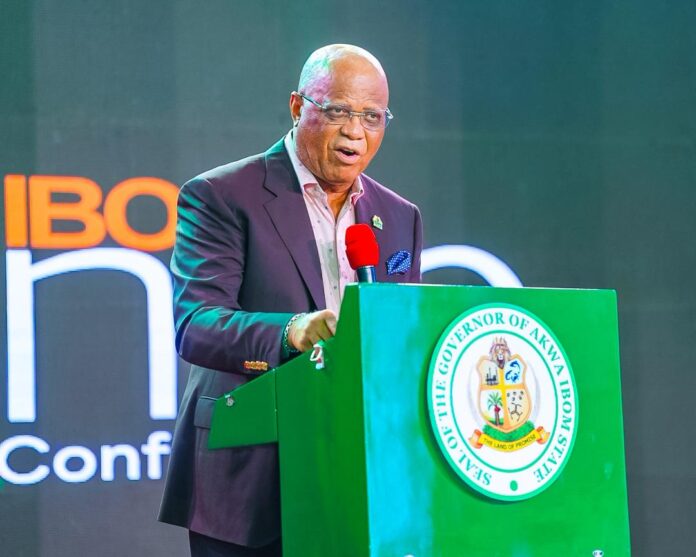
April 23, (THEWILL) — By all early indicators, the 2027 conversation in Akwa Ibom is not beginning with uncertainty; it is taking shape around continuity. Across political, professional, and community circles, endorsements for Governor Umo Eno’s second-term bid are emerging sooner than expected. But beneath the surface of this growing support lies a more layered story: one driven not just by achievements, but by expectations, lived experiences, and a few quiet reservations.
This feature draws from conversations across the state: civil servants, traders, healthcare workers, youth leaders, and rural residents, to understand why the endorsement wave is building, what it truly represents, and what people still want fixed before giving full political trust.
The Endorsement Momentum: Performance As Political Capital

Unlike traditional endorsement cycles often powered by elite bargaining, the current wave leans heavily on visible governance outcomes. For many respondents, support for a second term is less about political loyalty and more about perceived delivery.
The ARISE Agenda, which frames the administration’s development priorities, has provided a structure through which citizens can measure progress. While not every promise has been fulfilled, several flagship interventions are shaping public opinion in tangible ways.
Take healthcare. The construction of model Primary Health Centres across all 31 local government areas has become one of the most frequently cited reasons for support. In communities that previously relied on distant or under-equipped facilities, these centres are changing access patterns.
Residents describe a shift from uncertainty to predictability, where basic care, maternal services, and emergency response are no longer dependent on long-distance travel. For many rural dwellers, this is the first time government presence feels both visible and functional in the health sector.
Similarly, the housing initiative at Grace Estate has resonated strongly among lower- and mid-level civil servants. The decision to allocate 150 homes free of charge, particularly through a transparent selection process, has been interpreted as a rare example of policy reaching the intended beneficiaries without distortion.
One respondent, a Grade Level 07 worker, described it simply: “This is the first time I’ve seen something meant for people like us actually get to us.”
Infrastructure development is also shaping perceptions. The ongoing 28km Oron dual carriageway project is widely seen as more than a road; it is viewed as an economic connector with long-term implications for trade, tourism, and property development.
At the same time, the expansion of Ibom Air’s fleet has strengthened confidence in the administration’s economic direction. For business owners and frequent travellers, improved connectivity is not abstract; it translates directly into productivity and opportunity.
Security interventions, particularly through the strengthening of the Security Trust Fund, have further contributed to a sense of stability, which many respondents describe as essential for both daily life and investment.
Taken together, these initiatives are forming a narrative of structured governance, one that prioritises systems, not just announcements.
Why The Endorsements Are Coming Early
Several factors explain the unusually early alignment around a second-term bid.
First is the geographical spread of projects. Respondents repeatedly emphasised that development is not concentrated in Uyo alone. Communities like Etim Ekpo, Urue Offong/Oruko, and Nsit Atai are seeing direct interventions. This has reduced the traditional rural-urban development gap that often fuels political resistance.
Second is the visibility and accessibility of impact. Projects such as health centres and housing are not abstract; they are used daily. This creates a stronger emotional and practical connection between governance and the people.
Third is perceived administrative calm. Many respondents noted a reduction in political tension compared to previous administrations. This stability is being interpreted as a sign of focused governance.
Finally, there is a continuity argument gaining ground. A significant number of respondents believe that many of the current projects are midstream and require additional time for completion and consolidation.
As one community leader in Oron put it: “Stopping now would mean starting again.”
The Expectations: Support With Conditions
Despite the growing endorsements, public sentiment is far from unconditional. In fact, support appears to be tied to a clear set of expectations for the remaining months of the first term—and even more so for a potential second term.
Completion Over Commissioning: A recurring concern is the need to move beyond project launches to full delivery. Citizens want to see ongoing projects, especially roads and health facilities, completed, equipped, and fully operational.
Sustainability of Social Interventions: While initiatives like free housing have been applauded, there is concern about continuity. People want clarity on whether such programs will be expanded, maintained, or replaced.
Job Creation Beyond Construction: Many respondents acknowledged the employment generated by ongoing projects but emphasised the need for more permanent, private-sector-driven jobs, particularly for young people.
Cost of Living and Economic Relief: Like much of Nigeria, Akwa Ibom residents are feeling economic pressure. There is a growing expectation for policies that directly address affordability, small business support, and income stability.
Deeper Rural Penetration: Although progress has been noted, some remote communities still feel underserved. Respondents want the next phase of governance to push even further into hard-to-reach areas like Mkpeti Itam in Itu LGA, Use Ikot Amama in Ibiono Ibom LGA, among other such communities.
The Quiet Regrets: Where Expectations Have Not Been Met
While criticism remains measured, it is present and instructive.
Some respondents pointed to slow project timelines, particularly in road construction, where visible progress does not always match initial expectations.
Others raised concerns about limited communication on policy details, noting that while projects are visible, the broader strategy behind them is not always clearly explained to the public.
There were also mentions of uneven implementation, where certain local government areas appear to be progressing faster than others, raising questions about consistency.
A smaller but notable group expressed concern over youth inclusion, arguing that while infrastructure is improving, structured pathways for youth engagement and leadership remain limited.
Perhaps most telling is a sentiment captured by a trader in Uyo:
“We are seeing work, yes, but we are also watching closely.”
Looking Ahead: Endorsement Is Not a Guarantee
The emerging endorsements for Governor Umo Eno reflect a significant level of public approval, but they are better understood as provisional trust, not final judgement.
The people of Akwa Ibom appear to be making a calculated decision: to support continuity, but with heightened expectations for delivery, transparency, and inclusion.
If the administration can consolidate its current projects, deepen economic impact, and address the gaps identified by citizens, the path to a second term may become clearer.
If not, the same electorate currently offering endorsements may become more cautious.
The political message from the ground is clear: performance has opened the door, but only sustained results will keep it open.