

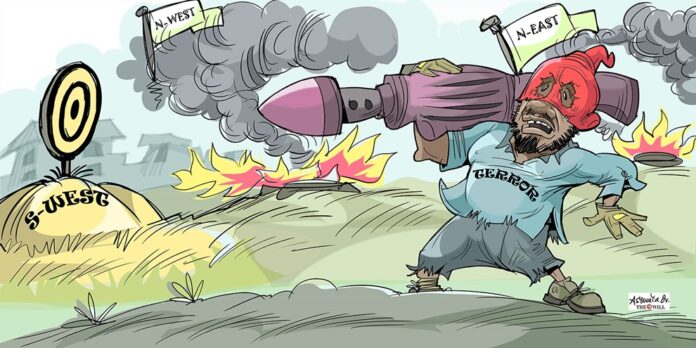
January 19, (THEWILL) – For the second time in a month, Nigerian military authorities have blamed the upsurge in terrorist attacks in the New Year, across many states in the North-West and North-East geopolitical zones, on foreign influence.
Between January 6 and January 14, 2024 terrorists linked to the Islamic State West Africa Province, ISWAP, attacked a military Base in Sabon-Gida, Damboa, Borno State, killing eight soldiers; 30 persons were reportedly killed by bandits in the Charanci, Safana, Kurfi, and Kaita Local Government Areas of Katsina State, while 20 farmers and fishermen were killed by Boko Haram/ ISWAP terrorists in Kukawa Local government Area of Borno State.
Also, 40 people, mostly women and children, were kidnapped in Gana Village in Shinkafi LGA of Zamfara State. About 77 persons have been confirmed killed and 43 kidnapped in 10 northern states in the past one week.

Last Thursday, the Nigerian military said the rise in terror attacks was due to an influx of foreign fighters, which provided reinforcement to local terrorist groups in the country.
According to the Director, Defence Media Operations, Maj. Gen. Edward Buba, the foreign fighters are from the Sahelian Region. “The other contributing factor is the local collaborators that form a support base for these terrorists. They serve as informants to the terrorist reporting on troop movement,” he said.
Maj Gen. Buba noted that the military has been doing its best to contain the situation by killing many of the terrorists, their commanders and senior leadership.
Earlier, Chief of Defence Staff, Lt. Gen Chris Musa, addressed the situation in a trending interview with Al Jazeera TV. He said, “The problem is that we have talked to the international community to help find out about their sources of funding. When they (Boko Haram fighters) started surrendering, over 120,000 were found with hard currencies, thereby raising the question of how they got the money, how they are funded, how they get their training and how they get their weapons and equipment. How have they been able to sustain themselves for 15 years? Maybe there is an international conspiracy. Who knows?”
With these claims, “there is no doubt that the chicken has come home to roost,” a seasoned security risk management and intelligence executive at Beacon Security and Intelligence Limited, Dr Kabir Adamu told THEWILL on Friday.
Adamu, who is the Managing Director of the security outfit, praised the military for being in the forefront of the fight against terrorism in the country, but he faulted it “for taking upon itself more than it can deliver.”
He said, “I have been saying the same thing 10 years ago that defence is just one component of national security. Besides, national defence and national security do not mean the same thing. The forte of the military is national defence, while the other 25 defence and security departments that we have, are concerned with national security. As an example, border management is not the function of the military. It is only when we have war with our neighbours that the military can be deployed to the borders, but when we are at peace with our neighbors, the standard rule is for the Immigration and Customs Services to be part of border management. I made this distinction so that we have to approach security from this paradigm where each of the security agencies are as important as the military.”
He summed up all of these in three key words: Coordination, cooperation and operation.
Of these three components in dealing with effective security maintenance, Adamu said Coordination appears to be the weak link. “The coordination element has been left almost undone. It is more about operation and cooperation.”
PRESIDENCY STEPS IN
THEWILL recalls that it was in an effort to enhance the coordination aspect of the war against terrorism that President Bola Tinubu, in September 2024, directed the Minister of State for Defence, Bello Matawalle and the service chiefs to relocate to Sokoto State, which alongside six other states in the Northwest geo-political zone had become the hotbed of kidnapping and banditry in the country, with four of the states in the zone, (Kaduna, Katsina, Zamfara and Sokoto) recording the highest number of kidnap cases between July 2023 and June 2024. This was contained in a report by SBM Intelligence, a market intelligence, security analysis and strategic consulting firm.
In an update last week, the Defense Headquarters disclosed that a combined team of infantry and air force personnel had dealt a severe blow to the new addition to bandits in the region, Lakurawa and dismantled the bases of the most vicious of the bandits in the Northwest, Bello Turji, killing scores of his commanders. In a swift reaction, Governors Uba Sani of Kaduna State and his Zamfara counterpart, Dauda Lawal and Governor Dikko Rada of Katsina state, commended the military and pledged their support.
Announcing the significant victory against banditry in the region last Sunday, the Nigerian Air Force, NAF, Director of Public Relations and Information Air Vice Marshal Olusola Akinboboye, said the killing of several top bandit commanders and other fighters in a series of airstrikes conducted in the North-West states, was a significant victory in the ongoing battle against banditry in the region.
But the most wanted man, Turji, fled, heightening tension in the region. Expressing concern over Turji’s recent ultimatum on communities to contribute gifts in cash and kind or face attacks that often result in loss of human lives and the burning of houses and farmlands, former Governor Attahiru Bafarawa of Sokoto State, said, “Most of the people living close to my town are now taking refuge in my village, fearing for their lives. Even Bafarawa town itself has become a no-go area, which is very pathetic.”
REACTIONS
Reacting to the renewed attacks by Boko Haram terrorists in Borno State, Senator Ali Ndume, representing Borno South at the National Assembly, said many of the attackers swooped in from the Lake Chad region through the porous borders and joined others still hiding in the Gwoza mountains in the state to launch the deadly attacks.
“Soldiers are so gallant, but they lack sufficient training, ammunition, equipment, and motivation. These are essential for them to succeed in this fight,” Ndume said on national television last Thursday, adding, “I know what is going on. If you see the conditions under which our soldiers are operating, you will pity them.”
Senator Ndume who said he undertook a tour of the affected areas, added that, “For example, the feeding allowance for a soldier is ₦1,500 — not per meal, but per day. The salary of a private is still ₦50,000, even though I understand it has been increased to ₦100,000. You can imagine that. Yet, these people are willing to lay down their lives to do what is actually not their job.”
FEAR OF TERROR ATTACKS SPREADS TO THE SOUTHWEST
As states in the North-West and North-East continue to witness increased attacks, residents of the South-West states live in fear of an invasion by terrorists who are said to be escaping the bombardments by the military in those regions. Governor Seyi Makinde of Oyo State raised the alarm last week, basing his claims on intelligence reports.
Investigation, however, shows that many of the states have put machinery in place to thwart possible, unexpected attacks by terrorists.
In Ogun, Oyo and Lagos State, for example, regular security meetings and a steady empowerment of local security outfits, as well as a combined army/police team has reinforced the security architecture in these states.
In a note made available to THEWILL, the Police Public Relations Officer, Police Command in Ogun State, CSP Omotola Odutola, stated that police divisions in the state regularly hold Stakeholders Security Awareness meetings to promote community safety and peace.
“The initiative aligns with the Commissioner of Police, CP Lanre Ogunlowo’s goal to make Ogun State a safe haven,” he said. According to him, the meetings are always attended by Police Community Relations Committees, PCPC, traditional rulers, local government chairmen, hunters, hoteliers, Amotekun corps, student unions, principals of public and private schools, transport unions and community development associations.
But vigilance remains the key word in security matters in the state as Mrs Odumosu, the wife of a former Commissioner of Police in Lagos State, retired Assistant Inspector General of Police Hakeem Odumosu, was on Friday abducted by gunmen in their Voera Estate in Arepo, Ogun State. Confirming the abduction, PPRO Odutola, said the command reacted swiftly to the abduction by deploying policemen to secure her release.
According to Odutola, “Reports indicate that she was about to enter her home when four masked men attacked her, dragged her from her LEXUS Jeep, and took her through swampy areas to an unknown location. The Divisional Police Officer has led a team of Police officers to the scene, where they are currently searching the swampy bush area. The Divisional Police Officer has also contacted Baale Warewa and Baale Maaba, to deploy local security forces to the riverine area.”
Lagos State Commissioner for Information, Gbenga Omotoso told THEWILL on Friday that Lagos citizens do not need to panic following the alarm raised by Governor Makinde.
“We have a solid and reliable security architecture that is at work. We have Lagos Security Council comprising the army, navy, airforce, police and neighbourhood watch and the security trust fund headed by Governor Babajide Sanwo-Olu. They regularly meet to review the security situation in the state. Recently, we got men into the neighbourhood watch to provide correct intelligence to the security agencies. Recently, the state government presented to all security agencies about 260 patrol vehicles and other equipment. So, Lagos residents should not go into panic mode.”
Similarly, Oyo State, besides regularly funding the local but region wide security outfit, Amotekun, last week donated 100 patrol vehicles to security agencies.
WAY FORWARD
Reacting to CDS Lt. Gen Musa’s claim of likely foreign sponsorship of Boko Haram’s activities in Nigeria, Dr Adamu noted that the recent increase in terror attacks in the country showed that there were gaps in the security architecture that needed to be filled. According to him, security agencies mandated to work for national security should be empowered to do so. An example is the National Financial Intelligence Unit, NFIU.
He said, “That agency has the capacity to monitor illicit funding, including terrorist groups. I know this because I have interacted with them. They know what the shadow economy is, what is involved and who the players are. The NFIU has partnerships with different international players that supports its monitoring of illicit funding, at the level of the Economic Community of West African States, ECOWAS, the African Union and the United Nations. The United Nations Office on Drugs and Crime, a UN agency, publishes periodic reports on illicit funding. Nigeria is one of the major countries, so why can see reports on illicit funding about Nigeria is public knowledge.”
For National Security Adviser, Nuhu Ribadu, an approach to tackling terrorism, violent extremism and organised crime will be vigorously pursued in the country in 2025.
He highlighted a “robust strategy involving enhanced collaboration, innovative measures and proactive responses to address the nation’s security challenges in 2025.”
Speaking at a public function in Abuja early in the month, the NSA said through the Coordinator of the National Counter-Terrorism Centre, Maj. Gen. Adamu Laka, that “recent advancements, including the operationalisation of the Multi-Agency Anti-Kidnap Fusion Cell, would help in combating violent crimes in the New Year.
Laka said, “Looking to 2025, Ribadu reassures Nigerians of renewed focus on combating terrorism, violent extremism and other serious organised crimes through enhanced collaboration, innovative strategies and proactive measures.
“He highlights recent advancements, including the operationalisation of the Multi-Agency Anti-Kidnap Fusion Cell at the National Counter-Terrorism Centre developed with support from the United Kingdom National Crime Agency to address kidnapping and related crimes. Additionally, dedicated emergency numbers will be made available to facilitate timely reporting and intervention.”

Amos Esele is the Editor of THEWILL Newspaper. He has over two decades of experience on the job.



