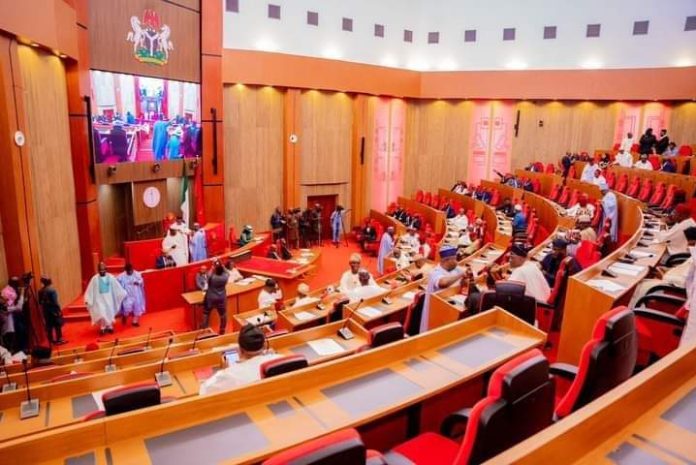
May 12, (THEWILL) — The Senate has amended its Standing Orders to impose a strict 14-legislative-day deadline for senators-elect to take their oath of office after inauguration, warning that failure to comply could lead to the declaration of their seats vacant and the conduct of fresh elections by the Independent National Electoral Commission (INEC).
The new provision, adopted as part of a broad review of the Senate Standing Rules, is aimed at addressing prolonged vacancies in the Red Chamber caused by post-election litigation, political disputes, delayed appearances and other circumstances that have in the past kept constituencies without representation for extended periods.
THEWILL reports that under the amended rules, any senator-elect unable to take the Oath of Allegiance and Oath of Membership on the first sitting of a new Senate may still be sworn in at a later sitting presided over by the Senate President, provided such swearing-in takes place within 14 legislative days from the first sitting of the Senate.

However, the rules also provide sanctions for failure to comply within the stipulated timeframe.
The amended Rule 2(e) states that where a senator-elect “fails, neglects, or is unable” to take the oath within the specified period, the Senate may, subject to constitutional provisions, declare the seat vacant and notify INEC to conduct a fresh election in the affected senatorial district.
The provision reads in part: “Any Senator-elect who is unable to take the Oath of Allegiance and Oath of Membership on the first sitting of the Senate shall be entitled to be sworn in by the President of the Senate at any subsequent sitting of the Senate, provided that such swearing-in shall take place within 14 legislative days from the first sitting.
“And where a senator-elect fails, neglects, or is unable to take the oath within the period specified, the Senate may, subject to the provisions of the Constitution of the Federal Republic of Nigeria, take appropriate steps to declare the seat vacant and notify the Independent National Electoral Commission to conduct a fresh election in the affected senatorial district.”
The amendment marks one of the most significant procedural changes introduced by the current Senate and is expected to reshape the management of post-election transitions in the National Assembly ahead of the 2027 general elections.
Apart from tightening swearing-in procedures, the Senate also retained and strengthened controversial eligibility conditions for lawmakers aspiring to become Senate President or Deputy Senate President.
According to the revised rules, only ranking senators who have served at least two full terms of eight years, with one of those terms immediately preceding the election, can contest for the Senate’s top leadership positions.
The amendment effectively narrows eligibility for the 2027 Senate presidency race to senators currently serving in the 10th Senate who secure re-election into the 11th Assembly.
The revised Rule 3 further provides that nomination of presiding officers shall strictly follow the ranking order of senators.
The order includes senators returning based on the number of times re-elected, followed by former members of the House of Representatives who later became senators, while first-time senators rank last in the hierarchy.
The Senate, however, reversed an earlier amendment that required senators-elect to first take their oath before participating in the election of presiding officers.
The chamber reverted to the long-standing parliamentary tradition that permits senators-elect to vote for the Senate President and Deputy Senate President before taking their oath of office.
Explaining the reversal, Chairman of the Senate Committee on Judiciary, Legal Matters and Human Rights, Adeniyi Adegbomire, said lawmakers decided to return to the old procedure to avoid constitutional controversy.
“In the past, you didn’t have to be sworn in before you voted for the Senate President and Deputy Senate President, and now, they said you should be sworn in first, before the election.
Members thought that the constitution says ‘you may,’ so that there won’t be any controversy thereafter, we decided to revert to the old Order,” he said.
Also speaking on the issue, Senate Leader, Opeyemi Bamidele, said making oath-taking mandatory before voting for presiding officers could create constitutional inconsistencies, particularly with Section 52 of the 1999 Constitution.
The Senate also approved additional amendments covering sitting hours, suspension procedures, committee representation across the six geopolitical zones, and the establishment of new standing committees.
Among the new committees created are those on Livestock Development, Reparations and Repatriations, as well as regional development commissions.

Felix Ifijeh is a journalist with years of professional reporting experience. Known for his keen news sense, compelling storytelling and commitment to accurate, impactful reporting, he has built a reputation for turning leads into clear, engaging, and well-structured reports that resonate with readers. His work reflects deep newsroom experience and a commitment to accurate, impactful journalism.