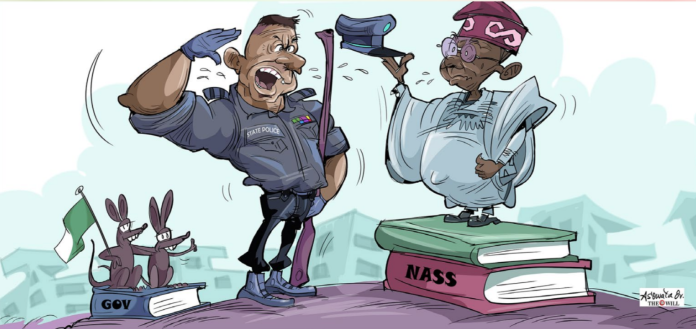
May 19, (THEWILL)- With the resounding call for state police from the executive and legislative chambers to town hall meetings, the advocates are winning the long-drawn battle to decentralise policing in Nigeria. The overwhelming security challenges in the country are the main drivers of the push.
In latest calls endorsing state police, the Speakers of the 36 Houses of Assembly in Nigeria last Thursday hailed processes by the National Assembly to amend the 1999 Constitution to allow for the establishment of state police.
The Conference of Speakers of State Legislatures of Nigeria, in a communique signed by the Conference Chairman, Adebo Ogundoyin, said, “The conference strongly advocates state policing to check the negative trend of insecurity in our country.

“To achieve this, the conference appeals to the National Assembly, Presidency and other relevant stakeholders to leverage the ongoing constitution review exercise.”
With this endorsement, it might be safe to say that state police is a done deal, given that it is a constitutional matter (that will come to the 36 Assemblies for vetting), which the Deputy Speaker of the House of Representatives, Benjamin Kalu and 14 others have triggered with a bill that has passed second reading as of February 20, 2024.
Recall that five days before the bill, President Bola Tinubu and the 36 state governors had on February 15, 2024 agreed on the need to create state police to curtail the worsening insecurity in the country. They agreed to set up a committee to work out the legal and constitutional details.
But security and police experts are urging caution. They think it is a project that should not be rushed, almost in sympathy with the Inspector-General of Police, Kayode Egbetokun, whose views against state policing collided with supporting views of ex-President Goodluck Jonathan and a former military Head of State, Gen Abdulsalami Abubakar (Retd.) and some stakeholders, who participated at a national dialogue on state police organised by the House of Representatives in Abuja on April 23, 2024.
Speaking in a brief interview with THEWILL on Friday night, Managing Director of Beacon Security Intelligence, Dr Kabiru Adamu, said that though there is a general desire for a different security model in the country with state police as the most popular, he thinks that “as a country, we still have not differentiated between policing and police.”
According to him, policing which deals with the processes that ensures maintenance of law and order, prevention of crime and prosecution of offenders is often confused with police, which is all about structure.
Executive Director of Rule of Law and Accountability Advocacy Centre, RULAAC, Okechukwu Nwanguma, agrees with Adamu. He told THEWILL on Friday that the state police debate has since gone beyond the question as to whether to support it or not since the President, state governors, senior and junior lawmakers have declared their support.
“The question the stakeholders should concern themselves with at this stage is what can be done to ensure that appropriate and adequate legal and institutional mechanisms are put in place to ensure effective democratic control and accountability, to ensure that state police is established in strict adherence to the principles of operational autonomy based on sound professional practices in appointment, operations and control.”
Former Benue State governor, Gabriel Suswam, has also sounded a note of alarm. Speaking from experience, he said, “I was governor for eight years and know the power that governors wield. If you add state police to them, the security situation will get worse,” he said in reaction to the stiff opposition that greeted IGP Egbetokun’s submission at the Abuja dialogue.
He said he agreed with Egbetokun that Nigeria is not mature for state police and would not support the idea of having a police force controlled by state governors.
According to Suswan, the governors will use police under their control to deal with political opponents. For the former Benue governor, the country’s civil culture still functions on expediency similar to the culture of misuse that supported the abuse of Native Police in the First Republic Northern Nigeria before they were disbanded, adding that current experience with local government elections where federal police are used by governors to subvert the electoral process was a pointer to what governors would do with state police. He however submitted that some governors are refined enough to handle the police in a civilised manner.
CONSTITUTIONAL HURDLE TO BE SCALED
For now, the major roadblock to the creation of state police are the provisions of the 1999 Constitution, which the ongoing bill in the National Assembly is designed to address before the 36 State Assemblies concur and the President gives his assent. They are Section 214 (1) and Section 215 (4) of the I999 Constitution.
While Section 214(1) of the Constitution clearly states that “There shall be a police force for Nigeria, which shall be known as the Nigeria Police Force, and subject to the provisions of this section, no other police force shall be established for the federation or any part thereof.”
Section 215(4) of the Constitution prescribes: “Subject to the provisions of this section, the Governor of a state or such Commissioner of the state Government state as he may authorise in that behalf, may give to the Commissioner of Police of that state such lawful directions with respect to the maintenance and securing of public safety and public order within the state as he may consider necessary, and the Commissioner of Police shall comply with those directions or cause them to be complied with: provided that before carrying out any such directions under the foregoing provisions of this subsection the Commissioner of Police may request that the matter be referred to the President or such minister of the Government of the Federation as may be authorised in that behalf by the President for his directions.”
WHAT THE EXPERTS SAY
While Dr Adamu, like RULAAC’s ED, Nwanguma, sees nothing wrong with the call for state police, he however thinks that basing the clamour alone on the worsening state of insecurity is misguided. For him, state governments in the country must take care of very important social and institutional challenges before embarking on the creation of state police or else what currently affects the centralised Nigeria Police Force will be replicated at the states and the noble idea will end up defeated.
He said the core drivers of insecurity are social and economic factors, which are beyond the police.
He said, “Cost of living, proliferation of light arms, and a criminal justice system that does not punish offenders are largely the main drivers of insecurity. Unemployment, lack of education and poverty are not what the police can solve, except of course, the issue of light weapons.”
Other issues that have been neglected or are yet to be fixed for effective take-off of state police deal with structure and institutional remedies.
Adamu argues, for example, that even till now, the Police Act 2020 is largely not operational. The Act contains operational activities that are yet to be implemented. Standard Operating Procedure, SOP, are yet to be reviewed to align with the mandate of the police as spelt out by the Act. Other issues of concern that he raised, regarding state police, are funding, jurisdiction and abuse in a lawless society such as Nigeria.
On the issue of funding, he thinks many states will have to address the issue of payment of wages. THEWILL recalls that some states are having problems funding some stop gap measures like the vigilante, which they have set up to tackle insecurity.
Zamfara State, for example, fired the head of the state’s vigilante for going public that his men were yet to be paid three months’ salaries.
Adamu maintains that jurisdiction between the Federal Government on the one hand and between the states on the other, have to be properly defined to avoid disputes arising from clashes over authority within boundaries.
While he submits that certain checks can be put in place like the state version of Police Service Commission into which the government would have no hand in making appointments, he however raises the fear that State Assemblies that are often loyal to the governor can make laws that stifle effective operations. To him, the current structure of the Nigeria Police Force will not solve “our security challenges.”
The police, he contends, is like a chameleon since it was balkanised during the military era into National Security and Civil Defence, Federal Road Safety Corps, even the Economic and Financial Crimes Commission, EFCC, all of them doing the same job as the police. This is a structural defect that renders the police ineffective.
Adamu, who attended the recent dialogue on state police organised by the National Assembly, said, “We are yet to define what kind of police we want so that we do not transfer the current problems plaguing the Nigeria Police Force to state police.”
Nwanguma agreed.
He said, “If the state legislature and the judiciary are not independent and effective in checkmating executive overreach, and if local government councils and the so-called independent electoral commissions are not able to function independently without being privatised by state governors who already control executive powers, then state police will not achieve the expected objectives of increasing police visibility and enhancing interaction between communities and the police. State police will instead become an additional armament in the hands of tyrannical state governors to further shrink the civil space.
WAY FORWARD
Nwanguman says that challenges that have rendered federal police ineffective will likely affect state police. Why is the federal police ineffective, he asked rhetorically?
The government, he answered, has not implemented the measures recommended for the reform of the Nigerian police by the police reform committees set up by successive administrations.
“These are depoliticisation of the police, improving police funding, recruitment, training, equipment, police welfare and decentralisation for effective performance. Police are not responsible for insecurity, but the root causes are socio-economic and political and lack of access to rights provided for under Chapter 2 of the Constitution.”
Adamu adds: “There is decentralised community policing where constables have been recruited in almost all the local government areas. But there is no budgetary provision to run them.”
The big issue now is how the police, federal or state, is to be operated. It was the point of agreement at the aforementioned dialogue of state police organised by the National Assembly. Former President Goodluck Jonathan, Speaker Tajudeen Abass and President of the Senate, Godswill Akpabio, all said so.

Amos Esele is the Editor of THEWILL Newspaper. He has over two decades of experience on the job.