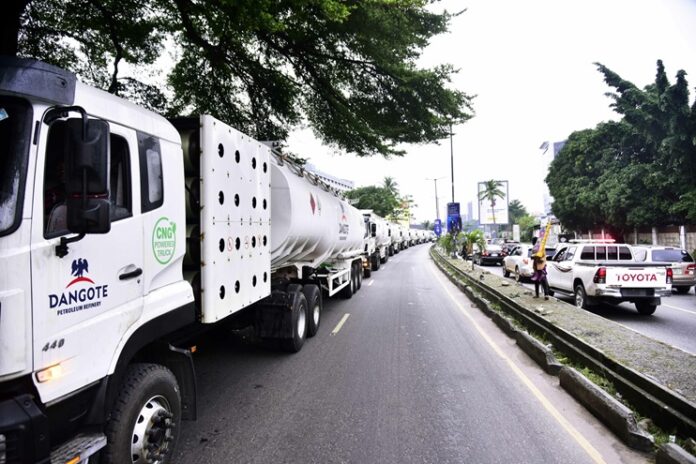
August 11, (THEWILL) — The Nigerian midstream and downstream petroleum sector is set for a drastic improvement in steady supplies and stable pricing as Dangote Petroleum Refinery and Petrochemical Limited announced that it has received 4,000 natural gas-powered trucks for its nationwide fuel distribution programme, set to kick-off on Friday, August 15.
Announcing the development on Sunday, Group Chief of Branding and Communication, Anthony Chiejina, who disclosed that the first batch of trucks has been received by Dangote Industries’ Vice-President, Oil and Gas, Devakumar Edwin at the refinery site in Ibeju Lekki, Lagos said the venture, which was facilitated by an estimated N720 billion capital investment, will “significantly lower distribution costs and improve fuel availability for our customers nationwide.”
He added that apart from reducing logistics costs and improving supply efficiency in the country’s fuel distribution networks the project is estimated to improve the petroleum value chain by drastically cutting down energy cost and increasing profitability for an estimated 42 million Micro, Small, and Medium Enterprises in the country.

He said, ”The fleet of fuel tankers, being imported through Apapa Port, represents a significant capital investment estimated at N720bn. This expenditure underscores the company’s commitment to pioneering innovative solutions as the world’s largest single-train refinery continues to expand its operational capabilities. Given the complexities inherent in global supply chains, the delivery of these specialised CNG-powered tankers is indeed commendable. This approach ensures that we maintain operational efficiency while scaling up the fleet.
“Our unwavering commitment to this programme is reflected in our ongoing collaboration with key regulatory bodies and stakeholders to facilitate seamless deployment. We believe this initiative will significantly lower distribution costs and improve fuel availability for our customers nationwide,” Chiejina stated.
He added that over the next six weeks, the refinery expects at least 60 shiploads of these trucks to arrive in the country.
“This innovative distribution model is expected to catalyse efficiency gains across Nigeria’s downstream petroleum sector, fostering greater transparency, reducing transportation bottlenecks, and ultimately enhancing energy security for the nation,” he added.
In June, the Dangote refinery revealed its plan to deploy 4,000 CNG trucks across Nigeria for the nationwide distribution of petroleum products.
“This bold initiative is projected to save Nigerians over N1.7tn annually in fuel distribution costs,” the company said.
The company said, “This strategic programme is part of Dangote’s broader commitment to eliminating logistics bottlenecks, enhancing energy efficiency, promoting environmental sustainability, and supporting Nigeria’s economic development. Lower fuel distribution costs will reduce production expenses, alleviate inflationary pressures, and stimulate overall economic growth.
“The initiative is also expected to revitalise dormant filling stations, creating over 15,000 direct jobs across the logistics value chain, including positions for drivers, station managers, and attendants at the new CNG stations,” the statement noted, stressing that the programme would help curb cross-border smuggling of petroleum products while supporting a more efficient and environmentally friendly distribution system.”
THEWILL recalls that fresh fears about stable and renewed pricing war among supplier and marketers in the petroleum downstream sector emerged a fortnight ago amid reports that data from the “Nigerian Midstream and Downstream Petroleum Regulatory Authority, NMDPRA, showed that a staggering 71.38 per cent of Nigeria’s daily petrol consumption in May and June 2025 was met through imports. The remaining 28.62 per cent was sourced from the $20bn Lekki-based Dangote Petroleum Refinery. This indicates that marketers, who are expected to access products locally with ease in the country, are instead spending the country’s scarce foreign exchange to import refined petroleum products.”
Nigerian National Petroleum Company Limited NNPCL, the downstream regulator of the oil sector was said to have briefed the Federal Accounts Allocation Committee, FAAC, “that marketers have resumed large-scale importation of refined petroleum products, choosing not to patronise local refineries.”
The report also disclosed that Liquefied Petroleum Gas was entirely imported, with zero local production recorded in both months. A total of 116.4 million litres was imported in May, but no LPG was supplied in June.
Meanwhile, the Dangote Petroleum Refinery at the weekend increased its ex-depot price of petrol to N850 per litre, while its refinery retail partners increased their pump prices to N915 in Lagos following a similar increase of N915 in Lagos and Abuja by the Nigeria National Petroleum Company Limited.
Arguing in support of the position of NNPCL and NMDPRA, the President of the Dangote Group, Aliko Dangote, recently called on President Bola Tinubu to include refined petroleum products in the list of items banned under the ‘Nigeria First’ policy of the Federal Government.
Dangote at a session during the Global Commodity Insights Conference on West African Refined Fuel Markets hosted by the Nigerian Midstream and Downstream Petroleum Regulatory Authority in partnership with S&P Global Insights, urged the government to add petrol, diesel, and other refined petroleum products be added to the items banned by the policy.
According to him, fuel importation into Nigeria is killing local refining and discouraging further investments in the sector and even the economy.
“The Nigeria First policy announced by His Excellency, President Bola Tinubu, should apply to the petroleum product sector and all other sectors,” he stated.
But Dangote’s position has been questioned by some oil marketers.
The National Publicity Secretary of the Independent Petroleum Marketers Association of Nigeria, Chinedu Ukadike told a national newspaper last week that any move to ban the importation of petroleum products could cripple the industry and hurt the Nigerian economy.
“We fear monopoly. The fear of monopoly is the beginning of wisdom,” Ukadike said, adding, “We have been battling with pricing for a very long time. Most of our marketers have lost millions of naira because of a pricing template that was once controlled by NNPC and now seems to have shifted to Dangote.”
He added that IPMAN was not against the success of the Dangote refinery but for a cheaper prices regime, arguing that “proper pricing rather than legislation, should be the tool to phase out imports.”

Felix Ifijeh is a journalist with years of professional reporting experience. Known for his keen news sense, compelling storytelling and commitment to accurate, impactful reporting, he has built a reputation for turning leads into clear, engaging, and well-structured reports that resonate with readers. His work reflects deep newsroom experience and a commitment to accurate, impactful journalism.