
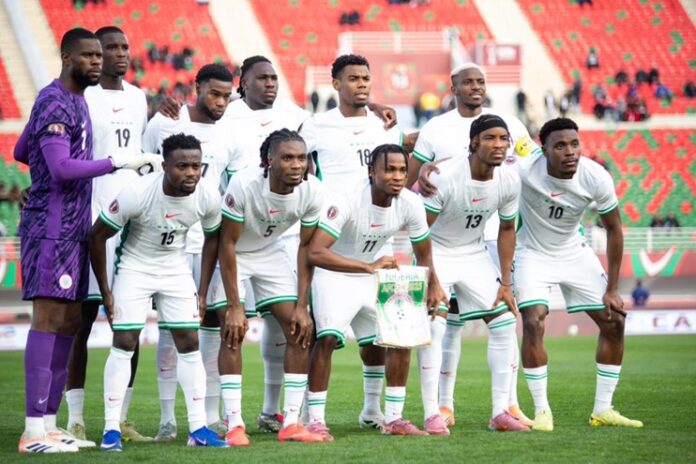
January 12, (THEWILL) — Nigeria’s resurgence at the 2025 Africa Cup of Nations in Morocco has offered the country’s football supporters an unexpected gift: A team they can believe in again. Yet this joy arrives wrapped in bitter irony. The Super Eagles, absent from the 2026 World Cup after a penalty shoot-out defeat to the Democratic Republic of Congo in the qualifiers, are now performing with a discipline and coherence that many believe would have served them well on the global stage. As they prepare for a semi-final against the host nation, the question haunting Nigerian fans is not whether their team can win this tournament, but what might have been had this form arrived six months earlier.
The transformation is remarkable. This is the same squad that fumbled their World Cup qualifying campaign, finishing second in their group behind South Africa before falling to Congo on penalties. The failure marked the second consecutive World Cup that Nigeria would miss, following their absence from Qatar 2022. Beyond the sporting disappointment, the financial implications were stark: billions of naira in FIFA prize money forfeited, a loss that reverberates through Nigerian football’s infrastructure.
Credit for the turnaround belongs largely to Eric Chelle, appointed by the Nigeria Football Federation in January 2025. The 47-year-old, born in Ivory Coast to a French father and Malian mother, arrived with a mixed reputation. His previous role with Mali had seen him guide them to the quarter-finals of the 2023 Africa Cup of Nations before his departure in 2024 following qualifier setbacks. Many Nigerian supporters viewed his appointment as uninspired, a safe choice at a time when bold leadership seemed necessary.

Chelle’s response has been to impose a philosophy that prioritises system over individual brilliance. In a nation blessed with attacking talent, including Napoli’s Victor Osimhen and Atalanta’s Ademola Lookman, previous coaches had often attempted to accommodate every star, creating tactically incoherent line-ups that leaked goals even as they scored them. Chelle recognised that with such firepower available, the goals would come naturally if the foundation proved solid. His emphasis has been relentless: defensive discipline, compact shape, and what happens when Nigeria do not have the ball.
The results speak clearly. Under Chelle’s management, Nigeria have won eight of 13 matches, with three draws and two losses. At this tournament, they have been the model of consistency, winning all five of their matches en route to the semi-finals. The group stage brought victories over Tanzania (2–1), Tunisia (3–2), and Uganda (3–1), with eight goals scored across the three matches. The round of 16 saw a comfortable 4–0 dismantling of Mozambique.
Yet it was the quarter-final against Algeria on January 10 that provided the defining performance of Nigeria’s campaign. Algeria arrived with formidable credentials: a team featuring talents like Riyad Mahrez, renowned for their technical ability and defensive organisation. What unfolded at the Grand Stade de Marrakech was a masterclass in controlled aggression. Nigeria won 2–0, with Osimhen heading home the opener before assisting Akor Adams for the second. The scoreline, however, tells only part of the story.
The statistic that truly captures Nigeria’s dominance is this: Algeria failed to register a single shot on target during the entire 90 minutes. They managed just two attempts in total, both harmlessly wide. To render an opponent of Algeria’s quality completely toothless required concentration that spanned every second, a defensive synchronicity that Nigerian teams have rarely demonstrated in recent years. The back line, marshalled by Calvin Bassey and Bruno Onyemaechi, operated with a cohesion that denied Algeria even a glimpse of goal. In midfield, Alex Iwobi delivered 14 line-breaking passes against Algeria alone, acting not as the primary creative force but as the rhythm keeper, shuttling horizontally to plug gaps and recycle possession.
Chelle’s tactical approach against Algeria revealed his core philosophy. Deploying a compact 4–4–2 formation that morphed into a low block when Algeria held possession, Nigeria denied space between the lines. Algeria’s creative midfielders found every passing lane blocked. When chances finally arrived, Nigeria took them with clinical efficiency that bordered on arrogance. Osimhen’s goal came from a cross of geometric precision delivered by Onyemaechi pushing forward from left-back. For the second, Osimhen, finding himself in space, chose to pass to the better-positioned Adams rather than shoot himself. That moment of unselfishness has become emblematic of Chelle’s tenure: the team comes first.
The players appear to have embraced this culture of duty and diligence. Chelle has stressed respect and unity, viewing football in Africa as something beyond mere sport. He manages his squad of stars by selecting based on form and tactical fit, even when it means difficult choices. This approach has addressed a persistent problem in Nigerian football: an abundance of talent that has not always translated into collective success.
Nigerian supporters have responded with a fervour that has surprised even seasoned observers. Social media posts highlight pride in the team’s discipline and results. One fan noted the absence of key players like Ola Aina without any visible impact on performance. Another praised the overall spirit, linking it to national character. The apathy that clouded the start of the tournament has evaporated, replaced by fervent belief that this squad has a duty to win.
Yet the emotions remain complex. Fans find themselves suspended between joy at the current continental run and bitterness over the missed World Cup opportunity. They are watching a team playing what many consider World Cup-quality football in the wrong tournament. The regret is palpable: if Chelle had been appointed six months earlier, might those costly draws in the qualifiers have become wins?
The semi-final against Morocco represents both opportunity and examination. The hosts, seeking their first title since 1976, will provide a hostile atmosphere in Rabat, the kind of environment where fragile teams crumble. Nigeria, ranked third among the semi-finalists behind Senegal and Morocco, will face this challenge with mental toughness they have already demonstrated. Chelle will likely stick to his blueprint: the same compact shape, fierce pressing, and clinical efficiency that destroyed Algeria.
Whatever the outcome, this Africa Cup of Nations campaign has already achieved something significant. It has restored confidence in the national team after the World Cup setback. It has demonstrated that Nigerian football’s problems were not about talent but about structure and discipline. And it has given the country’s supporters a team they can trust again. The World Cup may represent a missed opportunity, but the AFCON has become a platform for statement. Nigeria, it appears, is back.

Jude Obafemi is a versatile senior Correspondent at THEWILL Newspapers, excelling in sourcing, researching, and delivering sports news stories for both print and digital publications.
