
December 29, (THEWILL) — Nigerian sportswomen delivered an exceptional year in 2025, sweeping continental titles and global medals with a consistency that marked the period as one of the most successful in the nation’s sporting history. From football pitches in Morocco to basketball courts in Côte d’Ivoire and from athletics tracks in Tokyo to powerlifting platforms in Cairo, female athletes carried the country’s flag with authority, often outperforming their male counterparts and providing moments of national pride during a challenging period for Nigerian sport.
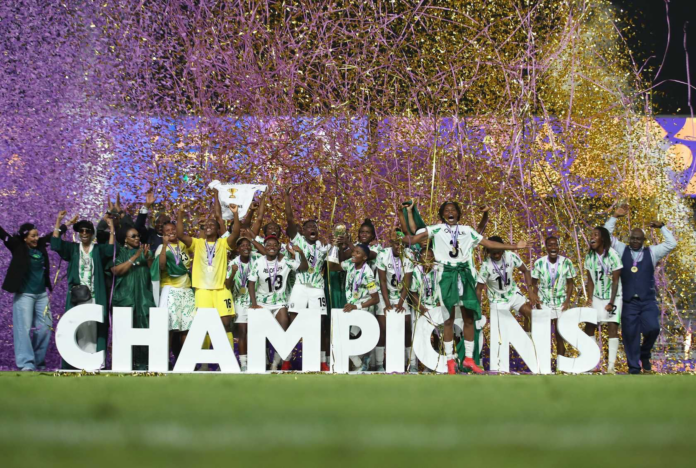
The year’s defining moment came in July when the Super Falcons claimed their 10th Women’s Africa Cup of Nations title in dramatic fashion. Facing hosts Morocco at Rabat’s Prince Moulay Abdellah Stadium, Nigeria found themselves two goals down within the opening 24 minutes, trailing before a hostile crowd that seemed poised to celebrate a historic home victory. What followed demonstrated both technical quality and psychological resilience. The second half recovery, orchestrated by Esther Okoronkwo who scored and provided an assist, culminated in Jennifer Echegini’s 88th-minute free-kick winner that sealed a 3-2 triumph. Captain Rasheedat Ajibade, who earned Player of the Tournament honours, led the team throughout with authority, while goalkeeper Chiamaka Nnadozie provided crucial interventions across the campaign. The victory extended Nigeria’s dominance in African women’s football and earned the squad recognition as CAF’s Best Women’s National Team of the year.
Basketball followed an equally impressive trajectory. D’Tigress claimed their fifth consecutive AfroBasket title in August, defeating Mali 78-64 in Abidjan to extend an unbeaten continental run that now stretches back to 2015 and encompasses 29 matches. Under inspirational head coach Rena Wakama, who became the first woman to guide a team to back-to-back titles in the competition, Nigeria overcame an early deficit through disciplined defence and measured offensive execution. The final quarter proved decisive, with Mali restricted to just eight points as Nigeria pulled clear. Amy Okonkwo’s tournament MVP performance anchored strong contributions from Ezinne Kalu, Promise Amukamara, Victoria Macaulay and Murjanatu Musa. The victory secured automatic qualification for the 2026 FIBA Women’s Basketball World Cup in Berlin, confirming the programme as one of Africa’s most stable and successful sporting operations.

Individual athletes maintained Nigeria’s presence on global stages. Tobi Amusan claimed silver in the 100-metre hurdles at the World Athletics Championships in Tokyo, clocking 12.29 seconds behind a European rival who posted a national record. The medal proved significant beyond its immediate value, representing Nigeria’s sole podium finish at the championships and making Amusan the first Nigerian woman to win multiple World Championship medals in her discipline. Her consistency across the season kept Nigeria visible at elite track meetings during a period when the athletics programme struggled for broader success.
Para sport delivered some of the year’s most emphatic performances. At the World Para Powerlifting Championships in Cairo, the Nigerian delegation finished second overall on the medal table, accumulating seven gold, six silver and five bronze medals. Folashade Oluwafemiayo provided the standout moment, breaking her own world and African records in the over-86kg category with a lift of 168kg. Rita Ferdinand, competing at her first world championships, won gold in the up to 79kg division and set a continental record. Rita Adaeze, Esther Oyema and Lucy Ejike contributed additional medals, demonstrating the depth within Nigeria’s para powerlifting programme. At the Islamic Solidarity Games in Riyadh, Rafiatu Lawal swept three golds in the 58kg category, dominating the snatch, clean and jerk, and overall competitions ahead of rivals from Uzbekistan and Egypt.
Emerging sports recorded notable progress. Mariam Eniola Bolaji continued her rapid ascent in para badminton, winning titles across Europe including competitions in Spain and the British and Irish championships before leading Nigeria to top position at the Africa Para Badminton Championships in Abia State. The women’s under-19 cricket team finished sixth at the ICC T20 World Cup in Malaysia, recording victories against established nations that suggested meaningful development in a sport still finding its footing domestically. Nigeria’s flag football team won the inaugural IFAF Africa Continental Championship in Egypt, extending the narrative of female success into newer disciplines.
The scale of achievement prompted formal recognition from federal authorities. President Bola Tinubu and Vice President Kashim Shettima hosted the Super Falcons and D’Tigress at the State House in Abuja, awarding each player a three-bedroom apartment and the national honour of Officer of the Order of the Niger. Such gestures reflected growing acknowledgment of women’s contributions to national sport, particularly during a year when men’s teams faced difficulties in qualification campaigns and international tournaments.
The broader significance extends beyond medals and titles. Reports from across the country pointed to rising participation among young girls, with local leagues and school competitions gaining momentum. Stories from northern Nigeria highlighted teenage players training despite social pressures, encouraged by the visibility of national figures performing on continental stages. These developments suggested that elite success was beginning to reshape participation patterns in communities previously under-represented in organised sport.
Yet, it is noteworthy the paradox underlying these achievements. Success occurred despite rather than because of domestic infrastructure, with many athletes competing at elite levels whilst local leagues struggled with funding, organisation and visibility. The ability of Nigerian women to perform consistently on global stages spoke to individual discipline and the quality of national team camps rather than systematic development pathways. This ought to change for more progress, of the female and male contingents representing the country.
When the sporting year is assessed, 2025 will stand as evidence of what Nigerian women can achieve with determination, focus and support. They competed where selected, met expectations and frequently exceeded them. Their record requires no embellishment beyond the results themselves: 10 continental football titles, seven basketball championships, multiple global medals, and emerging success across disciplines from cricket to badminton. For a nation seeking sporting vindication, Nigerian sportswomen provided it comprehensively.

Jude Obafemi is a versatile senior Correspondent at THEWILL Newspapers, excelling in sourcing, researching, and delivering sports news stories for both print and digital publications.
