
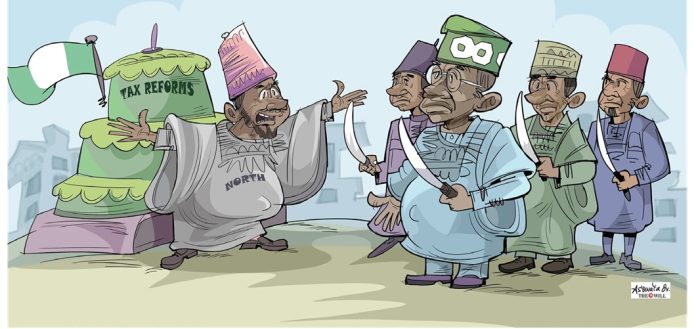
December 08, (THEWILL) – The zeal with which the Bola Tinubu Administration pursues its policies appears to give room for suspicion and upset those who think there is a hidden agenda somewhere. This fear became clear to the THEWILL in the process of investigating why the wall of opposition to the tax reform bills has been difficult to pull down, even as stakeholders, particularly senior lawmakers, from the South-South, South-West, South-East and the North-Central geopolitical zones have endorsed the bills.
There are four executive bills at the National Assembly, namely, the Joint Revenue Board of Nigeria (Establishment) Bill, 2024; Nigeria Revenue Service (Establishment) Bill, 2024; the Nigeria Tax Administration Bill, 2024 and the Nigeria Tax Bill, 2024.
“Suspicion is the cause,” a senior government official from a north-central state told this newspaper on Friday. “The speed with which this tax reform is being pursued is making many of my brothers in the North suspicious. You know, Tinubu was once in the forefront of advocacy of the restructuring of Nigeria. You will agree with me that if these bills are passed 100 per cent, it will amount to fiscal restructuring. Add that to the recent Local Government Autonomy Act adjudged by the Supreme Court and similar bills that may come, then the government would have executed restructuring without firing a shot.

“That is why the VAT aspect of the bill is generating so much opposition; governments were used to earning federal allocation of 60 per cent based on population, 20 percent derivation and 20 percent based on equity of states. Now this formula is being reversed in the proposed bill with 60 percent for derivation. This is a quantum leap and disruptive for many who have not read the bill well and understood their implications.”
The official said that with the mounting opposition to the bill, calls for more consultations and the Senate committee set up by the leadership of the National Assembly to liaise with the Attorney-General of the Federation and Minister of Justice following the hostile reception by members of the Senate and House of Representatives, that controversial aspect of the bills-VAT- could be rejigged. “The percentage on derivation is likely to come down to 40 percent just as they would with other parameters in the VAT distribution.”
STALEMATE
The ongoing debate between those for and against the passing of the bills has created a stalemate which may cause a possible logjam if both sides hold on to their respective positions without concessions, as disclosed by THEWILL’s government source. This scenario played out last Wednesday when all senators representing the South-South geo-political zone in the Senate endorsed the tax reform bills.
Already senators on the platform of the Nigerian Southern Senators Forum, NSSF, had since given backing to the tax reform bills, saying: “The bills will foster a fair, equitable and more inclusive tax system. Therefore, they deserve the support of all Nigerians.”
In a statement signed by Senator Seriake Dickson (Chairman), Senator Jarigbe Agom Jarigbe (Secretary), alongside Senators Barinada Mpigi, Adams Oshiomhole, Neda Imasuen, Munir Ned Nwoko, Thomas Joel-Onowakpo, Aniekan Bassey, Asuquo Ekpenyong and Allwell Onyeso, the South-South senators said, among other things, that, “recognising the importance of tax reforms in enhancing national revenue and fostering economic stability, we resolved to support the Tax Reforms Bills,” and “calls for restraint on the part of those bent on introducing sentiments, whether regional or ethnic, to a national dialogue…”
With these endorsements, the southern senators drew a battle line with their colleagues from the North and further polarised the ongoing debate. Indeed, both chambers of the NASS have failed to have meaningful dialogue on the bills since they were sent there by President Tinubu. The House of Reps has suspended action on the bills, while the Senate is proceeding with them, more diplomatically though, through talks with the Executive.
A presidential spokesperson, Mr Daniel Bwala told THEWILL on Friday that though deliberations on possible areas of concession are ongoing, there is no way to make a categorical statement on it.
“In terms of accommodation of interests, this is not what you can prejudge until the Senate Committee meets with the Attorney-General of the Federation and Minister of Justice, Lateef Fagbemi. I know for a fact that the Executive has not withdrawn the bill, the National Assembly has not suspended debate on the bill. Due to the various concerns across board, President Tinubu decided that the AG should liaise with the committee to look into how those things can be reconciled. This of course calls for more legislative process. That is all what politics is about. So, everything is on course and there is no stalemate,” the presidential spokesman said, adding that hopefully at the end of the day, the bills will be passed and critical areas of the bills that “touch on our economy and our people” will sail through.
He argued that some of the concerns raised by some state governors are issues that can be thrashed when you look at them on face value. According to Bwala, many of those opposing the bills have not read them thoroughly or advised by their attorney-generals, in the case of some governors.
“That is why public hearing is going to happen and the Senate Committee meeting with the AG is still part of the ongoing legislative process on the bill. I do not think it will last long,” he said.
Bwala said the vexed issue of VAT, which is dominating the controversy over the bills, would be addressed through ongoing deliberation.
“Nobody is under the illusion that once the bills are presented, they would be passed 100 percent the way they are presented. That is why there is a public hearing, first reading, second reading and the National Assembly committee will work on it. All of those stages are to fine tune bills. If you remember the Petroleum Industry Bill that later become the Petroleum Industry Act, it was like that too.”
“Once it falls into the National Assembly, how it is going to be interpreted or deliberated is outside the powers of the executive branch of government. And you know that once bills get to the National Assembly, those who are in support will tell you the good aspects, those opposed to it will tell you the bad aspects. All the interpretations you heard about inheritance, re-colonisation of Northern Nigeria came out during deliberation in the National Assembly. These are things that the executive branch cannot control. What the executive branch can do, which we are doing, is to clarify to the people. And the Presidential Fiscal Policy and Tax Reforms Committee, engineered and chaired by Taiwo Oyedele, as well as the communication team in the presidency have been doing so alongside other relevant stakeholders.”
Bwala agreed that the tax reform bills have divided Nigerians, though he attributed the reason for the division to politics. According to him, anytime people give a political interpretation of a policy it must come with its own crisis.
“When the conversation started, it was said the bill will impoverish the poor in the North. I went on air to say no. If you are making the argument that it will reduce the revenue coming to the state to use, that is a different conversation. But to say it will impoverish the poor in the North, is not true. In fact, provisions in this new tax law that will help the poor. Now, if you go to a restaurant, you do not have to pay tax, the same with public transport to go for medical treatment. The poor do not have to pay tax. Education is also exempted. So, the politics that has been brought into it is why the governors are trying to say that it will reduce the revenue coming to the state. Then they dragged in the poor. If you go to some states in the North, they collect local taxes which are quite heavy for the masses. So, people are applying their emotions disproportionately. My argument is that they are mixing politics with policy,” he said.
Taiwo Oyedele, Chairman of the Presidential Tax Reform Committee, sees the push back from the North as a big surprise.
Oyedele said last week that the Federal Government did not expect the resistance to the bills, especially to the VAT component, to come from the northern states, as they thought the resistance would come from Lagos and Rivers States instead.
“We did not envisage that this was going to be a pushback from the northern states; we thought the pushback would come from Lagos mostly and maybe a little from Rivers. It’s almost like we ended up with the people we are fighting for. Whereas for VAT, every state consumes. If you share anything based on VAT derivation, everyone gets something from it.”
OPPOSITION FROM THE NORTH
In addition to an earlier opposition to the bills raised by the 19 Northern Governors Forum at a meeting held in Kaduna on October 24, 2024, Governor Babagana Zulum of Borno State is currently championing the cause, though this time with calls for more consultation to enable clarity.
Zulum, who argues that northern governors are not against Tinubu’s administration as it has been insinuated in some quarters, however, expresses reservations about some of the provisions of the bills, including the status of the Federal Inland Revenue Service (FIRS) as the sole tax collection agency in Nigeria.
He alerted the public to the fact that if the bills become law, the Tertiary Education Trust Fund (TETFund), the National Agency for Science and Engineering Infrastructure (NASENI) and National Information Technology Development Agency (NITDA) will all cease to exist by 2029. In tow, the Coalition of Northern Groups, (CNG), has expressed fear that the proposed changes in the tax bill could disproportionately favour more economically advanced states and leave states in the North at a disadvantaged economic position.
Some of these unseen “enemies” in the bill appear to be coming out as people scrutinise them more and more. According to the President of the Academic Staff Union of Nigerian Universities, ASUU, Prof Emmanuel Osodeke, the TETFund aspect is one of “those things that are hidden from the public in that over 200 pages bill that people need to carefully study.”
Although he agrees that the problem is not with tax reform or taxation, he contends that it is about the utilisation of the money collected as tax, he told THEWILL on Friday.
“Let me give you an example. Have you ever heard of stamp duty? We are all paying for it today. Trillions of naira is generated from it. Do you know where that money goes? Is anybody talking about it? It is not in the reform bills. Anytime you buy a product beyond a certain amount, say N10,000, for example, I think you must pay stamp duty. For us, the challenge is corruption. If the government can check corruption and ensure that everybody who is due to pay tax pays up, you do not need these so-called reform bills.
“Now, with this tax reform bill, TETFund is going to be removed. Whether you like it or not, TRETFund is working and funding projects in public tertiary institutions. TETFund is a product of ASUU. You can’t make the tax laws without meeting with ASUU for inputs before proposing it before the National Assembly. Nobody was talking about it until Governor Zulum raised it. Why does the government want to take TETFund to NELFUND (Nigerian Education Loan Fund)? Let them go and look for ways to fund it. The tax reform bill is saying that by the year 2030, it should be scrapped and merged with NASENI and NITDA.
“NELFUND will become a dark place that nobody can monitor. When the loan thing happened in the past, it collapsed. Our idea is that stakeholders should have been invited for the tax review. If TETFund is killed, public universities will collapse in the very near future. If you wanted to review tax, why were states and local governments not invited to be part of the committees to discuss and agree on what make up the content of the reforms? I understand they say every state was carried along, but why are 19 states arguing against it?
Nonetheless, Oyedele said that the Federal Government has no intention to scrap TETFund but to unify the multiple tax system in the country.
“We want a tax reform, but it should be people friendly. Taxes should target the rich and be light on the poor. Everybody needs to take their time and study the bills. We don’t want collateral damages. Who is the ultimate consumer that is being talked about with respect to VAT distribution? Is it Aso rock? We need to know,” a vexed Prof Professor Ishaq Akintola of Muslim Rights Concern, MURIC, told this newspaper on Friday.
DATA CHALLENGE
At the weekend, Northern lawmakers met and supported a move by a North-based political caucus, League of Northern Democrats, to inaugurate a technical committee to review the contents of the bills, clause-by-clause and suggest ways to safeguard the interests of the North. In the same vein, a lawmaker from Tambuwal Federal Constituency of Sokoto State, Hon. Abdussamad Dasuki, urged the Presidency to “present data showing tax revenue that accrued to states and the FCT from January to September 2024 under the current tax law and the projected tax revenue that would have accrued to each state in the same period under the proposed tax reform bills for lawmakers and other concerned Nigerians to make informed decision on the tax bills currently before the National Assembly.”
WAY OUT
The arguments against the bills, according to a former Speaker of the House of Representatives, Yakubu Dogara, “are insufficient to throw the bills away. The politician argued that criticisms about timing and consultations are distractions.
“All we have is now. It is what you are doing now that will become your past. It is what you are doing now that will affect your future. I want to say this about consultation at the state level. How many people do state governors consult when they are making laws? I’m not challenging them. As a matter of fact, in some cases, state laws are written from the living rooms of governors,” Dogara said.
“People are complaining of hunger, these things should be addressed urgently, not going about taxing the people. VAT, which has become contentious, is a consumption tax. So, you are not taxing the one producing but the one consuming. Tell me how this will assist the production capacities of the states?” Prof Akintola noted.
“It is private companies that are producing, and consumers are the ones paying. Now, because of this, people from the North and South are fighting. These are not the issues that we should be quarrelling about. Where are the refineries and steel plants? These should be the genuine areas of concern for our policy makers. In the 1960s we had regions that were engaged in production,” ASUU president, Osodeke queried.
Oyedele noted that VAT derivation is a sensitive matter because people think about where it is based on production. “If they’re not producing crude oil, you don’t get any part of that derivation.” Oyedele observed that because VAT derivation is different from production-based derivation for oil and gas, it is a delicate topic for the states.
Citing an example with stamp duty collection, which section 163 of the Nigerian Constitution mandates to be shared on the basis of derivation, he maintained that the new tax regime is not strange to the law.
While asking for the identified grey areas in the bills to be addressed, Sheikh Abubakar Gumi, supports the bills: “I heard people debating that Lagos will benefit more from the new sharing formula in the proposed tax reform bills. This should not be the issue to debate on; our leaders should not say so. You said the corporate headquarters were relocated to Lagos, where are your banks’ headquarters in Kaduna or Kano?
“You people were sleeping. You deliberately allowed the population to wallow in poverty. You are shouting over the tax reform bills. Where are our industries? Who among you invested in the industries in Kakuri to sustain them? Only the breweries are still functional in the area. We are always applying politics on issues where there is no need for it. The President’s attempt to reform the collection system is commendable, continuing in the old system will not be good for the country because of the multiple taxation,” the cleric said.

Amos Esele is the Editor of THEWILL Newspaper. He has over two decades of experience on the job.
