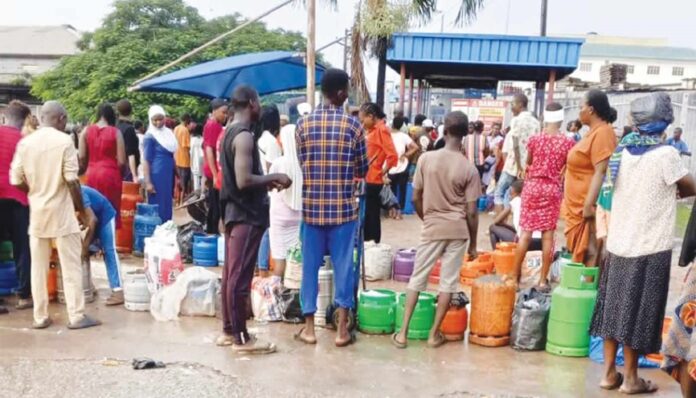
October 12, (THEWILL) — Proof that the Nigerian system is still being run in knee-jerk fashion is the pitiable sight of Nigerians queuing up at filling stations to buy gas. The damning sight recalls many years of suffering endured by Nigerians at petrol filling stations as they struggled to buy fuel due to scarcity of PMS which often lasted several weeks at a stretch. Sadly the queues still exist, despite official assurances that they will disappear in no time.
In a country that ranks 16th on the global scale of natural gas production and third on the African continent after Algeria and Egypt, this is a big shame. It speaks volumes about the bane of systemic and logistics failures, the lack of proactivity on the part of public officials and weak rules of engagement that allows exploiters game the system and to thrive with compunction.
And as usual the blame game has started. The official reason for the ongoing gas scarcity is the recent strike by the Petroleum and Natural Gas Senior Staff Association of Nigeria, PENGASSAN.

According to the Group CEO of the Nigeria National Petroleum Company Limited, NNPCL, Bayo Ojulari, the gas scarcity is artificial. The PENGASSAN strike disrupted the supply chain as loading and distribution failed to match up with demand. Yet this situation did not happen overnight nor was it prompted without indications of dire consequences that should have warranted urgent, proactive response from the relevant authorities.
In response to the sacking of 800 of its members by Dangote Refinery, PENGASSAN, had issued a three-day strike notice to its members. The statement, which was signed by its General Secretary, Lumumba Okungbowa, after an executive meeting of the association which described the private refinery’s action as “an affront to Nigerian workers, a violation of Nigeria’s Constitution, labour laws and international labour standards,” contained warning signals that the nation’s economy was heading for trouble.
According to Okungbowa, all PENGASSAN members in field locations were to down tools from 6:00 a.m. on Sunday, September 28, 2025. “A total nationwide shutdown by all members across offices, companies, institutions and agencies from 12:01 a.m. on Monday, September 29, 2025.
“Immediate suspension of all crude oil and gas supply to Dangote Refinery and its petrochemical operations. International Oil Companies (IOCs) to ramp down gas production linked to the refinery.”
If these statements were not alarming enough to set off an immediate official response, then it is safe to say that the managers of the nation’s premium assets were negligent in their response.
There is more. Even Ojulari himself disclosed that retailers who had reserved supply became opportunistic, cashed in on the situation and increased prices, not necessarily from scarcity.
But experts in the gas sector have added more reasons to the ugly fallout of scarcity that has enabled the queues. They say the country’s domestic gas supply network remains fragile and distribution and storage capacity inadequate.
If the authorities have been papering over these challenges in the gas sector before the PENGASSAN strike, now is the time to pay adequate attention to them. The promise that normal gas supply would soon be restored and prices go back to their former rate is not salutary at all. Nigerians should not be made to suffer for bureaucratic inertia.
In a country that is known and ranked as petroleum and gas producing, the citizenry should never be in want of petroleum products and often made to pay for official laxity and indecision in tackling sectoral crises. Paying between N2,000 and N3,000 per kg of gas in these harsh times is madness. Even the pre-strike price of N1,200 per kg is high. Nigerians need a break from these avoidable disruptions that are unsettling many households across the country.