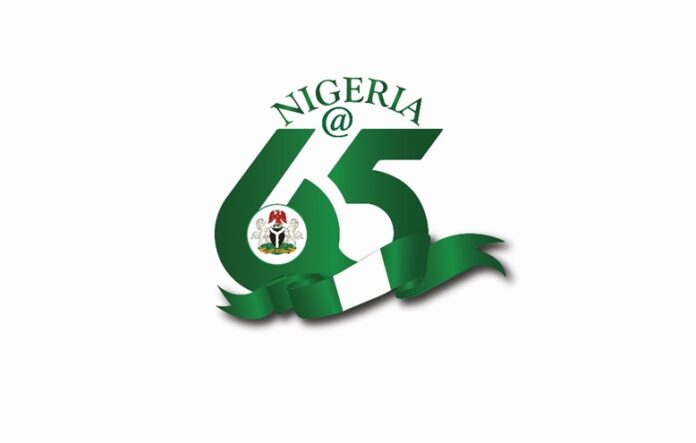
October 05, (THEWILL) — The Federal Government had announced that this year’s theme for the marking of Nigeria’s 65th Independence anniversary was “Nigeria @65: All Hands on Deck for a Greater Nation.” The assumption that the country is great and can be made greater, is sobering. In all fronts, from politics to governance, health care, economic development and cultural expansion, Nigerians can point to significant progress, but there are deep-seated challenges that have continued to dog and hamper all efforts aimed at moving the country forward.
Available data show that significant strides have been made in the areas of education with a significant increase in the number of primary, secondary and tertiary institutions over the years. Nigeria doctors and nurses, many who schooled in the country, are in high demands in developed countries round the world.
Parliamentary, military and presidential systems of government have been tried with the later currently in use. Over the past two and half decades, civil rule has gained ground during which elected governments have peacefully transferred power and a democratically elected party has defeated an incumbent president at the centre.

More states and local government areas have been created and the possibility of deepening democratic governance at the grassroots has increased since. What is more, the country has survived a bloody civil war even though its scars are yet to heal.
Nigerian artistes and music stars have achieved global fame and registered the country’s name and culture in the international circuit. Expanded Afrobeat that is patently Nigerian has since hit the world stage and won Grammys.
Sadly, however, the very indices for measuring well-being and health of any nation, suffer. That is the people. From approximately 45 million persons at independence in 1960, Nigerians are now approximately 200 million.
Of this rather disproportionately large number, in comparison to the development goals and achievement, 86 million are said to be in multi-dimensional poverty, going by government records.
Inflation is double digits, year in year out, at least for the past 10 years now and youth unemployment hovers around 40 per cent, according the National Bureau of Statistics.
Worse, insecurity has worsened, made more complex by the inordinate ambition of politicians. Chief of Defence Staff, General Chris Musa recently in a television interview said politicians were fuelling insecurity in order to weaken the government’s public image. A one-tine acting National Chairman of the Peoples Democratic Party, Kawa Baraje, who later defected to the All Progressives Congress, APC, disclosed sometimes ago that some leaders of the latter party imported bandits from abroad to wage political battle with the incumbent government.
If politics has become a path to commit treasonable felony against Nigeria by way of recruitment of and providing information to terrorists, ( 2013 Terrorism (Prevention) Amendment Act), then the Nigeria leadership, relevant stakeholders and committed patriots must rise to occasion and begin the process of sanitising the civic space of unpatriotic elements masquerading as paragons of excellence.
Currently, Nigeria is grappling with a security situation that is so bad no one can tell if it will ever end, given the complexity of the matter.
Nigeria, it is generally agreed by experts of all kinds, is a land brimming with human and natural resources. This endowment must be harnessed for the good and benefit of all. The time of echoing this obvious truth has passed. The governing elite cannot continue in the old ways of governance. That governance model has stagnated and it is time to discard it and agree what next is best for the country.
Many countries that gained independence 65 years ago alongside Nigeria have since charted their ways to progress and given their people a sense of belonging and well-being. It is hard to believe that the high-income global economic powerhouse, Singapore, whose transformative leader, Lee Kwan Yew, many of our politicians often idolise, achieved independence from Malaysia in 1965. Indeed, Malaysia which is a net exporter of palm oil, after Indonesia, got its seedlings from Nigeria at the same time both the West African country and its Asian counterpart were under British Colonial rule.
If all hands must be on deck for a greater Nigeria, it is time for the governing elite to devise and stick to a consensus that is nationalistic, inclusive and egalitarian. Anything short of this would lead to a vitiation of initiatives, projects and policies that may seem intended to diversify key sectors like agriculture, manufacturing and technology but end up billions in the pockets of the few, rich oligarchs.