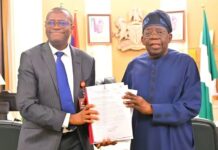
December 21, (THEWILL) — Sounding upbeat on Friday, December 19, 2025, President Bola Tinubu presented the N58.18 trillion 2026 Appropriation Bill to a joint session of the National Assembly, vowing that next year will mark a decisive shift toward stronger discipline in budget execution and results-driven governance.
President Tinubu said the Budget, titled “Budget of Consolidation, Renewed Resilience and Shared Prosperity,” is designed to consolidate recent economic reforms and translate stabilising macroeconomic indicators into improved living standards for Nigerians.
However, the 2026 Budget proposal was not accompanied with a 2025 official performance, a development that analysts consider curious and capable of rendering the fiscal projections defective.

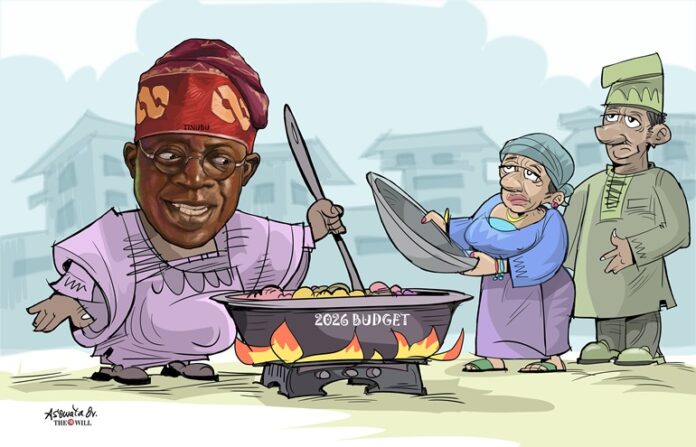
2026 Budget
The key parameters of the 2026 Budget include:
- Expected total revenue: N34.33 trillion.
- Projected total expenditure: N58.18 trillion including N15.52 trillion for debt servicing.
- Recurrent (nondebt) expenditure is N15.25 trillion.
- Capital expenditure will be N26.08 trillion.
- The Budget deficit is expected to be 23.85 trillion naira, representing 4.28 per cent of GDP.
The 2026–2028 MediumTerm Expenditure Framework and Fiscal Strategy Paper sets the following parameters for the Budget
- A conservative crude oil benchmark of US64.85 per barrel;
- Crude oil production of 1.84 million barrels per day; and
- An average exchange rate of N1,400 to the US Dollar.
Spending plan is prioritised, with defense and security receiving the lion’s share of the estimates, reflecting the administration’s unified counter-terrorism approach.
Security and Defence led sectoral allocations with N5.41 trillion (2024: N4.91 trillion), followed by Infrastructure at N3.56 trillion (2024: N4.06 trillion), Education at N3.52 trillion (2024: N3.52 trillion), and Health at N2.48 trillion (2024: N2.48 trillion).
2025 Budget Performance
Despite celebrated monetary policy gains, Nigeria recorded one of her most abysmal fiscal performances in 2025, setting the pace for a potential gloomy outlook for 2026.
Data from the Budget Office indicated that the Federal Government spent nearly three-quarters of its total revenue on debt servicing in the first seven months of 2025, highlighting the intensifying pressure Nigeria’s debt obligations are placing on public finances.
THEWILL’s analysis of the 2026–2028 Medium-Term Expenditure Framework and Fiscal Strategy Paper released by the Budget Office of the Federation shows that between January and July 2025, the Federal Government generated total revenue of N13.67 trillion. Out of this amount, N9.81 trillion was used to service domestic and external debts, meaning 71.8 percent of total revenue was absorbed by debt servicing alone.
When personnel costs of N4.51 trillion for ministries, departments and agencies (MDAs) as well as government-owned enterprises are added, total spending on debt service and wages rose to N14.32 trillion. This exceeded total revenue for the period, implying that debt servicing and salaries alone accounted for about 105 percent of Federal Government income.
With a lower revenue target of N34.33 trillion against N36.35 trillion in 2025 and increasing debt pressure, analysts doubt the prospects of a higher budget performance in 2026. BudgIT predicts debt servicing obligations climbing to 80 percent of revenue.
The Budget Office data shows that the revenue shortfall was driven largely by a steep decline in oil earnings. Between January and July, oil revenue stood at N4.64 trillion, far below the pro rata target of N12.25 trillion, resulting in a shortfall of N7.62 trillion or 62.2 percent.
Also, dividends from entities such as Nigeria Liquefied Natural Gas and development finance institutions equally underperformed significantly, yielding just N104.64 billion compared with a projected N428.71 billion.
Some non-oil tax lines recorded modest gains: Company Income Tax generated N2.54 trillion, slightly above the pro rata estimate of N2.49 trillion. Value Added Tax also outperformed, with the Federal Government’s share rising to N630.10 billion against a target of N567.54 billion, an increase of about 11 percent.
However, these gains were outweighed by weaknesses in Customs revenue which declined to N988.29 billion, about 39.1 percent below its N1.62 trillion target. Also, Federation Account levies fell sharply by 70.1 percent to N75.08 billion, while oil price royalties recorded no inflow during the period.
Overall, the Federal Government recorded aggregate revenue of N13.67 trillion against a pro rata target of N23.85 trillion in 2025, leaving a revenue gap of N10.19 trillion or 42.7 percent in the first seven months of the year.
Gloomy Capital Outlook
Capital expenditure bore the brunt of the fiscal strain during the period. Total capital spending stood at N3.60 trillion, far below the pro rata budget of N13.67 trillion, translating to a shortfall of 73.7 percent.
Data showed that capital releases to MDAs were particularly weak, with just N834.80 billion released out of a N10.81 trillion target.
The Budget Office attributed the weak capital outturn partly to the extension of the 2024 budget, noting that about N2.23 trillion from the 2024 capital vote was still being financed in 2025 following the National Assembly’s approval to extend implementation to December.
The document recalled that in 2024, total debt service cost N13.12 trillion, equivalent to 77.5 percent of Federal Government revenue. The 2025 figures suggest that debt servicing pressures remain elevated, continuing to crowd out capital investment and constraining fiscal space for critical sectors such as health, education and infrastructure.
Enter fiscal chaos
THEWILL reports that the Federal Government’s decision to defer the implementation of 70 percent of capital projects initially appropriated in the 2025 fiscal year to 2026, is seen as potential fiscal chaos amid pending, overlapping items that run through 2023-2025.
Although experts have cautiously endorsed the proposed 2026 FG budget as outlined in the Medium-Term Expenditure Framework and Fiscal Strategy Paper approved by the Federal Executive Council, concerns are being raised over a budget system that has pending, overlapping items through four distinct fiscal years.
The 2023 supplementary budget which extended into 2024 remains active. The 2024 capital budget was first extended to June 2025, and again, pushed to December 2025. This blurs the distinction between one year and the next. Amid delay in publishing the 2025 Implementation Report under the Responsibility Act, the scenario is weakening the transparency framework needed to understand the fiscal culture that supports or distorts the monetary policy strategies.
THEWILL also recalls that the 2025 Appropriation Bill arrived almost three months behind schedule, The National Assembly subsequently passed the bill which stood at N47.9 trillion. Other amendments raised it to N54.99 trillion, according to the Budget Office summary of June 2025.
Despite the large envelope, there are still invisible implementations of the capital projects so far. Data from the Budget Office showed that less than 30 percent of the capital components had been released by the ministries, departments and agencies (MDAs) as of September 2025, apparently responsible for shifting 70 percent of the 2025 capital budgets to 2026.
In a statement on Sunday, December 14, 2025, BudgIT, a leading civic-tech organisation promoting transparency and accountability in Nigeria’s public finance, expressed concerns over the development, maintaining that a positive change of implementation culture on the part of the FG is doubtful.
“From our analysis, while this development is not entirely surprising, we hold cautious reservations about the implications of this decision. The deferment suggests that the Federal Government intends to limit the number of capital projects under implementation, to use available funds more efficiently, prioritise critical projects and reduce the long-standing problem of abandoned projects.
“In this sense, the move appears to be an attempt to retain the 2025 capital projects—many of which are based on existing economic plans and strategies—rather than introduce an entirely new set of projects in the next fiscal year,” the group said in the statement signed by Nancy Odimegwu, Senior Communications Associate.
With this development, the Federal Government has once again plunged its fiscal operations into disarray, ordering ministries, departments and agencies to roll over 70 per cent of the 2025 capital budget into 2026.
This directive, outlined in the 2026 Abridged Budget Call Circular from the Ministry of Budget and Economic Planning, prioritises completing ongoing projects amid weak revenues and inflation pressures.
It noted that only 30 percent of 2025 capital allocations will be released this year, with the rest forming the backbone of next year’s spending and that no new projects are allowed.
This development extends the budgetary carry-overs begun in 2023, as only 20 per cent of the capital components of the 2025 budget have been released as of August. Interestingly, the 2023 supplementary, 2024 and 2025 budgets are still running concurrently just days before this fiscal year ends.
Dr Paul Alaje, Chief Economist and Partner at SPM Partners, Abuja, noted that the unbecoming trend undermines transparency and accountability. Speaking on Arise News Television on Friday, December 19, Alaje lamented the negative impact of the chaotic fiscal performance on the nation’s overall economic development.
He emphasised on the need to address the mounting debt stock which is consuming a huge chunk of the revenue through debt servicing. Nigeria’s public debt increased significantly in 2025, compared to 2024 rising from roughly N134.30 trillion in Q2 2024 to N152.39 trillion in Q2 2025.
An economist, Dr Benjamin Adeleke said that actualising the objectives of the 2026 budget without addressing the fiscal rascality of Nigeria’s political leadership amounts to a wild goose chase. According to Adeleke, the fiscal indiscipline in government underlying the chronic culture of waste and corruption makes an effective budget performance near impossible.
Also, Mr Peter Obi, former Governor of Anambra State and presidential candidate of the Labour Party in the 2023 general election, accuses the current Federal Government of massive borrowing to finance consumption without fixing the massive infrastructure deficit that bedevils the country’s economic development.
While the government has framed the latest directive to MDAs as fiscal prudence, analysts insist that it exposes deep-seated flaws in fiscal policy implementation. It also signals fiscal indiscipline, a chronic failure that stifles infrastructure development, makes a conducive business environment challenging and diminishes the survival opportunities of small and medium enterprises.
TINUBU’S VERDICT
Aware of these fiscal challenges, President Tinubu, who admitted before the senior lawmakers during the Friday budget presentation that “17.7 per cent of the 2025 capital budget — was released as of Q3, reflecting the emphasis on completing priority 2024 capital projects during the transition period,” said the administration of the 2026 budget would be a marked difference.
“Let me be clear: 2026 will be a year of stronger discipline in budget execution. I have issued directives to the Honourable Minister of Finance and Coordinating Minister of the Economy, the Honourable Minister of Budget and Economic Planning, the AccountantGeneral of the Federation, and the DirectorGeneral of the Budget Office of the Federation to ensure that the 2026 Budget is implemented strictly in line with the appropriated details and timelines,” he said, adding that, “We expect improved revenue performance through the new National Tax Acts and the ongoing reforms in the oil and gas sector — reforms designed not merely to raise revenue, but to drive transparency, efficiency, fairness, and longterm value in our fiscal architecture.
He said he had provided clear and direct guidance regarding governmentowned enterprises and that the heads of all agencies have been directed to meet their assigned revenue targets.
“To support this, we will deploy endtoend digitisation of revenue mobilisation — standardised ecollections, interoperable payment rails, automated reconciliation, datadriven risk profiling and realtime performance dashboards — so leakages are sealed, compliance is verifiable and remittances are prompt. These targets will form core components of performance evaluations and institutional scorecards. Nigeria can no longer afford leakages, inefficiencies, or underperformance in strategic agencies. Every institution must play its part,” he said.

Sam Diala is a Bloomberg Certified Financial Journalist with over a decade of experience in reporting Business and Economy. He is Business Editor at THEWILL Newspaper, and believes that work, not wishes, creates wealth.