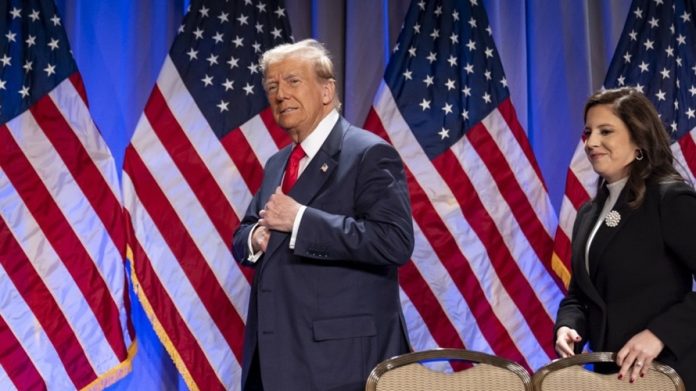
December 09, (THEWILL) – U.S. President-elect Donald Trump has announced ambitious plans to address illegal immigration, vowing to declare it a national emergency upon assuming office on January 20, 2025.
The proposed measures include mass deportations and an end to birthright citizenship, marking a significant escalation in immigration policy.
Trump, in an interview on NBC’s Meet the Press aired on Sunday, underscored his determination to enforce immigration laws, saying, “I think you have to do it. It’s a very tough thing to do. You know, you have rules, regulations, laws.”

The former president reaffirmed his intention to deport undocumented immigrants, even those with U.S.-born children, stating, “The only way you don’t break up the family is you keep them together and you have to send them all back.”
This stance highlights Trump’s unyielding commitment to addressing illegal immigration, despite potential pushback from immigrant advocacy groups and lawmakers.
Trump also outlined plans to end birthright citizenship through an executive order, a move that would challenge the interpretation of the Fourteenth Amendment of the U.S. Constitution.
While acknowledging possible legal challenges, Trump signaled readiness to seek broader support if necessary.
“We’ll maybe have to go back to the people. But we have to end it,” he said, emphasising the need for legislative or constitutional reforms to achieve his goal.
The Fourteenth Amendment, ratified in 1868, guarantees citizenship to all persons born or naturalized in the United States.
Rooted in the aftermath of the Civil War, it reversed the infamous Dred Scott decision of 1857, which denied citizenship to African Americans.
In the landmark 1898 case United States v. Wong Kim Ark, the Supreme Court affirmed that anyone born on U.S. soil is automatically a citizen, regardless of their parent’s immigration status.
While Trump’s proposals largely aim to tighten immigration controls, he signaled a willingness to negotiate protections for “Dreamers” — individuals brought to the U.S. as children under the Deferred Action for Childhood Arrivals programme. During his first term, Trump attempted to dismantle DACA, but the Supreme Court blocked the move.
The Department of Homeland Security estimated that over 11 million people were living in the United States without legal status as of January 2022.
The implications of Trump’s immigration policies, if fully implemented, could profoundly affect these individuals and reshape the country’s immigration landscape.
With these sweeping plans, Trump is set to reignite debates on immigration reform, constitutional rights, and the future of millions of undocumented immigrants in the United States.
Whether his proposals gain traction remains to be seen as legal and political battles loom.

Felix Ifijeh is a journalist with years of professional reporting experience. Known for his keen news sense, compelling storytelling and commitment to accurate, impactful reporting, he has built a reputation for turning leads into clear, engaging, and well-structured reports that resonate with readers. His work reflects deep newsroom experience and a commitment to accurate, impactful journalism.