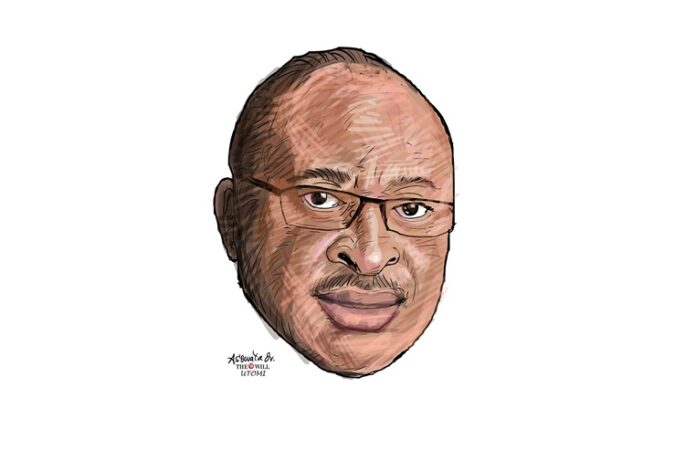
May 12, (THEWILL) – Renowned political economist, Professor Pat Utomi, has vowed to provide what he considers a democratic alternative to the perceived current drawbacks in Nigeria, arguing that the formation of a shadow government is both a moral and democratic imperative aimed at holding public office holders accountable.
Utomi defended the concept amid recent criticisms following his declaration of a shadow government in Nigeria.
“A group of people hijacked the state, subordinated the private sector, and completely sidelined civil society. Look at the mess we’re in—they’re going nowhere. To reclaim the promise of Nairobi 1985, we needed an alternative framework to address Nigeria’s problems,” he said.

He traced the idea to a historic push for inclusive governance across Africa, citing a pivotal 1985 conference in Nairobi organised by the Aga Khan Foundation.
“That conference called for a tripartite approach to governance in Africa. One of its major outcomes was the creation of the Enabling Environment Forum—the precursor to the Nigerian Economic Summit Group. Sadly, we’ve strayed from that vision,” he said.
Lamenting what he described as the capture of the Nigerian state by a narrow elite, Utomi said the shadow government initiative seeks to revive that abandoned vision through a coalition of opposition figures, civil society groups and development agencies offering alternative governance solutions.
Utomi dismissed threats and criticisms against the initiative, insisting that there is no legal basis for any action against citizens organising for good governance.
“What kind of legal action? On what grounds? That citizens have come together to comment on government performance? People can call themselves anything, as long as it’s for the public good,” he said.
He also criticised the fixation on elections at the expense of governance: “Stop talking about the next election. Government exists not for elections, but for service to the people.”
Utomi further accused the media of enabling political underperformance by failing to challenge public office holders.
“The media lets them get away with it. You should tell them when they’re talking nonsense. Let’s see what they’ve actually achieved,” he said.
Highlighting the decline in living standards, Utomi compared Nigeria’s development trajectory with those of peer nations.
“Think about it—the average Nigerian today lives far worse than the Nigerian of 1960. Compare that with where the average Vietnamese or Chinese citizen was in 1960 and where they are now. It’s like night and day,” he said.
Expectedly, the governing All Progressives Congress, APC, has taunted the idea, calling the professor of political economy an “intellectual drama king”.
Utomi had earlier in April 24, said he is mobilising 7.2 million Nigerians from all geo-political zones that will converge in Abuja for a protest tagged “Freedom Converge,” against the government of President Bola Tinubu and the APC.
He noted that the protest aims to reclaim the country from “entrenched systems of state capture and self-serving leadership” and return power to the masses.
He lamented that “The recent spate of defections to the APC provides further evidence that all is not well with democracy in Nigeria.”
For the Minister of Information and National Orientation, Mohammed Idris criticised the idea, saying that it is a slap on the concept of Presidential System of Government. He said, “the idea of a shadow government sadly does not pass the test.” Our bicameral legislature amply features members of the opposition and be the right place to contest meaningful idea for nation-building.
National Publicity Secretary of the party, Felix Morka dismissed Utomi’s claim that the shadow government was a response to the “policy missteps” of the federal government, which he said had worsened poverty and silenced dissenting views.
The part spokesperson said Utomi had always enjoyed the full liberty to express his thoughts and form coalitions, regardless of their lack of realism or traction.
“Utomi’s unilateral declaration of a ‘shadow government’, in a presidential democracy is, in and of itself, an exercise of democratic freedom and free speech, in the extreme,” Morka said in a statement.
Morka described as “reckless” and “irresponsible” Utomi’s comparison of Nigeria’s current political climate to Adolf Hitler’s Nazi Germany, adding that such comparisons were beneath Utomi’s intellectual standing and revealed a descent into “sensational and virulent discourse.
He argued that the Bola Tinubu administration’s tolerance of dissent is evident in the freedom Utomi has to make such pronouncements without consequence.
Morka said Utomi’s string of failed political attempts, from seeking the APC governorship ticket in Delta in 2019 to his involvement in Peter Obi’s 2023 campaign, has taken a toll on his sense of judgment.
He said Utomi was revising history by accusing the government of weaponising the removal of the petrol subsidy.
“Simply exploiting and dramatizing what are inevitable initial difficulties associated with the policies Nigerians have had to endure for sustainable growth and prosperity is not genius; it smacks of crass political opportunism and desperation,” Morka said.
He added that it is not the duty of the ruling APC to organise or educate opposition parties on how to manage their internal affairs.
According to the APC spokesperson, opposition figures who claim to have superior solutions for Nigeria’s challenges should first show capacity by managing their parties effectively.
“The wave of defections into the APC… is a clear endorsement of the visionary and inclusive leadership of President Bola Tinubu,” Morka said.
He said those joining the APC have chosen “patriotism over partisanship” and are ready to help reposition Nigeria under Tinubu’s leadership.
Speaking further about the idea of a shadow government, he described it as a democratic way for citizens to come together and demand more accountability.
“Nothing can be more democratic than a group of citizens coming together to find a structured way of asking the government to be more accountable. What could be more democratic than that?” he asked.
He urged Nigerians, including his critics, to read the Afrobarometer, a yearly survey that has collected opinions across African countries since 1999.
Arguing that it measures the democratic mileage in the continent, Utomi said it would arm readers with evidence that democracy’ challenge was with the managers and not the generality of the people.
“I usually pre-phase this conversation with what we’ve done to the African. There are Afrobarometer readings, an annual survey that has been going on since 1999, of how Nigerians, Africans generally, in every country, with all kinds of details. I mean all kinds of details,” he said, adding that, “I want all Nigerians who really want to understand what has happened to our country to go and study the Afrobarometer readings.”
“It states that Africans still love democracy, cling to it, but they are tired because their democracies are not working.
“Any serious democrat has to read this longitudinal data showing that people are fed up with what we call democracy.”
He believed it is time to fix democracy in Nigeria and other African countries.
“So, trying to make democracy a fine renewal or revival should be something that any true democrat should embrace.
“My expectation is that something like this will be hailed by the All Progressives Party, especially if you go back to the root of the APC,” he added.
Utomi also said that Nigeria’s democracy has lost its status because it is only serving the interests of the appointed and elected leaders.
The concept, according to him, would involve experts churning out policy reviews and options that would be published for public reading. He harped on production and creation of markets as key to sustainable development.
“The point is that our democracy does not have meaning. The purpose of serving the people is lost. It’s about individual gain or power.”
If people thought the purpose behind the project was self-interest, Utomi said that “Let me state clearly: I will not run for public office, I will not accept an appointment, contract by any government in Nigeria. My only concern is the well-being of the next generation
“I have lived my life decently without government money or stealing anybody’s thing. I want to take that away from people who talk nonsense like, ‘Oh, he is looking for a contract’,” Utomi said.
Felix Ifijeh is a journalist with years of professional reporting experience. Known for his keen news sense, compelling storytelling and commitment to accurate, impactful reporting, he has built a reputation for turning leads into clear, engaging, and well-structured reports that resonate with readers. His work reflects deep newsroom experience and a commitment to accurate, impactful journalism.