
-
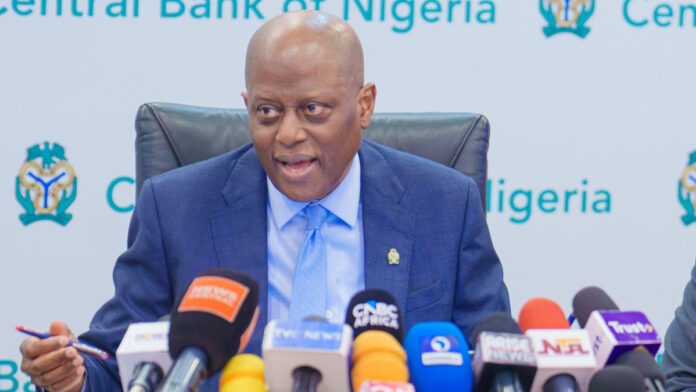
Central Bank of Nigeria Governor Yemi Cardoso says recent economic reforms are rebuilding investor confidence and strengthening Nigeria’s resilience.
-
He argues that artificial intelligence, stronger institutions and macroeconomic stability will determine Africa’s competitiveness in the evolving global economy.
-
WTO Director-General Ngozi Okonjo-Iweala says Africa must seize opportunities created by shifting global supply chains and invest in value-added industries.
-
Both leaders say deeper regional integration, policy credibility and innovation will be critical to unlocking the continent’s long-term growth.
July 30, (THEWILL) — Central Bank of Nigeria (CBN) Governor Yemi Cardoso has said the country’s recent macroeconomic reforms are beginning to restore investor confidence and strengthen economic resilience, while urging African countries to embrace artificial intelligence (AI), deepen regional trade and build credible institutions to remain competitive in a rapidly changing global economy.
Speaking at the 7th Africa Emerging Markets Forum in Abuja on Wednesday, July 29, 2026, Cardoso said the era of abundant global capital had ended, making policy credibility, macroeconomic stability and institutional strength increasingly decisive in attracting investment.
He said Nigeria had responded to global economic uncertainty over the past three years by implementing difficult reforms aimed at restoring confidence in the economy and strengthening its ability to withstand external shocks.

“Today, the results of those sacrifices are evident. Inflation has moderated from high levels despite the energy shock, external buffers have strengthened, and the financial system is safer and better capitalised to support the economy,” Cardoso said.
He added that the Central Bank had returned to its core mandate by unifying the exchange rate, restoring market-based price discovery, ending monetary financing of fiscal deficits and tightening monetary policy where necessary.
“We have learned one lesson. Credibility is built intentionally, one right decision after another, and strengthened through consistent action,” he said.
Cardoso said the changing global economic landscape presented Africa with an opportunity to move from being a passive participant in the international economy to helping shape emerging global rules, provided governments adopted consistent policies and strengthened domestic institutions.
He identified three major trends that would define Africa’s future competitiveness: the fragmentation of global trade, the growing selectiveness of international capital and the rapid rise of artificial intelligence.
According to him, geopolitical tensions are prompting countries to reorganise supply chains around trusted partners, creating both risks and opportunities for Africa.
While intra-African trade still accounts for only about 16% of the continent’s total trade, he said the African Continental Free Trade Area (AfCFTA) provides a platform for expanding regional value chains, provided governments address infrastructure bottlenecks, harmonise customs procedures and improve cross-border payment systems.
Cardoso also argued that attracting investment would increasingly depend on trust in public institutions rather than the promise of high returns alone.
“The era of abundant liquidity chasing returns regardless of risk is over,” he said. “Investors now have more choices and less tolerance for uncertainty.”
He urged African countries to mobilise domestic savings, pension funds, insurance assets and diaspora capital to finance long-term development instead of relying predominantly on foreign investment.
AI and Regional trade key to Africa’s future
![Passers-by, customers and traders visit the Makola market in the center of Ghana's capital. The market is considered one of the largest urban markets in Africa. [Photo Credit: Christina Peters//picture alliance via Getty Images]](https://staging.thewillnews.com/wp-content/uploads/2026/07/FotoJet-67.jpg "Ghana Market - THEWILL NEWS MEDIA")
“Africa must move beyond being consumers of technology. We must become creators, developing African solutions to African challenges and building businesses capable of taking those solutions to the world,” Cardoso said.
He said governments should invest in reliable electricity, affordable internet connectivity, digital infrastructure and skills development to prepare young Africans for an AI-driven economy.
The CBN governor also stressed the importance of expanding women’s participation in economic activity, arguing that Africa could not realise its full potential without greater inclusion.
The forum’s keynote speaker, World Trade Organization (WTO) Director-General Ngozi Okonjo-Iweala, echoed the need for African economies to position themselves for structural shifts in global trade, arguing that geopolitical tensions were reshaping rather than reversing globalisation.
She rejected suggestions that the world was becoming less interconnected, describing current developments instead as a shift from “cooperative to competitive interdependence.”
“The world is not becoming less interdependent. What we are seeing is not the end of globalisation, but its transformation from cooperative to competitive interdependence,” she said.
Okonjo-Iweala argued that the ongoing diversification of global supply chains presents Africa with a rare opportunity to become a larger player in global manufacturing and processing, particularly in critical minerals needed for the green energy transition.
She urged African countries to move beyond exporting raw materials and instead develop regional value chains capable of producing higher-value products.
“The time to seize this opportunity is now. If we miss this opportunity, I am afraid we will have missed a lot,” she said.
The WTO chief also defended the resilience of the multilateral trading system despite rising geopolitical tensions and protectionist policies.
She noted that global goods and services trade reached a record $34.65 trillion in 2025, while around 72% of world merchandise trade continues to take place under the WTO’s most-favoured-nation rules.
Okonjo-Iweala said negotiations to reform the WTO were under way to modernise rules governing global trade, including those relating to digital commerce, subsidies, transparency and decision-making, as members seek to adapt the institution to emerging economic realities.
Both speakers agreed that Africa’s ability to benefit from the changing global order would depend on maintaining macroeconomic stability, improving the business environment, strengthening regional integration and investing in innovation.
Cardoso concluded that while uncertainty in the global economy remained significant, the continent had an opportunity to convert disruption into long-term growth through strategic collaboration and credible economic governance.
“As established rules are rewritten, emerging markets have an opportunity to move from being rule-takers to becoming rule-setters,” he said. “Africa now has an opportunity to help shape the emerging order, but that opportunity will not be realised by potential alone.”

Segun Adeyemi serves as the Associate Editor of THEWILL Newspaper, leveraging more than ten years of editorial expertise and a proven track record in mainstream journalism.
