
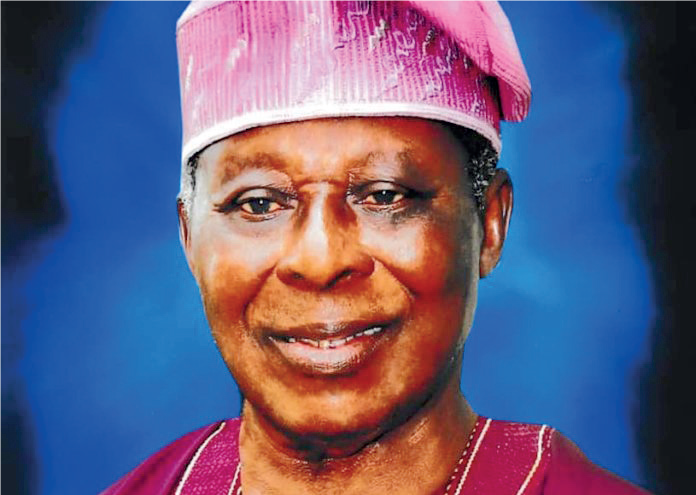
October 03, (THEWILL) – Former Dean of the School of Earth and Mineral Sciences at the Federal University of Technology, Akure and Fellow of the Nigerian Academy of Science, Prof John Adekoya, speaks on a compendium of metallic and industrial minerals of Nigeria recently published to showcase a neglected goldmine waiting to be explored and exploited for the country’s economic self-sufficiency and other issues in this interview with AMOS ESELE. Excerpts:
In view of the ongoing VAT war between the Federal Government and Rivers and Lagos States, isn’t it timely for the states to find a way to exploit the mineral resources in their localities to raise Internally Generated Revenue?
This issue was in contention many years ago when the Federal Government urged the states that wanted to invest to go into mining. Ondo State set up a company to exploit bitumen in the state. That was during the military era. It needed partners to bring in their money, but it did not succeed.

In this case, what would you advise the government to do?
In the case of gold, which was discovered in Ilesha in the 1950s, people like the late Odutola invested in it in a small scale. If you are going to do large scale mining, you require large scale capital. What the government can then do will be to give incentives to miners. Tax drove a lot of people away from the mining sector many years ago. Government can encourage investors by buying shares in companies to encourage their owners. I remember working as a consultant with the late Prof Sam Aluko when he was heading the National Intelligence Committee during the military era. His idea was that state governments, say, in the South-West, can collaborate to set up a refinery. They can contribute money for it. But I suspect that the governors will not be interested in such projects that have a long gestation period. They want quick money.
What do you say about the state of Ajaokuta Steel Company today?
It is the tragedy of our country because, incidentally, during our civil war years under military Head of State General Yakubu Gowon, when Britain failed to support Nigeria because of the Biafra war, Nigeria had to turn to Eastern Europe to make friends with Russia, then the Soviet Union. The Russians came to Nigeria and signed a MoU. Then there was iron ore around Lokoja and Koton Karfe area, but the metals were phosphorous and was not good for iron production; it made iron brittle and the Russians did not have the technology to remove phosphorous. They had to search for new deposits. That was how we came to Itakpe, hence they had to set up the iron and steel industry around there. They spent a lot of money and completed 95 per cent of the work, but because of corruption the Russians got angry and left. The government, during the civilian administration of Alhaji Shehu Shagari, said it had no money to complete it. There is a terminology we use in economic geology that the steel industry is the backbone of development and industrialisation. All the equipment we use are made with iron and that include machinery, cars, industrial equipment, buildings, even roads. Government should try and revitalise it.
Why do you think state governments are reluctant to explore these goldmines in their localities?
Like I discussed in Chapter 28 of my book, part of the problem is lack of capital and courage. If you want to go into mineral exploration and exploitation, you need a lot of nerves because you can put your money into it and not get your expenditure back. An example of such courage is Shell, which finally hit oil in Oloibiri in 1956. Before that breakthrough, the company had spent close to 30 million pounds in the present Ondo State and in the Sokoto basin and still did not strike oil. It was the discovery in the Niger Delta that helped the company to recoup its expenditure. So the mining business is discouraging to people. Unless businessmen like Aliko Dangote and Abdul Samad of BUA Group of Companies come in, we will continue to find artisanal, small-scale miners in the business.
You talked about inadequate government control of mineral resources. Is that why there are illegal miners in the country?
In the 1990s there were West African agents from Guinea, Senegal, Ghana and The Gambia who swooped on Nigeria to mine tin, columbite and tantalum, which is used in ICT. They mined illegally and took billions of dollars away from Nigeria. They did that during the military era, between 1989 and 1995. Then, there was a lot of massive illegal mining going on and the government could not contain it. That is what is going on in Zamfara State. The illegal miners and bandits are cooperating and depleting Nigeria of revenue.
What is your advice to stakeholders in view of illegalities everywhere?
It is the same suggestion that we made in the past. I was a member of a National Policy Committee set up in the 1990s and headed by the late Dr Pius Okigbo. We made some recommendations on how to stop illegal mining and benefit from its exploitation. First, we recommended that illegal artisanal miners aided by their allies from Senegal, Guinea and Ghana, should be licensed and then taxed. In response, the government set up a Federal Government Mining Initiative headed by a lady whose name I have forgotten. She was supposed to meet the agents, buy their takings and sell them officially to the Central Bank of Nigeria. Secondly, we recommended that the miners be organised into a cooperative so that it would be easy to control them.
They can take mining titles to mine for a fee and carry out corporate social responsibility in their area of operations. The government is aware of this suggestion, but I am not. They actually enforced it. There was even a time I learnt the government took a World Bank loan for this, but I don’t know if they used it for the purpose.
There is a third recommendation that deals with inadequacy of government in handling the mining sector. The colonial government introduced the Mine Police to monitor and inspect the mines and arrest illegal miners. On this, there was a suggestion to use the National Security and Civil Defense Corps, but I don’t know if this has crystallised.
When you said the government survey department where you once worked conducted a geological survey of the country, what exactly did that mean?
Geological survey is the principal function of the Geological Survey of Nigeria, a department of the Federal Ministry of Mines and Power. The principal survey is to carry out geological mapping of Nigeria, first on a small scale and then on a larger scale, to discover the water potential of the country and geological rock types and mineral resources in all the rocks. It highlights the map of Nigeria, showing the distribution of rock types.
As someone who has worked in the public and academic circles, why do you think the Federal and State governments have been unable to exploit and export the discovered mineral resources in commercial quantities in the face of dwindling revenue from oil?
It is one thing to discover mineral resources, it is another to explore and exploit them. It takes a lot of money and effort to evaluate the minerals, to do a mapping of the mineral that has been discovered first on a small scale and then on a large scale. Exploitation involves digging pits and to sample them in different places, depending on the site you are exploiting. Government does not have the money to do it.
Why? If not the government then who has that kind of money?
The private sector. Because they are interested in it, they will go into it with all their investment capital. The International Oil Companies (IOCs), such as Shell, Chevron, Mobil which invested in the oil sector in the country, have the capital and courage. They can bring in their money, conduct the study of the entire basin and geology costing as much as $20 million, particularly when they are doing it off-shore. At times the cost can go as high as $100 million. In spite of the investment, you may still not find enough minerals. In the case of the Niger Delta, there are certain wells that are yet to be harnessed long after work has been completed on them. They are called marginal fields which smaller, indigenous companies like Seplat and Niger Delta Oil Development companies are taking over.
In the early 1990s, the World Bank organised a mining conference during which they advised the Federal Government against setting up mining corporations as it was doing with the Niger Coal Corporation. They discovered that except for Brazil, the experiences from other parts of the world had shown that government was inefficient in running mining companies. I remember arguing that if Brazil could succeed, why not Nigeria. Maybe they were right because the Nigeria Mining Corporation soon packed up due to nepotism. One of the principal officers, I learnt, is now in detention over embezzlement of funds.
Some companies are exploiting the minerals in many states reportedly without permission. What do you say to this?
Yes, artisanal miners are taking over with some negative effect on the environment. In the last seven or eight years, the artisanal miners, particularly in the North, are doing that. Larger companies are also involved like what we have in the Ilesha area of Osun State where Canadian and Chinese companies are investing in the mining of gold.

Amos Esele is the Editor of THEWILL Newspaper. He has over two decades of experience on the job.
