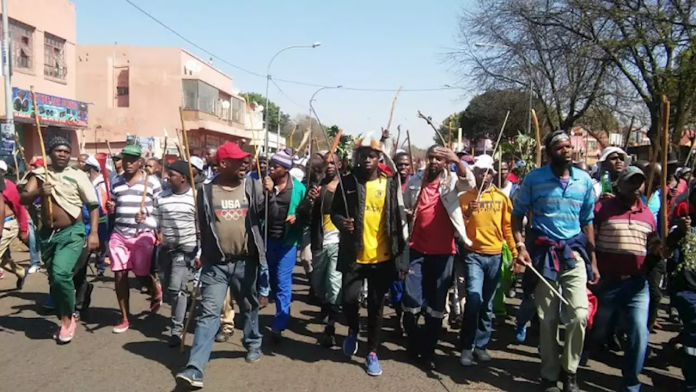
June 22, (THEWILL) — There is an indication that the Federal Government of Nigeria might be compelled to explore other options if diplomatic engagements fail to address the ongoing xenophobic attacks against its citizens in South Africa as Minister of Foreign Affairs, Mrs Bianca Odumegwu-Ojukwu warned on Thursday, June 11, 2026.
This follows the directive on Sunday by the Nigerian Communications Commission (NCC) and Corporate Affairs Commission (CAC) to introduced a new compliance requirement. The directive mandates prior approval for significant ownership changes in telecommunications companies operating in Nigeria.
According to the agencies in a joint statement signed by Mrs Nnenna Ukoha, NCC Director of Public Affairs, and Mr Rasheed Mahe, CAC Head of Public Affairs, telecom companies must obtain a Letter of No Objection from NCC before transferring shares. She explained that the approval applies to transfers amounting to 10 per cent of total share capital.
The requirement is based on the Nigerian Communications Act (NCA) 2003 and other relevant regulations. According to her, the rule takes immediate effect for NCC-licensed companies proposing ownership or control changes. The measure also covers multiple share transfers that collectively exceed the 10 per cent threshold.

Ukoha said CAC would ensure shareholding change requests have evidence of NCC approval before registration. She noted that the policy would prevent direct or indirect anti-competitive practices in the sector. “The requirement is designed to preserve a fair and competitive market structure within the communications sector,” she said.
The NCC official added that the move would strengthen oversight of ownership and control changes. She said the policy would improve transparency, investor confidence and regulatory certainty in the industry. According to her, the initiative would safeguard the long-term stability of Nigeria’s communications sector.
Ukoha reaffirmed the commitment of NCC and CAC to a transparent business environment. She said both agencies would continue working together to promote fair market practices. The collaboration, she added, would support the orderly and sustainable growth of the communications industry.
THEWILL recalls that on the heels of ongoing evaluation of Nigerians from South Africa following continued attacks on Blacks and Nigerians in particular amid President Cyril Ramaphosa’ s announced crackdown on illegal immigration, Odumegwu-Ojukwu hinted at possible regulatory measures against South African companies operating in Nigeria, such as telecommunications giant MTN, Multi choice, Stanbic and Protea.
She said, “As I indicated before, there are these huge conglomerates. By the way, there are over 120 South African companies operating in Nigeria. Nobody is asking them to provide proof of identity. Nobody is asking South African staff working there whether they are South African or Nigerians and nobody is talking over their shops or businesses.
“But this is happening to Nigerians in South Africa. So, I think that at some point, we really have to review the options available to us.
“We have MTN, MultiChoice, Stanbic, Protea and many other South African brands spanning multiple sectors.”
The minister, however, disclosed that retaliatory measures would have to follow constitutional provisions and due legislative processes, adding that the Nigerian government would continue to engage it’s South African counterpart through diplomatic channels, saying that National Assembly would play a constitutional role in determining Nigeria’s response should those efforts fail.
Though the National Assembly, NASS, is yet to frontally debate the South African problem, motions have repeatedly come to the floor during plenary.
In May, for example, Senator Adams Oshiomhole, drew the attention of the NASS to the need to revocate the licences of South African companies operating in Nigeria, including MTN and MultiChoice, owners of DSTV, following renewed xenophobic attacks against Nigerians in South Africa.
Foreign Affairs experts have at different times during repeated xenophobic attacks on Nigerians urged the government to engage in reprisal attacks.
Speaking to THEWILL on the ongoing attacks on Blacks in South Africa, former Director General of the Nigerian Institute of International Affairs, NIIA, Professor Bola Akinterinwa said the current leadership in the Southern country is complicit in the attacks.
He said many Southern Africans are unaware of Nigeria’s hugh material, diplomatic and financial support during racist Apartheid regime, making it hard for the politicians in the country to handle their people’s displaced anger against better competitors in social and economic spheres.
He said, “South Africans are divided against themselves. Anybody who want to solve the attack must look at the problems holistically. For Nigeria, we must begin by following the law of reciprocity. Blacklist South Africa. If you don’t want us, then why should we want you. I recommended reciprocity to former Minister of Foreign Affairs, Olugbenga Ashiru as his Special Assistant in 2012. Also, when I was DG of NIIA, we were engaged in robust policy making.Recall that some time ago when Professor Woke Soyinka went there to deliver a lecture as well as other 125 Nigerians, they were denied entry into South Africa because they were accused of not having yellow card. Many Nigerians went after MTN offices and destiny their materials. South Africa government came to Nigeria and begged the government. Nobody has monopoly of violence.”
Currently, MTN Nigeria is controlled by South African-based MTN Group Limited. The group holds approximately 73.39 per cent of the company’s total equity through its subsidiary, MTN International, Mauritius, Limited.
MultiChoice Group on the other hand is a wholly-owned subsidiary of French media conglomerate Groupe Canal+, though the local South African ownership is maintained through the company’s broad-based black economic empowerment (B-BBEE) scheme, Phuthuma Nathi, which holds a 25 per cent economic interest in MultiChoice South Africa Holdings in compliance with South African media laws.
Felix Ifijeh is a journalist with years of professional reporting experience. Known for his keen news sense, compelling storytelling and commitment to accurate, impactful reporting, he has built a reputation for turning leads into clear, engaging, and well-structured reports that resonate with readers. His work reflects deep newsroom experience and a commitment to accurate, impactful journalism.