-
DSS asks Federal High Court to foreclose Omoyele Sowore’s defence, accusing him of deliberately frustrating his criminal trial through repeated delays.
-
Proceedings descend into a heated exchange between senior lawyers for the prosecution and defence over an adjournment request and alleged dilatory tactics.
-
Justice Mohammed Umar rebukes both counsel, warns against unprofessional conduct in court and insists the defence has delayed the case since March.
-
Court adjourns the cybercrime trial to September for continuation of the defence after refusing to allow the courtroom confrontation to continue.
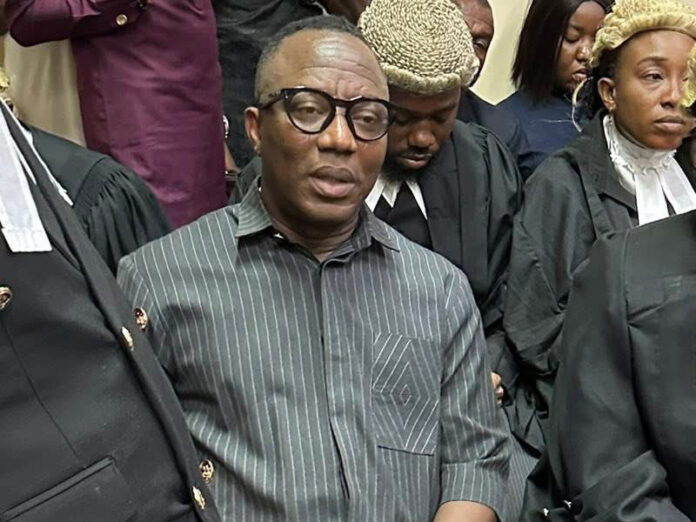
August 03, (THEWILL) — Proceedings in the trial of the presidential candidate of the African Action Congress (AAC), Omoyele Sowore, turned dramatic on Monday after a heated confrontation between lawyers prompted the Federal High Court in Abuja to halt proceedings, while the Department of State Services (DSS) urged the court to foreclose the defendant’s case over what it described as persistent attempts to delay the trial.
THEWILL reports that the DSS is prosecuting activist and publisher of Sahara Reporters, Sowore, on allegations of criminal defamation, cyberstalking and incitement arising from social media posts made on August 25, 2025, in which he described President Bola Tinubu as a “criminal”.
He was arraigned on December 2, 2025, on a two-count charge marked FHC/ABJ/CR/484/2025, bordering on alleged criminal defamation, cyberstalking and incitement under Sections 24(1)(b) and 24(2)(a), (b) and (c) of the Cybercrimes (Prohibition, Prevention, Etc.) (Amendment) Act, 2024.

At Monday’s proceedings before Justice Mohammed Umar, counsel to the DSS, Akinlolu Kehinde, SAN, asked the court to terminate the defence’s case and direct parties to file their final written addresses, arguing that Sowore had repeatedly frustrated the trial through unnecessary adjournments.
The application followed an adjournment request by Sowore’s lead counsel, Adeyinka Olumide-Fusika, SAN, who said he was unable to proceed because documents required to examine a subpoenaed DSS witness had only been released by the court registry shortly before the commencement of proceedings.
Olumide-Fusika explained that the defence had filed an application on July 22 seeking certification of documents intended for use during the testimony of an official representing the Director-General of the DSS, Oluwatosin Ajayi.
According to him, the defence had earlier been informed that the application had not been approved, only to discover minutes before the sitting that the trial judge had actually endorsed it on July 27.
“We filed an application on July 22, and we were told Your Lordship had not approved it. We only discovered moments before today’s sitting that it had in fact been approved since July 27”, he told the court, blaming the delay on the court registry.
He therefore sought an adjournment to enable the defence to study the documents before proceeding with the cross-examination of the subpoenaed DSS official.
Kehinde, SAN, immediately opposed the request, insisting that it formed part of a deliberate strategy to prolong the proceedings.
He reminded the court that all parties had earlier agreed that an officer nominated by the DSS Director-General would appear as the defence witness and that the prosecution had fully complied with that agreement.
“The prosecution fulfilled its obligation completely. The witness is here in court to testify on Exhibit DW-D tendered on July 22”, Kehinde argued.
He maintained that it was the responsibility of the defence to diligently pursue its own application and faulted attempts to shift the blame to the registry.
According to the senior advocate, the court had consistently accommodated the defence despite repeated delays since the prosecution closed its case in March.
Invoking Sections 36(4) and 36(6) of the 1999 Constitution, he argued that while every accused person has a constitutional right to fair hearing, that right does not extend to endlessly delaying criminal proceedings.
He also relied on the Supreme Court decision in Segun Ogunsanya v. The State (2011), which, he said, affirmed that courts should not tolerate deliberate attempts to frustrate criminal trials.
Kehinde consequently urged Justice Umar to foreclose the defence and order both parties to proceed directly to final written addresses.
The application triggered a sharp response from Olumide-Fusika, who accused the prosecution of ignoring the facts before the court and unfairly portraying the defence as obstructive. He insisted the defence could not determine when the judge approved its application since all official communication passes through the court registry.
The defence lawyer further accused the DSS of refusing to produce subpoenaed witnesses and argued that if his intention had been to delay the proceedings, he would not have appeared in court during the judicial vacation.
As arguments intensified, Olumide-Fusika rejected allegations of employing dilatory tactics and accused the prosecution of persecuting his client.
“What sort of talk is that? My calmness should not be taken for granted. Deal with the facts. What exactly are these alleged dilatory tactics?” he said.
He further informed the court that Sowore had earlier relaxed a subpoena compelling the DSS Director-General to testify following the intervention of the Attorney-General of the Federation and Minister of Justice, Prince Lateef Fagbemi, SAN.
The courtroom exchanges escalated into a verbal confrontation between both senior lawyers before Justice Umar intervened.
The judge, who recently took over the case, reminded the defence that the matter had suffered repeated delays since March and criticised the conduct of counsel.
“I have been on the Bench for 22 years. We have junior counsel here. This is not good. This should be the last time. If you are no longer interested in the case, you should say so. You cannot behave in my court in that manner”, the judge warned.
Justice Umar subsequently adjourned the case until September 20 for continuation of the defence.

Felix Ifijeh is a journalist with years of professional reporting experience. Known for his keen news sense, compelling storytelling and commitment to accurate, impactful reporting, he has built a reputation for turning leads into clear, engaging, and well-structured reports that resonate with readers. His work reflects deep newsroom experience and a commitment to accurate, impactful journalism.