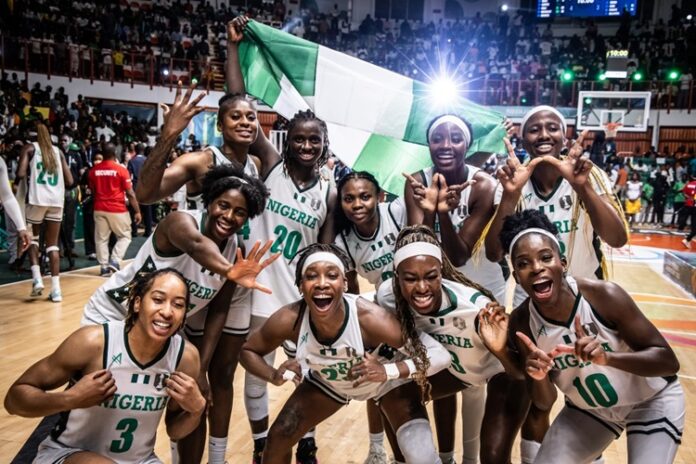
April 06, (THEWILL) — For the first time in the history of women’s basketball on the continent, an African team will take the court against professional franchises from the world’s leading domestic league. When D’Tigress open their three-game tour of the United States against the Los Angeles Sparks on April 25, the occasion will carry weight that extends well beyond a preseason friendly. It is the clearest measure yet of how seriously Nigerian women’s basketball has begun to take itself.
The fixture list, confirmed by the Nigeria Basketball Federation in late March 2026, moves through three cities across 10 days. San Diego comes first, with the Sparks at Viejas Arena. Two days later, the squad travels to Kansas City for a meeting with the Minnesota Lynx at the T-Mobile Center, a venue hosting professional women’s basketball for the first time in 20 years. The tour concludes on May 2 in Indianapolis, where the Indiana Fever have incorporated Nigeria into a preseason schedule that already features the New York Liberty and the Dallas Wings. That the Fever chose to include them says more about the standing of the African champions than any ranking figure could.
D’Tigress have worked hard to earn that recognition. At the 2025 FIBA Women’s AfroBasket in Côte d’Ivoire, they defeated Mali 78-64 in the final to claim a fifth consecutive continental title, their seventh in total, completing the competition without a single defeat. That run stretched their unbeaten record in African competition to twenty-nine games. FIBA’s current world rankings place them eighth globally, a position that reflects steady upward movement over several years and a programme that has developed its own coherent identity.

The architecture of that identity has been shaped significantly by head coach Rena Wakama, who maintains a parallel role on the staff of a WNBA franchise. Her coaching philosophy centres on defensive discipline and quick ball movement, principles that were tested at the 2024 Olympic Games in Paris, where Nigeria became the first African basketball team to reach the quarter-final stage of the tournament. More recently, at the World Cup qualifying tournament held in Lyon in March 2026, those principles produced a victory over Colombia and another against the Philippines before three defeats closed the window. Those results came after qualification had already been earned through AfroBasket success, which gave the Lyon fixtures the character of an exploratory exercise rather than an imperative one.
The United States tour offers no such comfort. The Minnesota Lynx finished the 2025 WNBA season with the best record in the league and have won four championships in their history, with Napheesa Collier and Kayla McBride among the players Nigeria’s defence will need to contain. The Los Angeles Sparks bring pace and athleticism in transition, with rotational pressure that forces opponents into quick decisions. The Indiana Fever operate through guard-led offence, long-range shooting and a tempo that compresses the time available for defensive organisation. Facing three distinct systems in rapid succession will demand adaptability from a squad whose strength has traditionally resided in physical control and structured half-court play.
The roster assembled for this challenge carries genuine professional pedigree. Amy Okonkwo, named most valuable player at the last AfroBasket, appeared for the Dallas Wings on a hardship contract during the 2025 WNBA season and currently plays in Türkiye. Ezinne Kalu, who manages the offence from the guard position and brings composure to high-pressure situations, held a similar arrangement with the Atlanta Dream in 2024. Statistical leadership during the Lyon qualifying window came from Victoria Macaulay, who averaged an efficiency rating of 16.4 per game, followed by Murjanatu Musa at 15.0, while Elizabeth Balogun contributed 10.6 points and 10.6 rebounds per game. Across positions, the group blends players developed through college basketball in the United States and professional leagues across Europe with those who came through Nigerian domestic competition, a diaspora-inflected mix that brings tactical range to a physically imposing collective.
Results in San Diego, Kansas City and Indianapolis will matter less than what is learned from them. Exhibition games exist to reveal rather than to judge, and Wakama has framed the tour accordingly. Turnover rates, shooting efficiency and the ability to sustain defensive organisation over four full quarters against opponents who train together across a full professional season are the indicators that coaching staff will weigh most carefully. The 2026 FIBA Women’s World Cup opens in Germany on September 4 and runs until the 13th, placing Nigeria alongside 15 other qualified nations including Australia, Belgium, the hosts Germany and the United States. The programme’s ambition, stated consistently by players and officials, is to move beyond the group stages and surpass the eighth-place finish that remains the team’s best World Cup performance to date.
Beyond the tactical dimension, the tour arrives at a moment of some institutional consequence. Following the AfroBasket victory, President Bola Tinubu announced that each player would receive the equivalent of 1000 USA, a three-bedroom flat within the Renewed Hope Estate in Abuja and the national honour of Officer of the Order of the Niger. Coaching and technical staff were promised fifty thousand dollars alongside the same recognition. In March 2026, during the Lyon tournament, title documents and honour certificates were formally presented by Shehu Dikko, chairman of the National Sports Commission, and director general Bukola Olopade. Cash payments were described as in the final stage of processing. Officials characterised the ceremony as proof that the current administration regards sporting achievement as a matter of serious national account.
That framing matters because Nigerian women’s basketball has long operated in the uncomfortable gap between genuine achievement and uneven institutional support. The record of D’Tigress across recent years represents something built largely through individual commitment and, often enough, in spite of administrative turbulence rather than because of it. If the delivery of prizes and recognition signals a more durable shift in how the programme is resourced and regarded, the WNBA tour becomes something greater than a technical exercise. It becomes evidence that the ambition on the court is being matched, at last, by the conditions required to sustain it. Whether that holds beyond the celebration will become clear in Germany.

Jude Obafemi is a versatile senior Correspondent at THEWILL Newspapers, excelling in sourcing, researching, and delivering sports news stories for both print and digital publications.