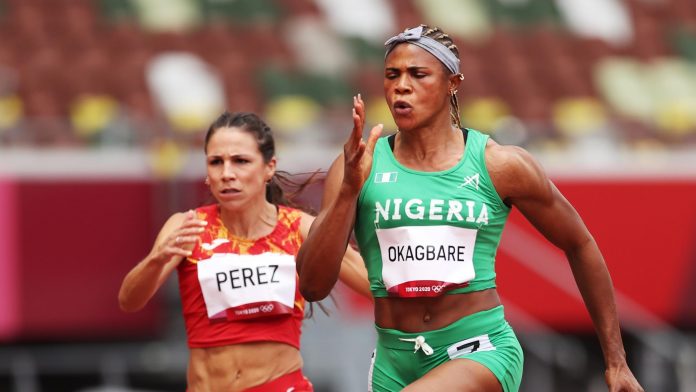
October 07, (THEWILL) – The Athletics Integrity Unit (AIU) has charged Nigerian sprinter Blessing Okagbare with three different charges: two for testing positive for banned substances and one for refusing to cooperate with an investigation.
After an out-of-competition sample collected on July 19 came back positive for human growth hormone (HGH), the Beijing 2008 Olympic silver medalist was embarrassingly barred from competing at Tokyo 2020, as THEWILL reported.
Okagbare was provisionally suspended for the offence on July 30, the day before she was scheduled to compete in the women’s 100 metres semi-finals.

A second charge has now been filed against the 33-year-old, this time for the presence of a prohibited drug in a sample. Following an AIU request for recombinant erythropoietin (EPO) analysis, an out-of-competition sample collected on June 20 revealed a positive result for EPO.
Okagbare has also been charged with a final charge by the AIU for her apparent unwillingness to comply with the inquiry. The athlete allegedly disobeyed a formal request to deliver pertinent documents, data, and electronic storage devices.
Okagbare has disputed all charges and has asked for a hearing before a disciplinary tribunal on each of them.
As THEWILL reported, the interim suspension of Okagbare in the middle of the Olympics was an embarrassment for Nigeria, as it came after the AIU barred ten Nigerian athletes from competing because they had not been thoroughly checked in the lead-up to the Games.
The AIU considers Category A National Federations to be the most vulnerable to doping, so they must meet additional conditions in order to choose athletes for the Olympic Games or World Championships.
On the basis of Rule 15 of the National Federation Anti-Doping Obligations, the ten Nigerians were barred from competing in the Games.
The restrictions, which were implemented in 2019, stipulate that each athlete from a Category A country must undergo at least three no-notice, out-of-competition doping tests in the ten months leading up to the Olympics, each of which must be conducted at least three weeks apart.
The athletes declared ineligible for Tokyo 2020 were not subjected to these testing procedures even though Nigeria is in Category A.
Okagbare, a multi-time African champion, won silver in the long jump at the 2008 Olympics in Beijing, but has since primarily competed in sprints.
She earned gold in the women’s 100m and 200m events at the 2014 Commonwealth Games in Glasgow, as well as silver in the long jump and bronze in the 200m at the 2013 World Championships in Moscow.

Jude Obafemi is a versatile senior Correspondent at THEWILL Newspapers, excelling in sourcing, researching, and delivering sports news stories for both print and digital publications.