March 09, (THEWILL) – After a spell of heated public debates, protests and drama over Senator Natasha Akpoti-Uduaghan’s allegations of sexual harassment, abuse of office and malicious obstruction of legislative functions, levelled against President of the Senate, Godswill Akpabio, everything comes down to the question of the rule of law.
“It is now a matter of dispute. Under our laws there is division of labour. And in that division of labour, the courts are the ones vested with the power to settle disputes between government and individuals, individuals and institutions, as well as between persons,” Dr Ehiogie West-Idahosa, a Senior Advocate of Nigeria, SAN, told THEWILL during an interview on Friday.
A two-time former member of the Federal House of Representatives, Dr West-Idahosa said the framework of the law in Nigeria is such that though there are three mutually interdependent arms of governance, “If the Constitution did not want the court to be involved in matter of disputes involving lawmakers, it would not have Section 4 (8), which states that the legislative activities of the National Assembly shall be subject to the decision of the court. That is one. Two, the Senate by its own rules also has a submission, which says that the Senate shall not debate any matter pending before a court in such a manner as to prejudice the outcome of the pending matter. Remember, the law says any matter. So, if a Senator took the Senate to court, it would be a pending matter.”

THE PENDING CASE
Tomorrow, Monday, March 10, 2025, the Federal High Court presided over by Justice Obiora Egwuatu, which had on March 5 restrained the Senate Committee on Ethic, Privileges and Public Petitions from conducting disciplinary proceedings against Senator Akpoti-Uduaghan, will hear from the defendants why the applicant’s reliefs should not be granted.
Justice Egwuatu issued the order, following an ex parte application filed by Akpoti-Uduaghan’s counsel.
The Senator representing Kogi Central at the National Assembly had been invited to appear before the senate’s disciplinary committee on March 6, following a dispute with Senator Akpabio on February 20, 2025. That day she protested the reassignment of her seat by Senator Akpabio, in what Senators say was a violation of Standing Rules 2023 (as amended). However, on March 5, she had submitted the petition to the Committee, alleging sexual harassment, abuse of office and malicious obstruction of her legislative functions by Senator Akpabio.
According to the pending suit, Senator Akpoti-Uduaghan prayed that the court grant an order restraining the Senate and its ethics committee from “proceeding with the purported investigation” against her, and an order “declaring that any action taken during the pendency of this suit is null, void, and of no effect whatsoever”.
The Kogi senator also prayed for a court order permitting the defendants to be served with the originating summons and other documents through proxy.
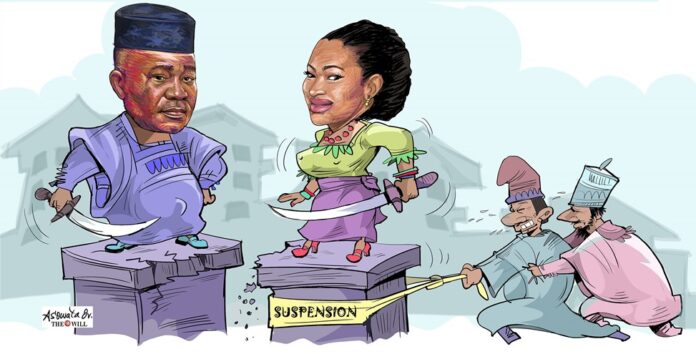
But on March 6, with Akpabio presiding, she was suspended for six months by the Senate, following recommendations of its disciplinary committee for bringing the Red Chamber into disrepute by violating Standing Rules 2023 (as amended). However, THEWILL notes that the Senate President should not be the presiding officer on any matter that is linked to the alleged sexual harassment claim made against him by Senator Akpoti-Uduaghan for equity and justice.
The committee recommended and the senate approved that Akpoti-Uduaghan should tender a written apology before resuming duty; that her office should be locked up for the duration and she hands over property belonging to the Senate; she must not come close to the National Assembly complex; that her salaries and allowances and security details be suspended and that she must be barred from presenting herself to local and international media.
“So, the main question to be answered now is whether an order made against an extant injunction should not be undone. We await the hearing on Monday,” Dr West –Idahosa said.
As someone who was elected to the National Assembly between 1999 and 2007, when the rules were made, the Senior Advocate of Nigeria explained that though the rules are the subject of rigorous debates and sound legal draughtsmanship, he was surprised to hear these days that they are largely being neglected.
According to him, there are two principal guidebooks on the subject matter under review. The first is a general one for both chambers of the National Assembly. It is called the Legislative Power and Privileges Act.
“Here, the rule says you can suspend a member only up to the next legislative day. So, if you were to suspend a member on Tuesday and the next legislative day is Wednesday, they will resume. But they always run away from implementing this one and instead use their own rules. Even so, the Senate, by its Order 64 rule, can only suspend a member for 14 legislative days. The same applies to the House of Representatives. So, the Senate cannot keep to their own rules and yet they are talking about rule, rule, rules. How can you say the Constitution has given you power to make rules and yet you cannot stick within your own rules and we are talking about independence of the arms of government? If you don’t stick to your rules, you are inviting the courts to come in. Where will aggrieved persons seek redress? Asigidi shrine? They will go to court,” he said.
West-Idahosa submitted that if the Senate Committee had listened to Senator Akpoti-Uduaghan, made their reports and at the end of the day suspended her for 14 legislative days, only a few people would have raised an objection. Reminded that the Committee complained that she failed to answer their summons, Dr West-Idahosa disagreed vigorously.
“No, that is not correct. I looked into the matter. From what I found out after I had spoken on this case on national television, they were unfair to her. From the invitation letter I saw, the investigating committee invited her for a hearing in the matter on March 6. Do you know what they did? On March 5, they found out that the court was to send them the papers. They then conveyed an emergency meeting at which the Chairman announced to the members that they had instruction to conclude the matter. It was at the meeting that they tried to change the date on the notice to her and at about 3:30 in the afternoon, they hurriedly sent her a notice that the hearing was no longer on the 6th but on the 5th. Do you know that by the time they sent the notice to her, they had concluded the business of the day? That is the truth of what I found out. I went out of my way to do so because the injustice was too glaring. The point I am making in all of these is that we should not mystify the parliament. Lawmakers are not above the law. That is why we have constitutional provisions which subordinate the National Assembly to the jurisdiction of the court.”
PRECEDING CASES
Professor of Constitutional Law, Maxwell Gidado, said that the law must take its course in this matter and considers the six months suspension order on Senator Akpoti-Uduaghan as “very drastic.” As a scholar who was once on sabbatical at the National Assembly, Prof Gidado, who is a Senior Advocate of Nigeria, SAN, however, thinks that the Senate should have followed precedence and deal with the matter within rather than go to the court, which has ruled on similar matters in the past and ruled in favour of the applicants.
He told THEWILL at the weekend that since representation at the NASS is a constitutional matter, no elected member should be sanctioned for any offence in such a way that hinders their duty to their constituents. “There is an established number of days that lawmakers can be suspended from the legislature so that their constituents are not left without representation for too long. And there are precedents on this matter. Some of the cases involved Senator Ali Ndume from Borno South, Senator Abdullahi Ningi from Bauchi Central and Senator Ovie Omo- Agege, Delta Central.”
Gidado argued that as an institution of government, the Senate should be seen to conduct its affairs with more dignity. Ranking Senators should be ready to assist the new ones to learn the rules of the game and conduct themselves in civil language.
“Where you have ranking senators and principal officers making offending comments that portray their new colleagues in bad light, you are calling for trouble. But, like I said, there are precedents on this pending matter that ought to serve as a guide to actions.”
Prof Gidado’s recollections of cases of precedence similar to Senator Akpoti-Uduaghan suit, which were settled by the courts in the past abound in both chambers of the NASS. The first is the suit involving Senator Ali Ndume, Borno South. In 2017. Senator Ndume had accused the Senate under the leadership of Senator Bukola Saraki of importing a bulletproof Range Rover with fake documents.
Upon investigation, the Senate Committee on Ethics, Privileges and Public Petitions recommended Senator Ndume’s suspension for “failing to conduct proper investigation before making the allegations” and for “bringing the Senate to unbearable disrepute”.
After the suspension, Senator Ndume approached a Federal High Court in Abuja over the matter. In November 2017, the court nullified the suspension and declared it “illegal, unlawful and unconstitutional”.
The court also ordered Senator Saraki and the Senate to pay the suspended senator all outstanding salaries and allowances.
In a similar suit, Justice Nnamdi Dimgba of the Abuja Division of the Federal High Court on May 10, 2018, nullified the suspension of Senator Ovie Omo-Agege from the Senate.
According to Justice Dimgba, the Senate’s decision to suspend Senator Omo-Agege, as well as the approach adopted by the National Assembly, was faulty constitutionally.
Senator Omo-Agege, who represented Delta Central, had approached the court, after the Senate’s committee on ethics and privileges began to investigate his comments in which he condemned the NASS’s decision to amend the Electoral Act in a design to alter the sequence of the 2019 General Election. The Senate committee investigated the matter and recommended the suspension of Senator Omo-Agege for 181 days, which was reduced to 90 days after a review was undertaken.
Ahead of his suspension, Senator Omo-Agege approached the court, challenging the decision of the Senate to investigate his allegations. Justice Dimgba said that though the Senate had a constitutional duty to discipline its members, such disciplinary measures must comply with provisions of the law.
The judge noted that Section 4 (8) provided that the exercise of legislative powers was subject to the decisions of the court, adding that the cited provision stated that the Senate could not take a decision that would tend to oust the functions of the Judiciary.
According to Mr Dimgba, where the actions of the Senate are found to be in violation of constitutional provisions, the section 4 (8) becomes fully applicable by the Judiciary.
He further ruled that constitutional provisions only allow the Senate to suspend its members for no more than 14 days.
The court therefore nullified Senator Omo-Agege’s suspension with immediate effect. It further ruled that all outstanding salaries and allowance be paid to the senator.
Senator Abdul Ningi of Bauchi Central got a three-month suspension on March 12, 2024, but had his suspension lifted 75 days after.
Just like in the Senate, the House of Representatives has had its fair share of rash suspensions in the NASS. The most celebrated case was the 2018 Abuja Federal High Court ruling which voided the 180-legislative-day suspension of Abdulmumin Jibrin. The House had suspended Jibrin in September 2016 because he reported cases of corrupt practices against its leadership to anti-corruption agencies.
Jibrin took the matter to court, where the judge ruled the suspension unlawful and unconstitutional and ordered the lower legislative chamber to pay Jibrin all the salaries and benefits owed to him during the period of his unjust suspension.
As with all aforementioned cases, the court also ordered that the suspended lawmakers be readmitted because the NASS was wrong in suspending them indefinitely when the law only allows the suspension of erring members for 14 legislative days.
Dr Monday Ubani, a Senior Advocate of Nigeria, and former National Vice-President of the Nigerian Bar Association, is of the view that the court cannot stop the Senate Committee from investigating its members and in this case, Senator Akpoti-Uduaghan. He told THEWILL that all the cases cited as precedence may differ from the current matter involving the Senator from Kogi Central.
He said, “Precedents can differ based upon facts. What happened in one case cannot decide another. It is only when the matter comes up in court that we can look at the facts of the case and decide. Disciplinary action is part of the internal affairs of the NASS or Assembly. Why the exparte order? That the Senate should stop investigating its members? Well, this is a judicial thing. It will be handled by the lawyers. The question is whether the judiciary has a right to interfere in the internal mechanism of the Senate.
“This principle is rooted in the doctrine of separation of powers as enshrined in Sections 4, 5, and 6 of the 1999 Constitution of the Federal Republic of Nigeria (as amended), which vests legislative powers in the National Assembly, executive powers in the President, and judicial powers in the courts.”
Citing the Supreme Court in Senator Ali Ndume v. Senate of the National Assembly and Anor (2019) LPELR-46543(SC), Ubani said that the apex court upheld the principle that the courts should not interfere with the internal affairs of the legislature, provided such actions do not contravene the Constitution of the Federal Republic or fundamental rights of individuals.
In this case, Senator Akpoti-Uduaghan, he argues, was not punished but given an opportunity to be heard. “Instead of appearing before the Committee for hearing, she headed straight to court to stop the constitutional function of the Senate. She is absolutely wrong and the case will be dismissed ultimately.
“Similarly, in Hon. Dino Melaye v. House of Representatives (2002) 18 NWLR (Pt. 799) 67, the Court of Appeal held that the courts cannot intervene in disciplinary actions taken by the legislature against its members, as it falls within the exclusive powers of the legislature.
“However, the courts can intervene only if the legislature exceeds its constitutional powers, violates the fundamental rights of the individual concerned, or breaches the principle of fair hearing (Section 36 of the 1999 Constitution). For instance, if the Ethics and Privileges Committee acts ultra vires by imposing a penalty beyond its powers or denies Senator Akpoti-Uduaghan the right to a fair hearing, the court may intervene.
“As we can see, the Committee invited her in order to hear her own side of the story, but she chose to run to the court instead. The court as a different arm of government cannot stop the Legislature from performing its functions.”
According to Dr Ubani, the Committee was right in ignoring the court order, going ahead with the investigation and making recommendations accordingly.
He noted that a legal team assembled by the Senate will tackle the case in court by filing an application seeking the setting aside of the court order, if any.
Another Senior Advocate of Nigeria, Mr Kunle Edun, SAN cites Order 67(4) of the Senate Rules, which states that a senator can only be suspended for a period not exceeding 14 days. He said in a note published in a legal opinion journal at the weekend that he does not support with the suspension order on Senator Akpoti-Uduaghan.
“The courts have several times held that a legislator is a representative of his or her constituents and that by suspending a legislator it automatically translates to an unconstitutional denial of the constituents right to representation at the Parliament. She represented millions of her constituents who have just been unlawfully denied representation.”
He said, the contention that the court lacks the power to interfere in the affairs of the legislature by virtue of the principle of separation of powers is not enough for the Senate to disregard an order of interim injunction made by a competent court of law restraining the Senate and its committee from proceeding with the hearing. “All the reasons that the Senate may have in disobeying the court order ought to have been presented before the court as a basis to set aside the interim order. It is lawless for a legislature to disobey an order of court, whether valid or otherwise.”
“Senator Akpoti-Uduaghan rightly refused to appear before the Ethics Committee in view of the court’s order. The Senate was wrong in proceeding with the hearing despite the court order. That was sheer legislative rascality by the legislators. The Court should proceed to set aside the purported resolutions of the Senate.”
Efforts to get reactions from the Senate Spokesperson, Senator Adaramodu Adeyemi failed. Multiple calls to his phone and messages went unanswered.
REPRIEVE
The Federal Government at the weekend waded into the matter. The Women Affairs Minister, Imaan Sulaiman-Ibrahim told State House Correspondents at the Presidential Villa, Abuja, that “It’s an unfortunate incident that should not happen. In the last assembly, we had nine senators that were women. We don’t want to lose any woman member in the Senate or decrease in the numbers. We’re going to be brokering peace. We’ll engage all the stakeholders to ensure that they temper justice with mercy.”
Suleiman-Ibrahim said she was emboldened by the Senate President’s openness to talk.
“I was at the National Assembly yesterday, at the Senate where we marked the International Women’s Day. The last thing the Senate President said was that ‘we’re open to broker peace.’ So, we’re going to be the intermediary between the two parties to see that we broker peace for peace to reign and then we’ll continue to sensitise everyone so that we learn to work better together as men and women,” she said.
There are four women in the current Senate – Senators Ireti Kingibe (FCT, Labour Party); Idiat Adebule (Lagos West, APC); Ipalibo Banigo (Rivers West, PDP) and Natasha Akpoti-Uduaghan (Kogi Central, PDP).

Amos Esele is the Editor of THEWILL Newspaper. He has over two decades of experience on the job.