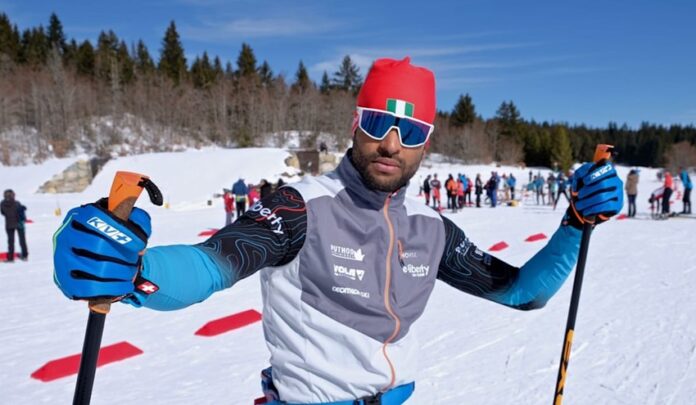
February 09, (THEWILL) — Samuel Ikpefan carried the Nigerian flag at the opening ceremony of the Milano Cortina 2026 Winter Olympics on February 6, and he did so alone. No teammates flanked him at the Predazzo Ski Jumping Stadium. For these Games, he is Nigeria’s entire Winter Olympic delegation, the sole representative of a country where temperatures rarely dip below 20° and snow exists only in photographs abroad.
Whilst Lagos and Abuja sweltered in the February heat, the Dolomite mountains of northeastern Italy lay buried under hard-packed snow, with temperatures in the Val di Fiemme valley hovering well below freezing. These two climates are connected by a 34-year-old cross-country skier who has made it his mission to prove that national identity transcends geography.
Ikpefan’s presence at these Games continues Nigeria’s consecutive appearance at the Winter Olympics, an unbroken streak that began in PyeongChang in 2018. That debut captured global attention when four Nigerian women competed in bobsleigh and skeleton, with Seun Adigun leading a team that included Ngozi Onwumere, Akuoma Omeoga, and Simidele Adeagbo. The bobsleigh team’s story resonated worldwide, bringing winter sport to a nation with no venue infrastructure or climate suited to skiing, ice skating, or sliding sports.

Four years later in Beijing, Ikpefan became the first Nigerian to compete in cross-country skiing and the first man to represent the country at a Winter Games. His Olympic debut, however, was marred by circumstances beyond his control. Upon arrival in China, he tested positive for COVID-19 and spent days in isolation, losing muscle tone and mental focus whilst confined to a hotel room. Released only two days before his first race, he finished 73rd in the men’s sprint freestyle and did not complete the 15-kilometre classic. He was, by his own admission, simply happy to have made it to the start line.
Milano Cortina represents redemption. Without pandemic restrictions and a clean run of training behind him, Ikpefan arrived in Italy as a competitor rather than a curiosity. On February 8, he competed in the men’s sprint classic at the Cross-Country Skiing Centre in Val di Fiemme, with the men’s 10-kilometre interval start free scheduled for 13 February. His goals are measured but meaningful: personal best performances and improved world rankings rather than improbable medal hopes. A finish in the top sixty would signal genuine competitiveness with professional skiers from established winter nations.
Born on December 19, 1991 in Annemasse, a French commune on the border with Geneva, Ikpefan holds dual French and Nigerian citizenship through his father, who hails from Edo State. Growing up in the shadow of the Alps, he learned to ski at five years old, developing early promise in a sport that demands an unusual combination of explosive power and marathon-runner stamina. For years he competed within the highly competitive French system before making the decision in 2018 to switch allegiance, honouring his father’s heritage and providing Nigeria with representation in a discipline where African nations remain historically invisible.
The transition required immense administrative work and personal sacrifice. He had to obtain his Nigerian passport, sort out his eligibility with the International Ski and Snowboard Federation, and fund much of his own training through Olympic Solidarity grants. Cross-country skiing demands expensive equipment, wax technicians, travel to snow-sure locations, and a caloric intake that would astonish the average person.
For the uninitiated, cross-country skiing might appear a leisurely glide through winter forests. In reality, it ranks among the most physically demanding sports in the Olympic programme. Unlike alpine skiing, where gravity provides momentum, cross-country skiers must generate their own power across flat terrain and up punishing hills. Physiologists often rank these athletes as having the highest VO₂ max scores of any competitors.
Ikpefan’s preparation for the 2026 Games has been meticulous. Training primarily in Switzerland, he focused on building power for the long, grinding climbs characteristic of the Val di Fiemme courses. He has also overcome anterior cruciate ligament and meniscus surgery, demonstrating a commitment that extends far beyond casual participation.
His presence in Italy carries significance beyond personal achievement. Ikpefan is part of a small but growing cohort. The 2026 Games feature only 15 athletes from the entire African continent, representing eight nations. This marks an increase from six athletes from five countries in Beijing. South Africa fielded the largest team with five athletes. Kenya, Morocco, and Madagascar sent two each. Benin, Eritrea, Guinea-Bissau, and Nigeria each have one. These athletes compete across alpine skiing, cross-country skiing, freestyle skiing, and skeleton, collectively demonstrating that winter sport is gradually extending its reach beyond traditional heartlands.
Critics sometimes dismiss such representation as “flag of convenience” athleticism, but this view ignores genuine effort to connect with heritage. Almost all African representatives at these Games are diaspora members, born or raised in Europe or North America, yet their presence validates an important principle: that a Nigerian belongs on skis just as legitimately as on a football pitch or running track.
The mental challenge of being a solitary representative cannot be understated. Summer Olympic delegations enjoy community and collective support. In the Winter Village, Ikpefan relies on his personal team and the solidarity of other small-nation athletes. Yet when he climbs the final hill in the 10km race, the cheers from knowledgeable Nordic crowds will likely be loud, not because they expect him to win gold, but because they respect the audacity of his presence.
When Ikpefan pushes out of the start gate in Val di Fiemme, fighting the friction of snow and the burning in his muscles, he proves that national identity is not bound by climate. He is the cold-weather warrior for a hot-weather nation, and for these two weeks in February, he walks that path alone. His legacy will not be measured in medals but in the doors he opens and the boundaries he expands for what a Nigerian athlete can be.

Jude Obafemi is a versatile senior Correspondent at THEWILL Newspapers, excelling in sourcing, researching, and delivering sports news stories for both print and digital publications.