Unrestrained fanaticism and unbridled passion are two explosive ingredients that often metamorphose into acts of brigandage and violence when an adrenaline-filled game like football is involved and when an unruly set of fans are on rampage. Easily explained as fan exuberance in its more positive light of the exhilaration, excitement and elation, when winning, or pain, agony and tears, when losing, it always carries a tendency to go to extremes with a trail of acts of violence, destruction, blood and deaths in its wake. When combined with irresponsible policing, the illegal use of tear gas in confined spaces as these stadiums often aren and the violent employment of batons in a failed attempt at crowd control, all the ingredients for disaster are at hand. That was how it came to be that no fewer than 131 people died in the early hours of Sunday last week in the post-match stampede at the venue of a domestic game between local rivals in Indonesia to become one of the deadliest stadium fatalities in history.
There was an indication that violence could erupt during the game from the onset. It was concerning to authorities, given the rivalry and the precedence of bad blood that existed between the two clubs: Arema FC and Persebaya Surabaya. The October 1 fixture was billed for a late kickoff but so concerning was the threat of violence that the football association of the domestic League mulled the decision to shift it to a daytime match to minimise the dangers that a breakdown of law and order posed for the players, match officials, fans, residents and police, as well. The very concrete basis for this trepidation was grounded on a history of tensions that have their origins outside football itself. It dates to the rivalry between Surabaya, Indonesia’s second-largest city and the locale of the Persebaya Surabaya club, and Malang, about two hours’ drive away, which is home to Arema FC.
Both cities have been making the case to being the best city in East Java and this has been fraught with such animosity that the locals have become incompatible with one another. In the 1980s, there was a perception in Surabaya that the inhabitants of Malang did not know how to conduct themselves because they had caused trouble in other people’s cities, specifically by making noise and upsetting the populace of Surabaya with their actions and remarks. On the other hand, Malang people regard Surabaya residents as erratic and unreliable. The antagonistic split between these two neighbouring but rival residents reached the point that the mutual hostility infiltrated their football, making it a boiling pot on the verge of tipping over. Indeed, there have been clashes between fans of both clubs that were destructive. For instance, after a brawl involving these fans in February 2020, the result was damage totaling 250 million rupiah ($18,000). Recently, during and following the East Java Governor’s Cup semifinals, which saw Persebaya defeat Arema 4-2, fights were reported outside the stadium.

It was therefore understandable why the All-Indonesian Football Association (abbreviated as PSSI) was pensive ahead of the October 1 encounter between the sides and did not think it was a good idea to have the match played late in the day. However, a set of precautionary measures were taken to retain the late kickoff. All visiting fans, of Persebaya were disallowed from the game and the number of security personnel deployed to the stadium to keep the peace was beefed up to present a show of force that will discourage indiscipline. Details that will emerge in the aftermath of the tragedy will demonstrate that these policemen were of the opinion that they were entering a situation with the potential to become hostile and came ready to dispel any disturbances in much the same way that they did in riot instances.
Furthermore, there were conditions that predisposed any crisis occurrence to end with a string of causalities. The Kanjuruhan Stadium, the venue of the fixture, was supposed to have only 38,000 fans in its 42,000 capacity, especially as visiting fans were barred from watching live. It was capped at 38,000 to make for better spacing and better opportunity to handle crowd control. The authorities did not pay attention and, on October 1, in the match between rival teams with historically fractious fans, an overly excited match organiser provided 42,000 tickets for willing buyers desirous to watch the match live in the stands, filling the grounds beyond capacity and creating the very undesirable conditions for mayhem should anything untoward occur. And, occur it did because, frustrations that were building up as the game went on obviously boiled over when the visiting side, with no fans of theirs in the stadium, beat the host team, whose 42,000-strong supporters were left bitter to have suffered their first League defeat in 23 years to their biggest rivals. Unable to logically process the loss and seized by football frenzy, some 3,000 fans broke protocol and invaded the pitch after initially pelting the players with whatever objects they could lay their hands on such that the players had to be shepherded to the dressing rooms under police protection.
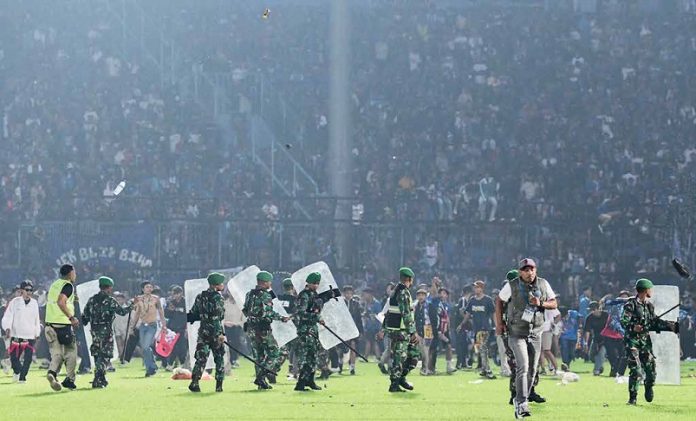
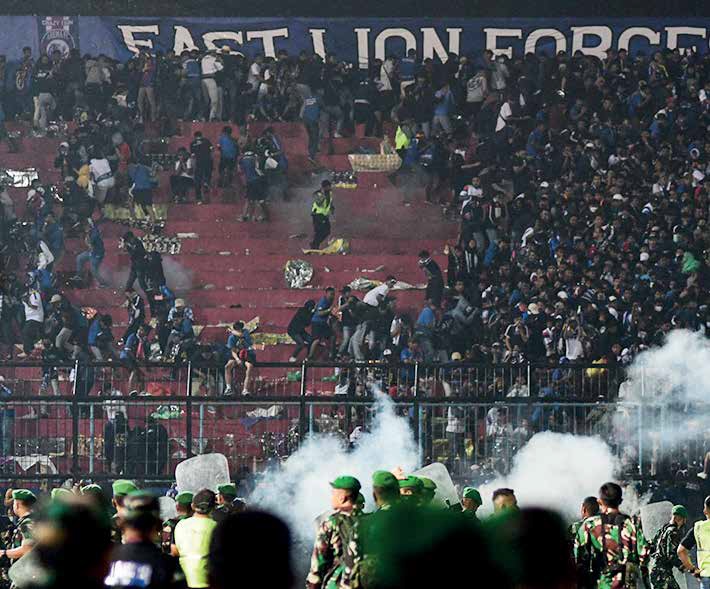
The pitch invasion was the trigger that sparked the viral scenes that showed the police deployment of tear gas and brutal use of their riot gear, consisting of shields and batons, in their violent and repressive attempts to restore order. That they shot some of the tear gas canisters at stands crowded with fans, specifically stands 10-14, meant that overly petrified supporters were left with little choice, no time and a rapidly closing window to find an escape. The fact that the stadium was overcrowded and the frantic determination of these fans to escape the debilitating effects of the tear gas, the antics of the police and the desperation of other fans created panic that only fuelled the melee and exacerbated the stampede. By the time the dust settled, the deaths were in over a hundred, with the youngest being a two-year-old boy, among the 31 other children who lost their lives in the incident. The harrowing experience was so traumatic that some of the dying fans breathed their last in the arms of a few of the players.
Widespread condemnation naturally followed and it came from the very top as the Indonesia President, Joko Widodo, insisted on an immediate investigation to fish out those responsible while demanding for stadiums across the country be reviewed for safety to avoid any such recurrences. In the televised address the President delivered in the immediate aftermath of the tragic event, he directly ordered the Indonesian Football Association chief, National Police chief, and Country’s Minister of Sports and Youth Development, “to conduct a thorough evaluation of football matches and the security procedures”. Also, amidst the charred remains of torched vehicles, including a police truck, Zainudin Amali, Indonesia’s Sports and Youth Minister, suspended the league, apologised and promised to act especially in view of the fact that the country is billed to host the Under-20 World Cup next year and is bidding for joint-hosting of the Asian Cup alongside South Korea and Qatar after China relinquished its hosting rights in May.
The actions from the investigations have also been swift after the government apologised and promised to investigate in the midst of national outcry and widespread condemnation of police brutality and the handling of the match by the regulators. Five days after, Police Chief Listyo Sigit Prabowo revealed that three police officers and three individuals in charge of the game’s security, including the chairman of the organising committee for Arema FC and one of the club’s security personnel have been charged with negligence causing death. The police officers under investigation gave orders for their colleagues to use tear gas. The third police officer under investigation, despite being aware of FIFA safety rules prohibiting the use of crowd control teargassing at pitchside, did not stop his colleagues from using tear gas. If proven guilty, the suspects could receive a maximum term of five years in prison. In addition, the head of the Arema FC organising committee and a security officer had already been permanently barred from football by the Indonesian Football Association. Meanwhile, a tearful Arema president Gilang Widya Pramana apologised to the victims of the stampede and said he took full responsibility for the disaster.
The avoidable tragedy is a veritable lesson for the football world, especially when passions seize hold of the senses and induce fans into a lawless herd that take laws into their fans to cause havoc. It is reminiscent of the pitch invasion that occurred after the Super Eagles’ 1-1 tie with the Black Stars of Ghana in a 2022 World Cup playoff on March 29, this year. The draw meant Nigeria was going to miss out of the Qatar tournament and enraged Super Eagles’ fans flooded the grounds at the Moshood Abiola National Stadium in Abuja, forcing police to use tear gas to remove them. There were several instances of vandalism carried out by these pitch-invaders, which left some parts of the recently refurbished Stadium wrecked and advertising boards defaced as security forces struggled to restore order.
Some of the players from Ghana and Nigeria were assaulted with debris and forced to quickly make their way into the locker rooms before it escalated ominously.
Following an analysis of the official match report, FIFA fined the Nigeria Football Federation 150,000 Swiss Francs (roughly N64m) for the incident and mandated that the Super Eagles play one competitive encounter behind closed doors. Although the death of doctor Joseph Kabungo, who was the anti-doping officer for the match and a member of the CAF and FIFA Medical Committees, followed, his death of cardiac arrest was unrelated to the pitch invasion.
Yet, the warning is clear for all parties involved as the world joins in the mourning of the 131 lives lost. The fans must keep their enthusiasm and energy in check whilst remaining within the stands at all times and use appropriate channels to register their grouses. Sufficient emergency control measures and exit strategies must be planned ahead of football matches especially games with a history of fan animosity and outrage. Match officials are to be as consistent in their decisions as is possible to remove any thoughts of partiality, bias or favour for one team or the other in the minds of the fans. Whenever the need to quell an outbreak of disorder, security personnel must be focused on deescalation rather than resorting to aggressive and repressive actions at the first signs of disturbance. They must also keep to the FIFA regulation 19b, which clearly states that tear gas should not be used in stadiums by pitchside stewards or police. It is hoped that the world will not experience a similar tragedy in future to taint the joy and excitement of the beautiful game.

Jude Obafemi is a versatile senior Correspondent at THEWILL Newspapers, excelling in sourcing, researching, and delivering sports news stories for both print and digital publications.