May 19, (THEWILL) – Nottingham Forest’s 2-2 draw with Leicester City last Sunday should have marked a moment of triumph, confirming their return to European football after three decades. Instead, the match sparked a public dispute that revealed the intense emotions and high stakes within a club chasing UEFA Champions League qualification. At the centre of this storm was Nigerian striker Taiwo Awoniyi, whose serious injury during the game led to a medical misjudgment, a heated exchange between owner Evangelos Marinakis and head coach Nuno Espírito Santo and a broader discussion about player safety and club dynamics.
The match against Leicester City was a critical moment for Forest. Sitting seventh in the English Premier League with two games remaining, they were one point behind fifth-placed Chelsea and three behind fourth-placed Manchester City. A victory would have lifted them into the UEFA Champions League places, a remarkable feat for a club that had fought relegation battles in the previous two seasons. The game began poorly, with Leicester taking the lead in the 16th minute through Conor Coady, who headed in after goalkeeper Matz Sels parried a shot from Bilal El Khannouss. Forest equalised through Morgan Gibbs-White and took the lead in the 56th minute with a goal from Chris Wood, his 20th of the season. However, Leicester’s Facundo Buonanotte levelled the score in the 81st minute, denying Forest a crucial win. The draw brought European football, likely the UEFA Europa League or Conference League, to the Nottinghamshire club but dented their hopes of a top-five finish.
The defining moment came in the 88th minute. Awoniyi, who had come on as a substitute in the 83rd minute, stretched to meet a cross from Anthony Elanga and collided heavily with a goalpost. The impact, compounded by Leicester’s Buonanotte also hitting the post, left Awoniyi in visible pain. He received several minutes of treatment on the pitch, during which the medical team assessed his condition. Controversially, they cleared him to continue, despite his evident discomfort. With Forest having already used their final substitution, replacing Elliot Anderson with Jota Silva in the first minute of stoppage time, Awoniyi remained on the field, hobbling and unable to contribute effectively. This left Forest playing the final stages with what was effectively 10 men, hampering their chances of finding a winner.

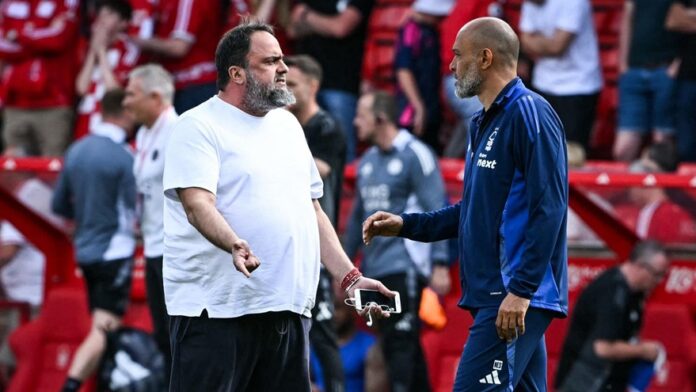
The decision to allow Awoniyi to continue sparked immediate repercussions. At the final whistle, Evangelos Marinakis, Forest’s owner, walked onto the pitch, visibly agitated. Initially appearing to head elsewhere, he engaged in a brief but animated exchange with Nuno Espírito Santo, who was speaking with Leicester’s Oliver Skipp. The conversation, captured on television, lasted only seconds, ending with Marinakis throwing his arms wide in exasperation and kicking a training cone as he left the field.
Nuno, however, defended Marinakis in his post-match press conference. He attributed the owner’s reaction to a “miscommunication” between the coaching and medical staff, which led to Awoniyi remaining on the pitch. He described Marinakis’ passion as a driving force behind Forest’s progress, stating that the owner’s desire for improvement had pushed the club to its current heights. Marinakis later issued a statement on Instagram, congratulating the team on their European qualification but acknowledging the shared frustration over the handling of Awoniyi’s injury. He emphasised that the incident reflected the deep emotional investment of everyone at the club, from players to supporters. Forest, as a club, also released an official statement, dismissing reports of a confrontation between Marinakis and Nuno as “fake news” and criticising “baseless” outrage from pundits and former players. The club urged public figures to avoid rushing to judgment, arguing that such commentary served no one, least of all the injured player.
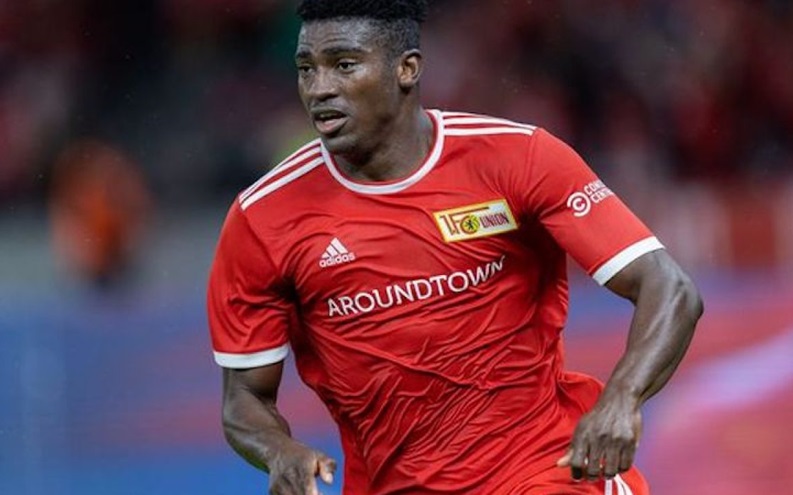
The severity of Awoniyi’s injury became clear in the days following the match. The day after, further medical checks revealed a ruptured intestine, a condition that can be life-threatening in some cases. Awoniyi was rushed to the hospital for urgent abdominal surgery. The operation was complex, requiring a second procedure on Wednesday. To stabilise his condition and restrict movement, medical staff placed Awoniyi in an induced coma, a decision made for his comfort and to regulate his heart rate. Forest confirmed on Tuesday, May 13, that the surgery had been successful and that Awoniyi was recovering well, though he remained in intensive care. The club’s statement underscored the physical risks of football and reiterated their commitment to player welfare, a principle they said was deeply held by Marinakis.
The incident raised questions about the medical team’s judgement. Sources close to Forest, as reported by The Athletic, suggested that the decision to clear Awoniyi was a collective error rather than the fault of any individual. The medical staff’s initial assessment underestimated the injury’s severity, a mistake that became apparent only after post-match evaluations. The situation was complicated by the timing of Forest’s substitutions. Had Awoniyi been substituted immediately after his collision, the team might have maintained 11 fully fit players for the final minutes. Instead, the misjudgment left them vulnerable at a critical juncture, fuelling Marinakis’ frustration.
The controversy was further amplified by the circumstances leading to Awoniyi’s injury. Elanga, who provided the cross, was in an offside position when he received the ball, but the assistant referee delayed raising the flag, following International Football Association Board guidance aimed at preventing valid goals from being wrongly disallowed. This rule, in place since 2021, has been contentious, and Awoniyi’s injury prompted renewed calls for its review. Former player Stephen Warnock, speaking on Sky Sports’ Ref Watch, argued that “common sense” should prevail in clear offside situations to prevent such incidents.
Awoniyi’s injury also cast a spotlight on his importance to Forest and Nigeria. The 27-year-old striker has been a key figure for both club and country. Despite limited game time this season due to competition from Chris Wood, Awoniyi’s physical presence and finishing ability have made him a fan favourite. His injury history, including a groin issue that sidelined him for months in 2023, has been a recurring challenge, but his determination to return stronger has endeared him to supporters. In Nigeria, where football is a unifying force, Awoniyi’s plight prompted an outpouring of support on social media, with fans and media outlets closely following his recovery.
Forest’s season, meanwhile, remains a story of remarkable achievement. Under Nuno’s leadership, the club has transformed from relegation candidates to European contenders. Their seventh-place position, with 62 points from 36 matches, reflects a campaign of consistency and ambition. The final two games, against West Ham United on May 18 and Chelsea on the last day, offer a chance to secure a UCL spot, though they will need favourable results elsewhere. The draw with Leicester, while disappointing, guaranteed at least a place in the UEFA Europa League or Conference League, a testament to Nuno’s tactical acumen and the squad’s collective effort.
The incident also raised questions about Marinakis’ role as owner. His passion, while a driving force, has occasionally courted controversy. Earlier in the season, he received a five-game stadium ban for spitting on the floor as match officials passed him after a defeat to Fulham. His ownership of Olympiacos, the Greek champions, adds complexity, as UEFA rules prohibit owners from having decisive influence over multiple clubs in the same competition. Forest’s compliance with these regulations, through a blind trust for Marinakis’ shares, ensures his continued involvement, but his visible presence on the pitch against Leicester underscored his hands-on approach.
The broader context of Forest’s season reveals a club at a crossroads. The pressure of chasing Champions League qualification has tested their mental and physical limits, with players showing signs of fatigue in recent weeks. Yet, their achievement in bringing European football home again after 30 years evokes memories of the club’s glory days under Brian Clough, who famously dismissed doubters during their 1979 European Cup campaign.
Regarding Awoniyi’s current state, recent updates indicate positive progress. On May 14, Forest confirmed that Awoniyi was brought out of the induced coma following the completion of his surgery. He remains in hospital under close monitoring but is now with his family, a significant step in his recovery. Nuno, speaking ahead of the West Ham match on May 16, expressed hope that Awoniyi could join the squad in a supportive capacity before the season’s end, though his return to playing is likely months away. The club and fans continue to rally behind him, with messages of support flooding social media.
Still, the Awoniyi incident encapsulates the passion, pressure, and peril of Nottingham Forest’s 2024/2025 season. If anything, it highlights the fine margins that define success in the EPL, from medical decisions to officiating protocols. While the confrontation between Marinakis and Nuno drew headlines, it also revealed a club united by ambition and emotion. Awoniyi’s recovery, though ongoing, offers hope, and Forest’s European journey promises to be a fitting reward for their remarkable campaign. Whether they can climb into the top five remains uncertain, but their story is already one of defiance and determination.

Jude Obafemi is a versatile senior Correspondent at THEWILL Newspapers, excelling in sourcing, researching, and delivering sports news stories for both print and digital publications.