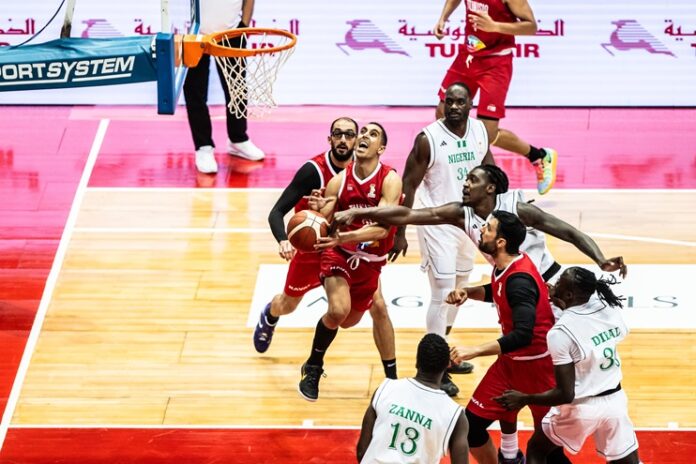
November 30, (THEWILL) — Nigeria’s journey towards the 2027 FIBA World Cup began not with triumph but with a sobering lesson in the unforgiving nature of international basketball. On Thursday night in Radès, the D’Tigers fell 88–78 in overtime to Tunisia, a result that laid bare the fragility of a squad attempting to rebuild its continental standing whilst battling against the clock. For a team ranked eighth in Africa and still recovering from the indignity of missing the 2023 World Cup entirely, the defeat served as an immediate and uncomfortable reminder that ambition alone cannot substitute for cohesion.
The match unfolded as a tightly contested affair for much of regulation time. Nigeria opened with purpose, taking a 15–12 lead after the first quarter through energetic interior work, yet Tunisia responded sharply in the second period, outscoring the visitors 23–17 to establish a 35–32 advantage at the interval. Nigeria managed to draw level at 53–53 following the third quarter, and when both teams added 20 points in the fourth, regulation ended locked at 73–73. What followed in overtime, however, was decisive and damaging. Tunisia outscored Nigeria 15–5, exploiting transition opportunities with ruthless efficiency whilst the D’Tigers faltered under pressure.
Veteran forward Talib Zanna shouldered much of Nigeria’s burden, finishing with 22 points and eight rebounds across 31 minutes, whilst Morris Udeze added 10 points in support. For Tunisia, the backcourt pairing of Omar Abada and Oussama Marnaoui proved devastating, combining for 53 points as Abada recorded 29 points, four rebounds and five assists. Their composure in the closing stages underscored the gulf in experience and collective understanding between the two sides, qualities that proved insurmountable when the contest reached its critical juncture.

The statistics from the encounter tell an even starker story. Nigeria committed 25 turnovers, a catastrophic figure that Tunisia converted into 27 points. By contrast, the hosts coughed up possession just nine times, a disparity that speaks directly to the central challenge facing head coach Abdulrahman Mohammed. His squad, assembled hastily for this opening window of qualifiers, comprises nine players based abroad and three drawn from Nigeria’s domestic league. The former bring international exposure and technical polish honed in European and North American competitions, whilst the latter offer familiarity with the local game and an injection of energy. On paper, the blend appears sensible; in practice, however, the lack of preparation time has exposed dangerous fault lines.
Mohammed, a former D’Tigers captain who represented Nigeria at four AfroBasket tournaments between 2001 and 2007, inherited the role as interim coach in 2024 after serving as an assistant in previous campaigns. His task is not simply to win matches but to establish a tactical framework capable of functioning under immense pressure despite limited training time. Much of that framework rests on the shoulders of Chris Obekpa, the 32-year-old centre from Lagos Legends, whose shot-blocking prowess offers a defensive safety net for the entire team. Obekpa’s ability to protect the rim allows perimeter defenders such as captain Stanley Okoye and Ike Nwamu to press aggressively, secure in the knowledge that any penetration will be met by a last line of defence. This arrangement is essential for a team with scant opportunity to master complex defensive rotations, yet it places enormous responsibility on a single player.
On the offensive end, the absence of intricate set plays forces Nigeria to rely heavily on isolation and transition opportunities. Nwamu, who returned to the squad after missing recent duties and averaged 18 points per game for his Turkish club last season, is expected to stabilise proceedings and prevent the attack from devolving into chaotic individual efforts. Against Tunisia, however, he managed just nine points, and the 25 turnovers confirmed that fluency remains elusive. The friction between the professional polish of the foreign-based contingent and the more physical, improvised style of the home-based players has yet to be resolved, creating a turnover-to-assist ratio that speaks to deeper issues of communication and trust.
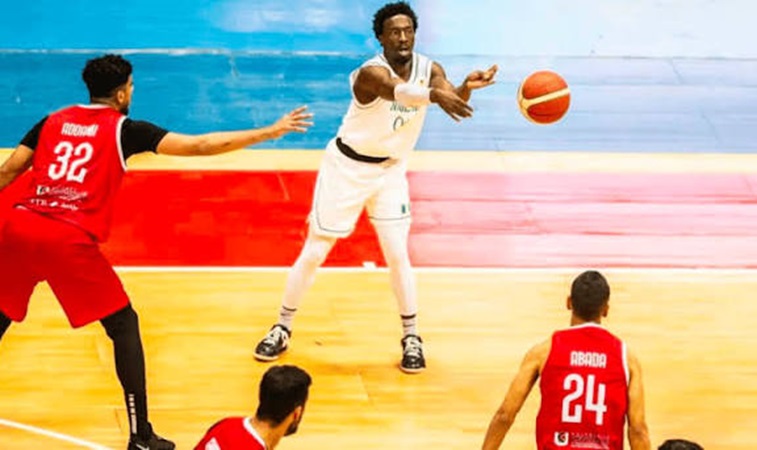
The defeat places added urgency on Nigeria’s remaining fixtures in this window. On Saturday, the D’Tigers face Rwanda, a side that lacks Nigeria’s individual talent but operates within a stable, well-defined system under coach Cheick Sarr. Rwanda will not attempt to overpower Nigeria athletically; instead, they will seek to exploit defensive lapses through superior execution and tactical discipline. For Nigeria, this demands precision in communication and movement, qualities that were conspicuously absent against Tunisia. The final match of the window, against Guinea on Sunday, presents a different challenge entirely. Guinea’s physical, interior-focused style, built around bruising frontcourt play, will test Nigeria’s rebounding ability and frontcourt depth. If Zanna and Udeze cannot control the glass, fatigue and second-chance points could prove decisive.
This opening window, therefore, represents more than a simple qualification hurdle. It serves as a stress test of Nigeria’s current identity and structure, revealing whether individual talent can overcome the deficit of collective preparation. The qualification route extends until March 2027, with only the top three teams from Group C advancing to the second round and ultimately five African nations securing passage to Doha. Early failures will compound pressure on future windows, when player availability becomes even more uncertain due to club commitments. For Mohammed’s side, the immediate task is measurable improvement across three key areas: reducing turnovers below 15 per game, ensuring meaningful contributions from the bench, and maintaining defensive rebounding discipline, particularly against Guinea’s physicality.
Nigeria’s basketball tradition includes some of the continent’s finest talents, and the nation claimed its sole AfroBasket title in 2015 with Okoye among the victorious squad. Missing the 2023 World Cup due to internal disputes and roster instability heightened expectations for redemption, yet this defeat in Radès confirms that the path back to global competition will be arduous. The blend of veterans such as Okoye and Nwamu with emerging domestic players like Chinkpa Cohesion and Paul Dibal offers promise, but promise alone will not secure qualification.
As the window progresses, fans and analysts will scrutinise not merely results but the manner in which the team responds. Whether patterns of turnovers disappear, offensive balance emerges and defensive intent becomes consistent will reflect more than raw talent; it will reveal discipline, unity and focus. The burden of accountability now lies squarely with the D’Tigers. The opening-day loss to Tunisia will be remembered not simply as a result but as a moment of truth, one that confirmed the difficulty of the task ahead whilst illuminating precisely what must change if Nigeria is to reclaim its place among Africa’s elite.

Jude Obafemi is a versatile senior Correspondent at THEWILL Newspapers, excelling in sourcing, researching, and delivering sports news stories for both print and digital publications.