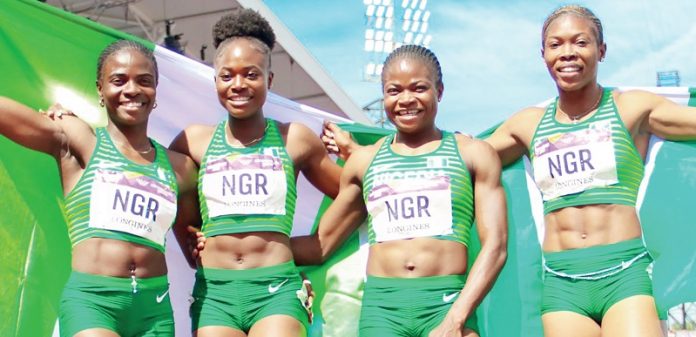
August 15, (THEWILL) – With its best-ever performance at the Commonwealth Games, Team Nigeria finished the 2022 event held in Birmingham with a handful of new records, carting home 12 gold, 9 silver, and 14 bronze medals to finish in the seventh position and earn a new ranking as the highest-ranked African country among the participating nations.
It meant that the Nigerian contingent surpassed the previous best record that the country had managed in the history of the Commonwealth Games, when in 1994, Nigeria won 11 gold medals. Yet, the more remarkable aspect of this epoch-making outing was the fact that every one of the historic gold medal run was won by a female athlete to the point where not a few Nigerians wondered if the male athletes were not competing sat the Games. So dominant were the displays of the women that every time there was a Nigerian national anthem played across the duration of the event, it was a female victoriously standing at the top of the podium making the country proud, over and over again.
Without exception, Nigeria’s best ever Commonwealth Games record owes its place to the outstanding displays that these women produced to stay ahead of the competition from other commonwealth countries, who were champions in their own rights. At each event that returned a gold medal, the Nigerian woman (or women, in the case of the 4×100-metre relay event) did not relent in their persistent pursuit of excellence but strived even more to outperform the competition and earn the glorious applause of champions and earn the country a place of honour among the Commonwealth. From the 100m hurdles, long jump and relays to weightlifting, wrestling and shot put, the women stood up to be counted in gold. Even in the women’s discus event, there was a woman in the traditional Nigerian green-white-green to stake a claim for the gold medal and win it proudly.

Before Team Nigeria took to the tracks to leave a trial of gold medals, the weightlifters and powerlifting athletes were making a statement. It began when Adijat Adenike Olarinoye followed up the silver medal she won at the World Wrestling Championship in Tashkent, with her first Commonwealth Games gold in Birmingham.
The 23-year-old lifted a total of 203 kg in the women’s 55 kg weightlifting competition to claim the gold medal. Olarinoye opened the record-breaking feat for the Nigerian women as she broke two records in the women’s 55kg weightlifting Snatch category, lifting 90 and 92 kg in 10 minutes. Right behind her was Rafiatu Folashade Lawal, the clear favourite for the women’s 59kg weightlifting coming into the Games. The 25-year-old was boasting of a four-gold-medal haul from international tournaments, beginning with the African Games in Rabat in 2019; the 2021 African and Commonwealth Championships. Not only did she live up to expectations but made sure to claim gold at her first Commonwealth Games with a new Games record of 206kg from her snatch and clean and jerk lifts.
They set the tone for the dominating displays that brought the gold medals and record breakers from the women arm of Team Nigeria. Chioma Onyekwere, the defending champion of the All African Games and the African Championships, won the third gold medal for Nigeria in the women’s discus event, becoming the first Nigerian woman to do so at a competition. With her 61.70-metre fourth throw, the US-based 28-year-old mechanical engineer at Ford Motors passed local girl Jade Lally, who had held the lead since in the event with her first throw of 57.33m. After South African Elizna Naude won gold at the 2006 Melbourne Olympics, she became the second African woman to ever win a gold medal at the Commonwealth Games.
Then, the spectacular para-athlete Goodness Nwachukwu put on a show for the audience at Birmingham’s Alexander stadium by shattering not just one but two world records in short succession to win the women’s Discus F42-44/61-64 event for Nigeria’s fourth gold.
Folashade Oluwafemiayo did not want to be left out and broke her record to win gold in the women’s Heavyweight para Powerlifting event. The Paralympic champion was in an incredible form, lifting a new world record of 155kg to victory for her first gold medal at the Games.
The sixth gold belonged to Odunayo Folasade Adekuoroye, who may not have broken a record but triumphed in the final of the Women’s Freestyle 57 kg wrestling event, defeating India‘s Anshu Malik by points (7-3) to claim gold. Nigeria earned a second gold medal in wrestling soon after as Blessing Oborududu, participating in the 68kg women’s freestyle division final, comfortably defeated Canadian opponent Linda Morais. Oborududu had previously won gold at the 2018 Commonwealth Games, making her a two-time winner at the Games.
There was one more wrestling gold as Genesis Miesinnei Mercy defeated Canada’s Parks Madison in the Women’s Freestyle 50kg event, taking a 3-1 VFA (victory by fall) win.
Amazingly, 48-year-old Eucharia Njideka Iyiazi got in on the record-setting act, clinching the gold medal with a new Games record in the women’s shot put F55-57 event. The two-time Paralympic champion and world record holder registered a throw of 10.03m on her fifth attempt to record her season’s best performance in the final Para athletics field event at the Alexander Stadium.
Then, it was time for Oluwatobiloba Ayomide Amusan to continue her record-setting in the 100-metre hurdles as the Nigerian won the gold medal with a record time of 12.30 seconds in the women’s event. She not only successfully defended her Games crown, but also currently holds the Nigerian record, African record, Commonwealth record and World record in the 100m hurdle with only the Olympics record outside her collection.
Nigeria won the 4×100-metre Women’s Relay with a team comprising Amusan, Favour Ofili, Rose Chukwuma and Grace Nwokocha to claim Nigeria’s 11th gold medal at the Commonwealth Games in Birmingham and set a new African Record of 42.10s. It was left for Ese Brume to cap it all up by another Commonwealth long jump gold with a 7.00-metre leap that surpassed the competition record of 6.97 metres set by Bronwyn Thompson.
There were medals for Nigeria in other medal categories (9 silver, and 14 bronze medals) and the male athletes, including some other female contingent featured, but this was a record of the dominant display of Nigeria’s gold medal and record-breaking female champions, whose performances brought the best Nigeria has ever accomplished in the Commonwealth Games annals.
Many of these champions benefited from sports scholarships and improved their talents through regular collegiate competitions. They had very minimal assistance from the sporting federations in Nigeria, such as Amusan’s inclusion in the Adopt-An-Athlete initiative of the Sports Ministry, when her State governor, Dapo Abiodun of Ogun State agreed to adopt her, but the Nigerian government was quick to own their excellence at the Birmingham Games. Of course, their victories rub off on the government but it is not enough for the government to take claim of the accolades their victories have brought the country.
What must be the lesson from their successes is government’s accepting that they have been lagging behind in giving female sports the level of support that their male compatriots enjoy with football as a telling example. The most successful African national football team is the Super Falcons and yet the ladies had to stage a protest and sit out a training session to get government’s response to a backlog of bonuses and allowances due them. It is unfair treatment for a team that has not stopped, until recently, to bring glory to the country as Asisat Oshoala gave evidence to when she won a historic fifth African Footballer of the Year honour. The support of our female teams and athletes must become a priority now, as should the males too, to give them the onus to continue this outstanding level of performance all the way to the next Olympics in Paris. The women ought to also be recognised with national honours and gifts accordingly to show government’s appreciation of their excellence and act as a spur to encourage others to emulate and even surpass their accomplishments. That is how we can celebrate them and what they have brought Nigeria at Birmingham.

Jude Obafemi is a versatile senior Correspondent at THEWILL Newspapers, excelling in sourcing, researching, and delivering sports news stories for both print and digital publications.