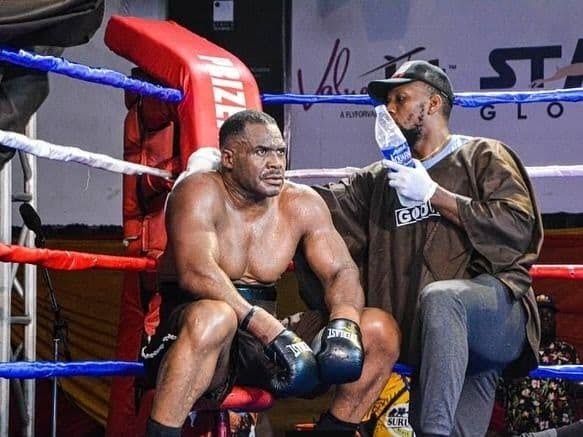
August 25, (THEWILL) — On 23 August 2025, Ike Ibeabuchi, a 52-year-old Nigerian heavyweight, stepped into the ring at Teslim Balogun Stadium in Lagos, ending a 26-year absence from professional boxing with a third-round stoppage of Idris Afinni. The crowd, numbering over 5,000, roared as Ibeabuchi, weighing 240 pounds, unleashed a barrage of body shots that floored the 40-year-old Afinni at 1:47 of the round.
Once dubbed “The President” for his commanding ring presence, Ibeabuchi preserved his undefeated record, now 21 wins with 16 knockouts. Post-fight, he issued a bold challenge to undisputed heavyweight champion Oleksandr Usyk, declaring, “I remain undefeated and dangerous, Usyk, come face me.” This marked his first bout since a 1999 knockout of Chris Byrd, a victory that had positioned him as a contender for Lennox Lewis’s crown before legal troubles halted his ascent. The Lagos fight, sanctioned by the Nigerian Boxing Board of Control, stirred both local pride and global debate over the ethics of his return.
Ibeabuchi’s early career defined him as a prodigy. Born in Isuochi, Nigeria, in 1973, he relocated to Dallas, Texas, as a teenager and turned professional in 1994 at age 21. His relentless style, marked by high punch output and an iron chin, earned him swift recognition. In 1997, he outlasted David Tua in Sacramento, California, in a 12-round war where both men threw over 1,000 punches, a record for heavyweight bouts at the time.

Two years later, he stopped Chris Byrd in Tacoma, Washington, with a fifth-round knockout, cementing his status as a future champion. Promoters praised his blend of speed, power, and stamina, with some comparing him to a young Mike Tyson. Yet, even then, reports of erratic behaviour surfaced, hinting at the mental health challenges that would later emerge. By 1999, Ibeabuchi stood on the cusp of a title shot, with a 20-0 record and a reputation as the division’s most feared prospect.
In July 1999, Ibeabuchi’s career collapsed following his arrest in Las Vegas for sexual assault and battery at the Mirage Hotel. Convicted in 2001, he received a sentence of up to seven years, extended by parole violations to over 16 years in Nevada prisons. Court documents cited diagnoses of schizophrenia and bipolar disorder, which complicated his incarceration and sparked debates over his mental state during the crime.
Released on parole in 2015, he faced deportation to Nigeria in 2016 after visa complications, ending hopes of a U.S. comeback. In Nigeria, Ibeabuchi trained sporadically, often in obscurity, while battling licensing rejections in multiple jurisdictions. He consistently maintained his innocence, stating in a recent interview: “They took my prime, but my spirit remains unbroken.” His return to the ring required navigating regulatory hurdles, with Nigerian authorities granting approval only after medical evaluations confirmed his physical fitness, though questions lingered about long-term health risks.
The Lagos bout revealed both Ibeabuchi’s enduring strengths and the toll of time. Against Afinni, a journeyman with limited recent fights, Ibeabuchi appeared tentative in the opening round, absorbing jabs as he shook off ring rust. By the second, his instincts resurfaced: a right hook staggered Afinni, followed by a left to the body that set up the third-round finish. Though neurologists have often warned of heightened concussion risks for boxers over 50, Ibeabuchi appeared unfazed as he retained power punches but slower footwork compared to his 1990s peak.
Ibeabuchi’s callout of Usyk, the 38-year-old Ukrainian holding the WBA, WBC, and WBO titles, ignited speculation about his future. While his victory can be celebrated as a symbol of perseverance, the debate over the legitimacy and safety of allowing a 52-year-old challenge for boxing bouts remains. Most Boxing Boards of Control would straightaway deny Ibeabuchi a licence due to his age and history, limiting potential bouts in major markets. His story might mirror boxing’s complex redemption arcs, such as George Foreman’s title win at 45, yet, his more advanced age and history as a convicted offender present very realistic hurdles.
Still, Ibeabuchi remains defiant, training daily and eyeing regional fights to build momentum. Whether his comeback proves a fleeting moment of glory or a path to renewed relevance, it raises profound questions about second chances, the physical limits of ageing athletes, and the moral boundaries of a sport that thrives on spectacle.

Jude Obafemi is a versatile senior Correspondent at THEWILL Newspapers, excelling in sourcing, researching, and delivering sports news stories for both print and digital publications.