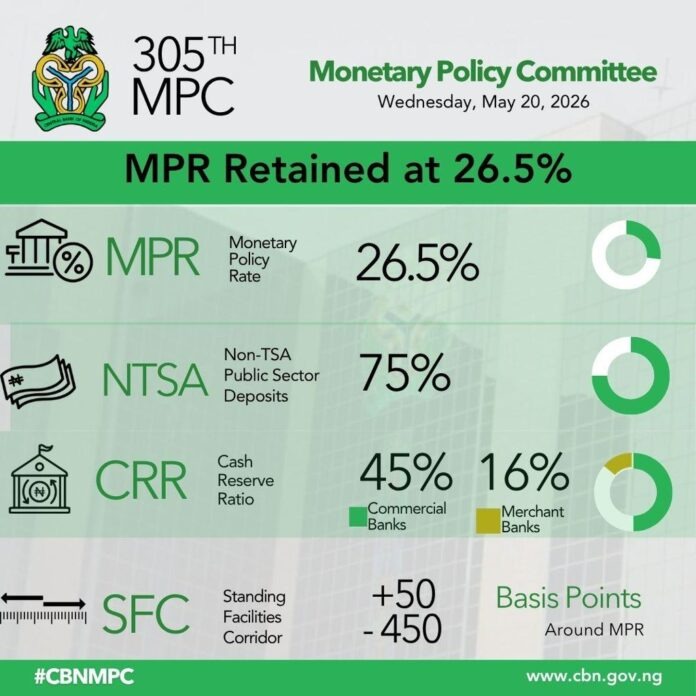
May 20, (THEWILL) — The Monetary Policy Committee (MPC) of the Central Bank of Nigeria has retained the Monetary Policy Rate (MPR) at 26.5 percent, reaffirming the apex bank’s cautious but confidence-driven approach towards sustaining macroeconomic stability, curbing inflation and strengthening investor confidence in the Nigerian economy.
The decision was reached at the conclusion of the MPC’s 305th meeting held in Abuja, where all 11 members in attendance voted to maintain existing monetary policy parameters.
The Governor of the Central Bank of Nigeria, Olayemi Cardoso, announced the outcome of the meeting on Wednesday, stating that the Committee resolved to retain the benchmark interest rate at 26.5 percent.

Beyond the retention of the Monetary Policy Rate, the Committee also voted to maintain the Cash Reserve Ratio (CRR) at 45 percent for Commercial Banks and 16 percent for Merchant Banks, while retaining 75 percent for non-Treasury Single Account (non-TSA) public sector deposits.
The MPC further retained the asymmetric corridor around the MPR at +50 and -450 basis points for the Standing Lending and Deposit Facilities.
According to Cardoso, the Committee considered recent domestic and global economic developments before arriving at its decision to sustain all key policy parameters at their current levels.
“The Committee resolved to retain the Monetary Policy Rate at 26.5 percent”, Cardoso stated while briefing journalists after the meeting.
The latest decision follows the MPC’s 50-basis-point reduction in February 2026 and a previous hold announced during the November 2025 policy meeting, reflecting what analysts describe as a careful and measured monetary policy approach to consolidate recent economic gains.
By maintaining the benchmark interest rate and associated policy instruments, the apex bank signalled its determination to continue monitoring inflation trends, exchange rate stability and liquidity conditions while ensuring stability within the financial system.
The retention of the CRR and standing facilities corridor is also expected to help the central bank sustain tighter liquidity management across the banking system while preserving stability in the financial sector.
The Monetary Policy Rate remains the benchmark rate that influences lending costs, deposit rates and credit conditions within the banking industry, making MPC decisions critical to businesses, investors and households.
Since assuming office, Cardoso has consistently emphasised disciplined monetary policy, foreign exchange reforms and stronger policy coordination as essential pillars for restoring confidence in the economy and driving long-term growth.

Felix Ifijeh is a journalist with years of professional reporting experience. Known for his keen news sense, compelling storytelling and commitment to accurate, impactful reporting, he has built a reputation for turning leads into clear, engaging, and well-structured reports that resonate with readers. His work reflects deep newsroom experience and a commitment to accurate, impactful journalism.