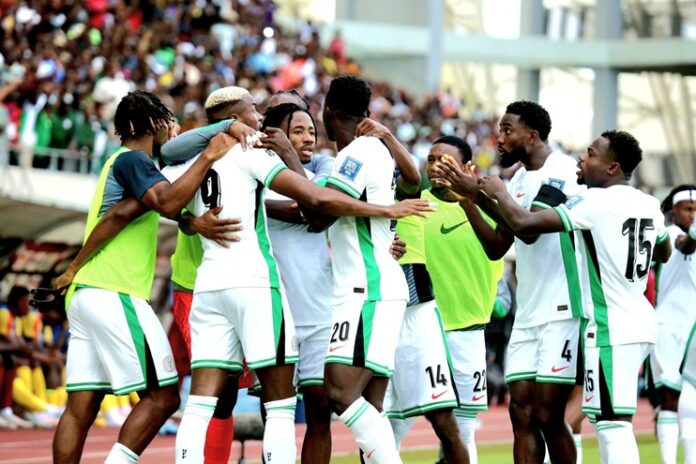
December 21, (THEWILL) — Nigeria’s Super Eagles departed Cairo this week with more questions than answers following a 2-1 defeat to Egypt in their final preparatory fixture before the Africa Cup of Nations. The match, played at the Cairo International Stadium on December 16, was intended as a confidence-building exercise ahead of the tournament in Morocco. Instead, it exposed defensive frailties and tactical uncertainties that head coach Eric Chelle must resolve within days if his side are to mount a credible challenge for a fourth continental title.
The result marked Egypt’s first victory over Nigeria in a decade, though both camps insisted the scoreline mattered less than the lessons extracted. Yet the manner of the defeat will trouble Chelle. Egypt took the lead in the 28th minute when Ahmed Zizo, operating with menacing freedom down the right flank, delivered a low cross that found Mahmoud Saber unmarked to tap home from close range. The ease with which Saber ghosted into space reflected poorly on Nigeria’s defensive organisation, particularly the positioning of left-back Zaidu Sanusi, who struggled throughout the opening period to contain Zizo’s movement.
Nigeria’s response came in first-half stoppage time through an unlikely source. Sanusi, seeking redemption, delivered a free kick from the left that Egyptian goalkeeper Mohamed El-Shenawy failed to collect cleanly. The loose ball fell to Chidozie Awaziem, who reacted quickest to head Nigeria level from close range. The centre-back’s goal was reward for his leadership during a testing half and his composure under pressure suggested he remains central to Chelle’s plans.

The second half brought further concern. Chelle made multiple substitutions, including replacing first-choice goalkeeper Stanley Nwabali with Amas Obasogie, a decision designed to provide the latter with valuable experience. Within eight minutes of the restart, Egypt had restored their advantage. Mostafa Mohamed timed his run perfectly to exploit a poorly coordinated offside trap, collecting a cutback before finishing clinically past Obasogie. The goal highlighted precisely the sort of defensive lapse that will prove costly against stronger opposition in Morocco.
Nigeria’s attacking threat, meanwhile, remained largely theoretical. Paul Onuachu led the line in the absence of Victor Osimhen, who had only recently arrived in camp from his club commitments in Europe. Onuachu’s physical presence caused occasional problems, forcing a strong save from El-Shenawy with a first-half header, but he lacked the dynamic support typically provided by Ademola Lookman and Samuel Chukwueze, both rested for this fixture. Without their pace and creativity, Nigeria’s forward play appeared predictable and struggled to unsettle an organised Egyptian defence.
Zizo’s performance will have given Nigeria’s coaching staff particular cause for reflection. The Egyptian midfielder orchestrated both goals and repeatedly found space between Nigeria’s defensive and midfield lines. His ability to combine vision with technical execution underscored the threat posed by players allowed time and room in dangerous areas. That Nigeria afforded him such latitude suggests their defensive rotations in wide positions require urgent attention before the tournament begins.
The match also served as an audition for fringe players competing for places in Chelle’s final squad. Ebenezer Akinsanmiro earned his first cap in midfield, showing composure alongside Frank Onyeka and Raphael Onyedika. His inclusion reflected Chelle’s willingness to integrate younger talent, though the overall midfield unit sometimes struggled to transition the ball quickly to the forward line. Tochukwu Nnadi, introduced in the second half, displayed calmness beyond his years, whilst Fago Lawal offered glimpses of creative spark despite lacking the final ball to trouble Egypt’s defence consistently.
Both managers treated the fixture as a laboratory for experimentation, with unlimited substitutions permitted. This pragmatic approach allowed Chelle to evaluate different combinations, yet the frequent changes disrupted Nigeria’s rhythm in the second half and prevented them creating clear opportunities to salvage a draw. For Egypt, the absence of Mohamed Salah and Omar Marmoush provided opportunities for domestic-based players to stake their claims, and the hosts’ superior coordination in transition phases suggested a squad more settled in its patterns despite missing headline names.
The defeat arrives at an awkward moment for Nigeria. The Super Eagles failed to qualify for the 2026 World Cup, intensifying pressure on Chelle to deliver success in Morocco. The Nigeria Football Federation has set a target of reaching the final, expectations that reflect both the quality available and the urgency for silverware after 12 years without continental glory. Nigeria’s last AFCON triumph came in 2013, and the current squad possesses the individual talent to end that drought. Whether they can coalesce into a cohesive unit remains the central question.
Nigeria face a demanding Group C containing Tunisia, Uganda and Tanzania. They open against Tanzania in Fez on December 23 before facing Tunisia four days later and Uganda on December 30. Tunisia bring tactical discipline and tournament experience that will test Nigeria’s defensive organisation. Uganda and Tanzania possess the physical strength and counter-attacking pace to exploit any complacency. The fixture list offers little margin for error.
Chelle’s immediate task involves integrating late arrivals into a functional system within an impossibly compressed timeframe. Osimhen’s capacity to press from the front and occupy multiple defenders is fundamental to the tactical approach Chelle hopes to implement. Lookman provides the creative dimension absent in Cairo, whilst Chukwueze and Moses Simon offer width and direct threat. Ensuring these players are physically prepared and tactically aligned with teammates they have barely trained alongside presents a significant challenge.
The goalkeeper situation adds further complication. Nwabali has been first choice, but fitness concerns persist. Obasogie’s performance against Egypt, whilst limited in sample size, will have done little to settle nerves. Francis Uzoho remains an option, yet the lack of a settled defensive unit risks hesitation during high-stakes moments when decisiveness proves crucial.
The Cairo friendly stripped away any complacency that might have accompanied Nigeria’s journey to Morocco. It demonstrated that reputation alone guarantees nothing, that minor errors in judgement and positioning will be punished, and that the margin between success and failure at tournament level remains perilously thin. Whether the Super Eagles can learn from these mistakes and transform a chastening evening into a valuable lesson will become clear when competitive football begins in Fez. The talent exists. Converting potential into performance under pressure remains the defining challenge.

Jude Obafemi is a versatile senior Correspondent at THEWILL Newspapers, excelling in sourcing, researching, and delivering sports news stories for both print and digital publications.