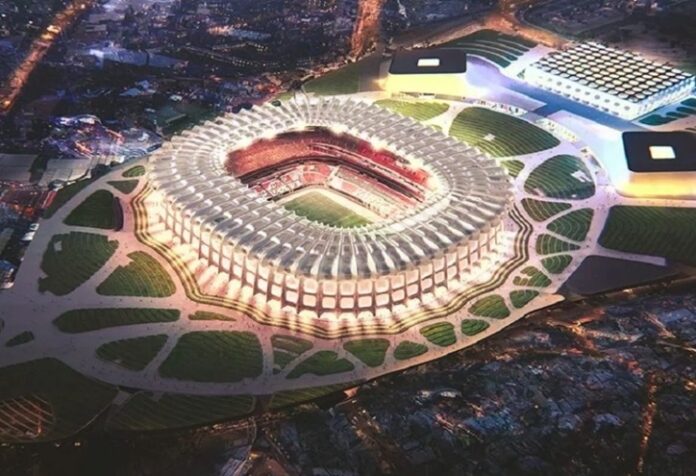
June 08 (THEWILL) — When the 2026 FIFA World Cup kicks off on June 11 at Mexico City’s iconic Estadio Azteca, football will enter a new era. Co-hosted by the United States, Mexico and Canada, the tournament represents the most significant transformation in World Cup history, featuring an expanded field, a revised competition structure and a global footprint unlike anything seen before.
The last major expansion came in 1998, when the tournament grew from 24 to 32 teams. Now, for the 23rd edition of football’s biggest event, FIFA has expanded the competition to 48 nations, welcoming 16 additional teams to the world stage.
The result is a World Cup that is bigger, longer and potentially more unpredictable than any that has come before.

A NEW FORMAT, A NEW CHALLENGE
The most significant change is the tournament structure.
The 48 participating nations will be divided into 12 groups of four teams. The top two teams from each group will automatically qualify for the knockout phase, while the eight best third-placed teams across all groups will also advance.
This creates a new Round of 32, consisting of the 12 group winners, 12 runners-up and eight third-placed teams.
From there, the tournament follows the familiar knockout format through the Round of 16, quarter-finals, semi-finals and final.
The expansion increases the total number of matches from 64 to 104 and extends the tournament schedule to 39 days, making it the largest World Cup ever staged.
For coaches and players, the revised format means every goal, every point and every disciplinary decision could prove decisive. Goal difference, head-to-head records and fair-play rankings may become crucial in determining which third-placed teams advance.
In a competition of such scale, every statistic could matter.
AFRICA’S HISTORIC MOMENT
No continent stands to gain more from the tournament’s expansion than Africa.
For the first time in FIFA World Cup history, 10 African nations have qualified for the finals, marking a record representation for the continent on football’s biggest stage. The qualified teams are Algeria, Cape Verde, DR Congo, Egypt, Ghana, Ivory Coast, Morocco, Senegal, South Africa and Tunisia.
Among the standout stories is DR Congo’s remarkable return to the World Cup. The Central African nation ended a 52-year absence from the tournament by defeating Jamaica in the intercontinental playoffs, securing its first appearance at the finals since 1974.
Cape Verde’s qualification is another milestone. One of Africa’s smallest nations by population, the island country will make its World Cup debut, underlining the opportunities created by the expanded format.
Morocco arrive carrying the hopes of a continent after becoming the first African nation to reach a World Cup semi-final at Qatar 2022. Senegal, Ghana, Egypt, Algeria, Tunisia, Ivory Coast and South Africa also possess the experience and talent to challenge some of the sport’s traditional powers.
The expanded format offers African teams a greater opportunity than ever before to progress deep into the tournament and potentially reshape the global football hierarchy.
For Nigerian football supporters, however, the tournament will be viewed with disappointment following the Super Eagles’ failure to qualify. The absence of one of Africa’s most passionate football nations remains one of the major talking points ahead of the competition.
TECHNOLOGY TAKES CENTRE STAGE
Technology is expected to play an even greater role in the 2026 tournament.
FIFA continues to invest heavily in innovations designed to improve decision-making, enhance officiating accuracy and provide fans with deeper insight into matches.
Advanced semi-automated offside technology, improved player-tracking systems and enhanced broadcast tools are expected to help officials and viewers better understand critical decisions during matches.
Artificial intelligence is also being integrated into several operational areas, reflecting FIFA’s ambition to modernise the tournament experience for teams, officials and supporters alike.
A TOURNAMENT ACROSS THREE NATIONS
The 2026 FIFA World Cup will be staged across 16 host cities in the United States, Mexico and Canada, making it the most geographically expansive tournament in history.
Mexico City’s Estadio Azteca will host the opening match, further cementing its place among football’s most iconic venues. Already the first stadium to host two World Cup finals, it will once again become the focal point of the global game.
The tournament concludes on July 19 at MetLife Stadium in East Rutherford, New Jersey, where one nation will be crowned world champions.
THE ROAD TO GLORY
Defending champions Argentina will arrive with the pressure of retaining their crown, while traditional powerhouses Brazil, Germany, Spain and France are expected to be among the leading contenders.
Beyond the established giants, the expanded format could create opportunities for emerging football nations to make deep runs into the tournament, adding another layer of intrigue to an already unpredictable competition.
What is certain is that the 2026 FIFA World Cup will be unlike any edition before it.
Forty-eight nations.
One hundred and four matches.
One trophy.
And a month of football that promises to capture the attention of the entire world.

Olumide Atiba