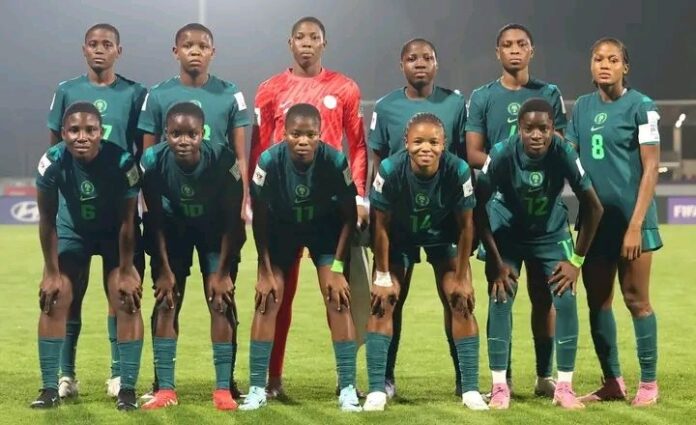
October 27, (THEWILL) — Nigeria’s U17 women delivered the result they needed to remain in the 2025 FIFA U-17 Women’s World Cup after a 4-0 win over Samoa in Rabat, a victory that moved them through to the last 16 on one of the best third-place slots.
The scoreline tells the basic fact, but not the pressure the players carried into the match. Two earlier defeats to Canada and France left qualification dependent on a clear win and favourable outcomes elsewhere. The side recovered professional focus and produced four well-taken goals, with Queen Joseph scoring twice, captain Shakirat Moshood converting a penalty, and defender Azeezat Oduntan adding the fourth. The goals changed the group math and gave Flamingos a lifeline.
The win altered the group table enough for Nigeria to finish third in Group D and to qualify as one of the best-performing third-placed teams across the tournament. That status is the technical reason the team avoided an immediate exit, and it sets up a tougher match in the knockout round. The Flamingos will meet Italy in the Round of 16, with the match scheduled for Tuesday October 29 at the Stade Olympique in Rabat.

To realise their ambition of staying in the competition despite the opening two losses, players who scored took responsibility when it mattered. Queen Joseph’s two goals gave the team an early edge in the second half, and the penalty taken by Moshood removed doubt about whether the team could finish the job. Oduntan’s strike sealed the scoreline and ensured there could be no late scramble.
The context is important. Nigeria had lost its opening game to Canada by four goals to one and then suffered a 1–0 defeat to France. Those results placed the team under immediate pressure heading into the final group match. Many teams with two straight defeats would have seen their tournament end there. That the Flamingos responded with a large win speaks to the technical adjustments made by the coaching staff and to the players’ ability to perform on the day. The team needed a clear margin of victory to reach the knockouts and that they achieved exactly what was required.
On the field, the team showed a mix of forward intent and controlled game management. The early goal opportunities allowed Nigeria to build confidence and to force Samoa into errors. The penalty that the captain took underlined the team’s willingness to carry responsibility through senior players on the pitch. The fourth goal, coming from a defender making an attacking run, demonstrated that the team could create chances from different areas and finish them.
The coaching staff must now prepare the squad for a significant rise in difficulty. Italy will present a different test in terms of tactical organisation, technical skill and game tempo. The Flamingos have not yet faced that level in this tournament and will have to adapt their defensive shape and chance-creation plan to cope. The Round of 16 game with Italy will be a stiffer challenge and Nigeria must not rely on the momentum of one result. The team’s planning must include clear defensive markers, quick restarts and a realistic plan to contain Italy’s best players.
There are clear positives to take from the group phase. The players who scored did so when the team needed goals most. The coaching staff found a way to create scoring chances and to pick players who could finish them. So far, Nigeria has concentrated many of its attacks on the flanks and into the box, where crosses produced goal chances. The goalkeeper and defensive line kept a clean sheet at a moment when simpler errors would have risked elimination. Those are practical signs the team can rely on in a knockout match.
There are matters to correct. The opening two matches revealed problems in retaining possession under pressure, and an inability to close down key spaces in midfield gave opponents room to create chances. The staff will need to work on ball retention, distance between the lines and quick outlets the team can use when pressed. The depth of the squad will be tested. If Italy force substitutions or bring significant pace late in the game, Nigeria must have bench options prepared to match intensity without losing organisation.
The players will feel a mix of relief and renewed focus. Relief because the immediate threat of elimination is over, and focus because the next round will demand a higher standard. The mental shift from tournament survival to active competition must be handled carefully by the technical team. They must enforce the best practices to avoid complacency and to prepare for a match where small errors will be punished.
For Nigeria’s wider programme, progressing beyond the group stage is useful for player development and national visibility. Playing in a knockout match exposes young players to pressure that helps build technical and tactical maturity. The result gives the team competitive minutes against another strong European youth side and will test how the domestic pathway has prepared them for higher-level contests. Historical context shows that tournament exposure at this level can be important for individual growth and for national planning of youth coaching. Documentation from the tournament organisers and national federation highlight the value of such matches for player pathways.
The next hours will be a concentrated test. The coaching staff must balance rest, recovery and tactical work. There will be no room for lengthy experiments. The match plan should identify limiting Italy’s key threats, keeping the midfield compact and making sure set plays are managed tightly. If Nigeria can keep the game close into the second half, they may find opportunities on the counter or from late set pieces. The practical goal is to neutralise Italy’s strongest channels and to allow Nigerian attackers space to exploit any overcommitment.
The result against Samoa will be remembered as the match that kept the Flamingos in the tournament. That fact will mean little if the team does not prepare properly for the next stage. The coming game is a clear test of whether the squad can translate one good performance into consistent competitive results. The players who rose to the occasion on Saturday have earned a chance to prove their quality on a tougher stage. The technical staff will decide whether their plan is good enough or needs change. The wider public and the National Football Federation will watch closely to see how the team meets the next test.

Jude Obafemi is a versatile senior Correspondent at THEWILL Newspapers, excelling in sourcing, researching, and delivering sports news stories for both print and digital publications.