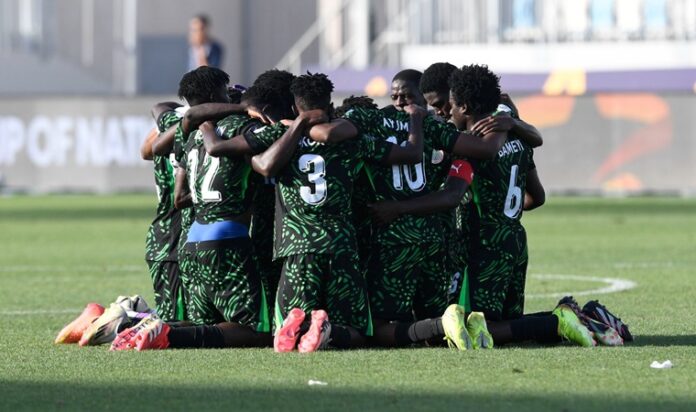
October 12, (THEWILL) — The Flying Eagles’ journey at the Under-20 World Cup in Chile ended with a crushing 4-0 defeat to Argentina in Santiago. It was one of the heaviest losses Nigeria has suffered at this level and it reopened old conversations about the state of youth football in the country. For a nation that once inspired global respect in age-grade competitions, this exit was more than a bad day, it was a mirror held up to the failures of structure, planning and leadership.
Argentina did not waste time asserting control. Alejo Sarco scored within two minutes, taking advantage of defensive disorganisation that left the Nigerian back line exposed. Maher Carrizo doubled the lead midway through the first half with a well-placed free kick and the same player added another shortly after the interval. Mateo Silvetti sealed the rout in the 66th minute, finishing off a sequence that summed up the gulf in sharpness between both sides. Argentina were coordinated, direct and confident. Nigeria were flat, reactive and stretched in all areas of the pitch.
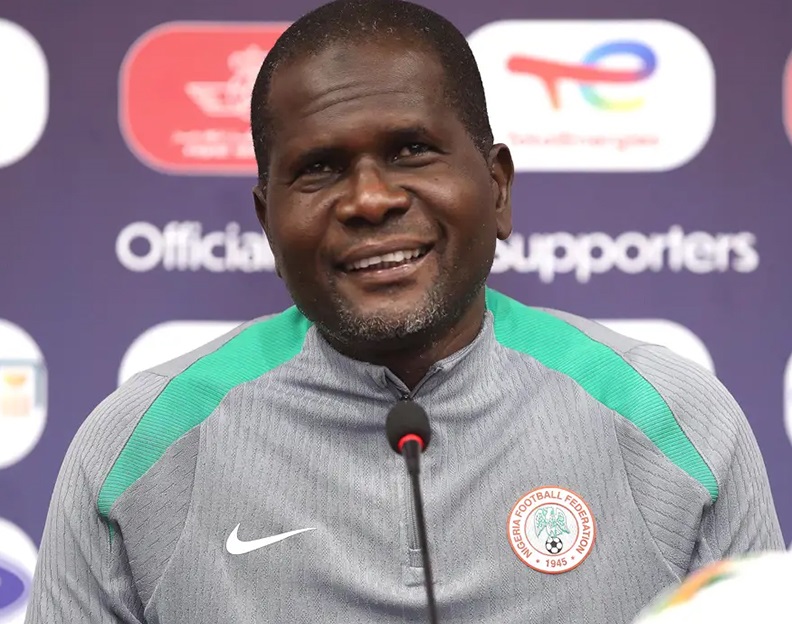
The Flying Eagles’ coach, Aliyu Zubairu, admitted after the game that his team did not meet expectations. He said the loss was difficult to accept and that the players could not manage the pressure or tempo imposed by Argentina. His words were a rare moment of accountability, but they also pointed to deeper problems that cannot be fixed by a single apology.

This defeat did not come out of nowhere. Nigeria had stumbled through the group stage, scraping past Saudi Arabia, losing to Norway and drawing with Colombia. They only advanced as one of the best third-placed teams. The inconsistency had already raised questions about the team’s readiness for tougher opponents. Against Argentina, those concerns became undeniable. The Flying Eagles were overrun in midfield, unable to keep possession and repeatedly caught out of shape when defending transitions. Every misplaced pass carried a sense of inevitability; each Argentine attack exposed a lack of coordination and belief.
Beyond tactics and formations, this loss revealed a structural vacuum in Nigerian youth football. For decades, the country has relied on raw talent rather than sustained development. The system remains scattered, with coaching appointments made and changed without long-term vision. Youth training camps often start late due to funding delays, while grassroots football lacks the organised linkages that feed into national teams. There are bright spots, private academies in Lagos, Jos, and Abuja continue to produce gifted players, but there is no unifying national framework that ties these efforts together.
The contrast with Morocco is instructive. Since opening the Mohammed VI Football Academy in 2009, Morocco has transformed its youth football structure. The Academy, built with around €13 million in investment, is more than a training ground; it combines education, medical care, nutrition, and football science under one roof. Young players are scouted from across the country through a coordinated regional system, given full academic support, and trained under a clear technical philosophy that connects seamlessly to the senior national team. The result is not luck but planning: Moroccan youth teams are now among the most consistent on the continent, and several academy graduates play for leading European clubs.
Nigeria, in contrast, still depends on talent identification rather than development. Scouting remains informal and underfunded. Promising players often fade away after youth tournaments because there is no structured bridge to professional football. Coaching at the grassroots level mostly lacks standard certification, and local competitions are poorly run. Administrative instability also means that programmes started by one federation executive often end when another takes over. This lack of continuity leaves the country starting from scratch every few years.
The Flying Eagles’ defeat in Chile must therefore be seen not as an isolated failure but as a symptom of a neglected system. If a country as football-rich as Nigeria cannot produce teams capable of sustaining performance across tournaments, then the problem lies in policy, not in players. The lesson from Morocco’s rise is that serious nations treat youth development as long-term infrastructure, not short-term opportunism.
Fixing this will require more than slogans or one-off camps. The Nigerian Football Federation must make youth coaching a profession with multi-year contracts and clear development goals. Training should include sports science, psychology, and nutrition as standard elements, not luxuries. Funding must be predictable and transparent, allowing teams to plan ahead without waiting for last-minute government approvals. A national scouting framework should be created to link schools, private academies, and state sports councils under one monitoring system. That way, young players can be tracked, supported, and guided as they grow.
Equally important is the need for accountability. Coaches and administrators must be evaluated on measurable progress, not political loyalty. Age-grade football should no longer be a platform for patronage or short-term publicity. Nigeria has the human and natural talent to dominate youth football, but without structure, that talent will continue to be wasted.
Argentina’s victory over the Flying Eagles was comprehensive, but it was also clinical, rooted in planning and precision. The South Americans approached the match with preparation born of systems that work. Nigeria, on the other hand, looked like a team improvising its way through another competition. The result was not surprising; it was inevitable. If Nigeria is to return to its former heights in youth football, the lessons from Chile must not be ignored. The Flying Eagles were not only beaten by Argentina; they were exposed by their own lack of readiness. This should be a turning point, a moment to stop blaming players and start rebuilding the system that failed them. Until Nigeria commits to a coherent, well-funded, and transparent development pathway, every generation of young talent will face the same fate: flashes of brilliance overshadowed by structural decay.
The match in Santiago was painful to watch, but it should serve as a warning. Talent alone will not win tournaments. Planning, education, and continuity will. Morocco understood this years ago and acted on it. Nigeria can too, if it finally accepts that football success, like any form of national progress, depends not on hope, but on hard, deliberate work.

Jude Obafemi is a versatile senior Correspondent at THEWILL Newspapers, excelling in sourcing, researching, and delivering sports news stories for both print and digital publications.