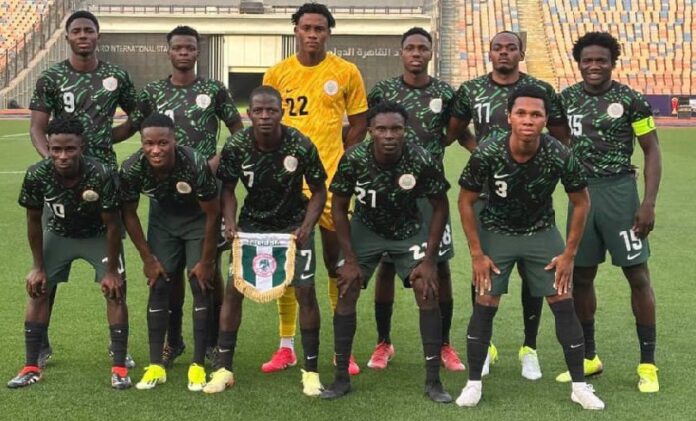
May 11, (THEWILL) – Nigeria’s Flying Eagles entered the 2025 TotalEnergies CAF Under-20 Africa Cup of Nations Competition in Egypt with measured confidence and a clear goal: to reclaim continental authority and reach the FIFA U-20 World Cup in Chile.
With a record seven U-20 AFCON titles to their name, expectations surrounding the team were expectedly high. Their performance in Group B has now met the first major requirement of the campaign: qualification for the knockout stage. A 2-2 draw with Kenya in their final group match was enough to see Nigeria through to the quarter-finals, where they will face Group C winners Senegal.
The competition began on April 27 and is scheduled to conclude on May 18. Nigeria opened their campaign with a narrow but well-earned 1-0 victory over Tunisia. Auwal Ibrahim provided the only goal of the match in the first half, and it stood until the final whistle. That performance reflected a disciplined start, and though the margin was slim, the outcome gave the team a platform on which to build.

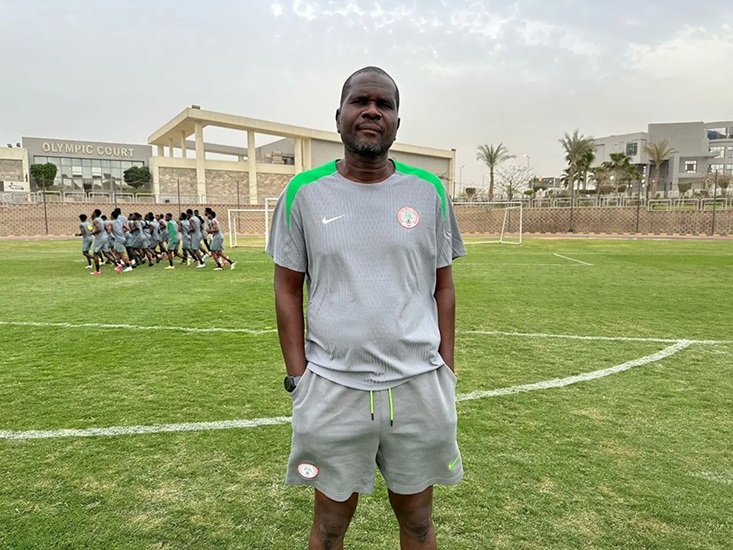
The following match on May 4 offered a much sterner examination. Nigeria took on Morocco at the 30 June Stadium in Cairo, a side equally determined and technically sound. The contest ended goalless, but that result did not tell the full story. It was a tense match in which both teams applied pressure and sought openings without taking undue risks. Nigeria kept their shape and managed key threats. In terms of tactical structure, Coach Aliyu Zubairu maintained his 4-3-3 setup, allowing his side to press high when needed but also fall back into a more compact arrangement when Morocco advanced the ball.
One of the key features of Nigeria’s performance against Morocco was the defensive line led by Daniel Bameyi. His leadership and organisation helped prevent Morocco from exploiting spaces behind the midfield. Bameyi read the game effectively and communicated constantly with his teammates. His positioning allowed Nigeria to absorb spells of pressure and prevent clear chances from materialising. The defensive unit played with clarity, and Bameyi’s role was central to that effort.
Midfield play was characterised by a balanced approach. Nigeria used the flanks well when transitioning from defence to attack. Quick passes to the wings helped stretch Morocco’s shape, and while there were limited clear chances, the approach ensured Nigeria remained a threat throughout. The match may not have produced goals, but it displayed tactical discipline and the ability to compete evenly with one of the tournament’s stronger sides.
Both Nigeria and Morocco finished that day with four points, while Tunisia had one and Kenya none. With one group match remaining, Nigeria’s next opponent was Kenya. That match, scheduled for May 7, became crucial not only for qualification to the quarter-finals but also for building momentum toward the deeper stages of the competition. The team knew that avoiding defeat would confirm their place in the knockout round and bring them within touching distance of the FIFA U-20 World Cup.
Kenya, appearing at this level for the first time, had found the group challenging. Despite their debut status, they remained a potential threat. Nigeria could not afford to underestimate a team with nothing to lose and everything to gain. The meeting with Kenya came with high stakes and required a professional attitude from start to finish.
The match began with a jolt. Kenya took a surprise lead in the 6th minute from the penalty spot, Kevin Injehu converting after a handball in the Nigerian box. Nigeria responded quickly with Kparobo Arierhi equalising in the 13th minute with a composed finish after a clever through ball split the Kenyan defence. Despite continued pressure, the first half ended 1-1.
Kenya shocked again midway through the second half when William Gitama finished off a flowing counter-attack in the 68th minute to restore their lead. However, Nigeria’s response was again swift. In the 72nd minute, a foul on midfielder Kehinde Ibrahim resulted in a penalty, which captain Daniel Bameyi confidently dispatched. The 2-2 draw was not the dominant display Nigeria might have hoped for, but it was enough to secure second place in Group B, with five points from three matches.
Nigeria’s preparation for this tournament had included winning the WAFU Zone B tournament, a success that confirmed their readiness for regional competition. That triumph also provided an opportunity to shape a squad capable of competing at the continental level. Zubairu’s side showed cohesion from the early stages of the WAFU campaign, and those foundations carried into the first two matches in Egypt.
Tactically, Zubairu’s methods focus on high energy and positional discipline. The 4-3-3 formation enables Nigeria to press with three attackers, maintain structure in midfield, and transition quickly down the wings. Against Tunisia, this shape allowed for compactness, while against Morocco, the same shape adjusted depending on the demands of the match. It is a system that gives room for both defensive control and attacking width.
In Auwal Ibrahim, Nigeria have found a forward capable of turning half-chances into meaningful returns. His goal against Tunisia demonstrated composure and sharp awareness. Alongside him, the wide players have contributed to ball progression and created space for midfield runners. However, decision-making in the final third remains a focus area. Opportunities have been created, but the team has yet to convert those chances into a consistent output of goals.
The midfield trio has been functional rather than spectacular. Their job has been to link play, break up opposition attacks, and provide coverage for the full-backs. Against Morocco, this midfield was tested repeatedly. The players responded by remaining organised, cutting passing lanes, and avoiding unnecessary fouls in dangerous areas.
Nigeria’s back four has functioned as a unit. In all three matches, they have limited the opposition to few clear chances. The defensive structure appears settled, and there is communication between the lines. Bameyi’s leadership is notable, but the collective approach has been just as important. The goalkeeper has also played his part, dealing with crosses and commanding his area when called upon.
Morocco, by contrast, employed a more possession-based system in their match with Nigeria. They rotated well in midfield and tried to isolate Nigeria’s full-backs. That approach forced Nigeria to adapt during the match, and Zubairu responded with subtle changes in pressing triggers and midfield movement. These adjustments helped Nigeria keep their shape and ensure Morocco could not dominate proceedings.
With the group stage now concluded, Nigeria stand where they had aimed to be: in the knockout phase of the U-20 Africa Cup of Nations, and just one win away from returning to the FIFA U-20 World Cup. The next test, however, is the most formidable yet, defending champions Senegal await in the quarter-finals. Zubairu’s side will be best served approaching the Senegal tie with full awareness of what is at stake, not just a place among the final four in Africa, but a return to global competition.
The coach has thus far managed his squad with purpose. Rotations have been limited, but the starting group has delivered the required results. There is, however, an awareness that stronger sides await beyond the group stage. The technical staff must consider squad depth, player fitness, and mental focus going into the knockouts.
The Flying Eagles are not short on support or expectation. Football followers in Nigeria follow the youth teams closely, and success at this level has traditionally fed into national team progress at the senior level. Performances in Egypt are being watched not just by supporters but by clubs and scouts looking for players capable of playing professionally at higher levels. With Senegal up next, the Flying Eagles must now elevate their performance and meet the rising demands of tournament football. The path to an eighth title and a World Cup return remains open, if they can seize it.

Jude Obafemi is a versatile senior Correspondent at THEWILL Newspapers, excelling in sourcing, researching, and delivering sports news stories for both print and digital publications.