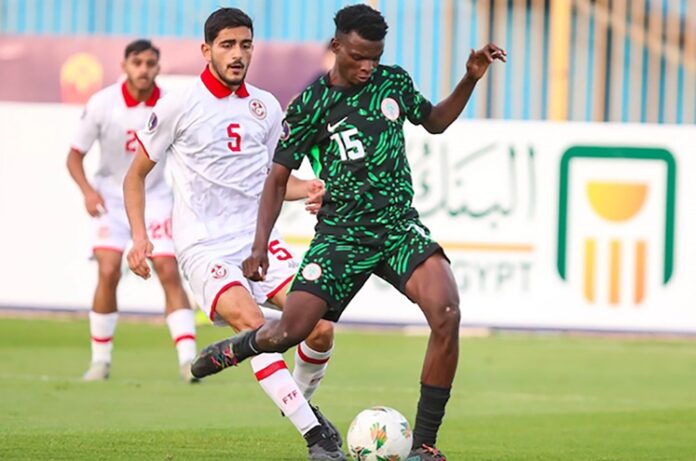
May 05, (THEWILL) – Nigeria’s Flying Eagles opened their 2025 Under-20 Africa Cup of Nations campaign with a 1-0 victory over Tunisia’s Junior Carthage Eagles on Thursday at the 30 June Air Defence Stadium in Cairo. This match, a Group B opener, marked a significant step in Nigeria’s pursuit of an eighth tournament title, a record they already hold with seven previous wins. The game was a tightly contested affair, decided by a single goal from Auwal Ibrahim in the 38th minute, assisted by Odinaka Okoro.
The 2025 Under-20 Africa Cup of Nations, hosted by Egypt from 27 April to 18 May, is the 18th edition of the biennial youth football tournament organised by the Confederation of African Football. Thirteen teams are competing, with the top four earning qualification for the 2025 FIFA Under-20 World Cup in Chile. Nigeria, with their storied history of seven titles, entered the tournament as favourites in Group B, which also includes Morocco and Kenya. The Flying Eagles’ victory over Tunisia provided them with three crucial points, setting a positive tone for their group stage campaign. Tunisia, by contrast, qualified for the tournament at the last moment, replacing another team, which limited their preparation time and made their performance less predictable.
The match saw Nigeria deploying their preferred 4-3-3 formation under coach Aliyu Zubairu. The Flying Eagles controlled possession early, pressing high to unsettle Tunisia’s defence. Despite creating several chances, they struggled to convert until the 38th minute, when Odinaka Okoro delivered a precise pass to Auwal Ibrahim, who finished clinically from close range. This goal, the only one of the match, earned Ibrahim the Player of the Match award. Tunisia responded with determination, nearly equalising through efforts from Omar Ben Ali and Anis Doubal, but Nigeria’s defence, anchored by captain Daniel Bameyi and goalkeeper Nathaniel Nwosu, held firm. A late scare in the 87th minute saw Doubal’s shot smothered by Nwosu, preserving Nigeria’s lead.
Nigeria’s preparation for the tournament provided them with a clear advantage. They arrived in Cairo having won the WAFU B Under-20 Championship in Togo in 2024, defeating Ghana 2-1 in the final after overcoming an initial loss to Burkina Faso. A 2-1 friendly win over hosts Egypt just days before the tournament further boosted their confidence. Coach Zubairu, speaking after the friendly, noted that the result gave his team momentum but stressed the need to focus on each match individually. His decision to start Auwal Ibrahim over Israel Ayuma in midfield proved effective, with Ibrahim’s goal and overall performance validating the choice. Other key players, such as Kparobo Arierhi, the top scorer at WAFU B, and defender Daniel Bameyi, brought experience and leadership to the squad.

Tunisia, despite their lack of preparation, displayed the tactical discipline typical of North African teams. Their strategy focused on a compact defensive shape, aiming to frustrate Nigeria’s attacking play and exploit counter-attacking opportunities. However, their limited cohesion, a consequence of their late qualification, hindered their ability to create clear chances. The Junior Carthage Eagles’ best moments came late in the match, but they could not breach Nigeria’s defence. This defeat extended Tunisia’s winless streak against West African teams at the Under-20 level, a record that dates back to 1987.
The historical context of Nigeria-Tunisia encounters adds depth to the significance of this victory. The two nations have met five times previously in the Under-20 Africa Cup of Nations, with Nigeria holding three wins, Tunisia one, and one draw. Their rivalry began in 1981, when Nigeria progressed 5-4 on aggregate in a two-legged qualifier, winning 4-0 in Lagos before losing 4-1 in Tunis. In 1985, they met in the final, with Nigeria securing a 3-2 aggregate victory after a 1-1 draw in Tunisia and a 2-1 win at home. More recently, in 2023, Nigeria dominated Tunisia 4-0 in the third-place playoff in Egypt, a result that lingered as motivation for both sides. Zubairu acknowledged the historical edge but cautioned his team against complacency, treating the 2025 match as a fresh challenge.
This victory carries significant implications for Nigeria’s campaign. Group B, comprising Nigeria, Tunisia, Morocco, and Kenya, is highly competitive. The top two teams from each group, along with the best two third-placed teams, advance to the quarter-finals, where the stakes include not only the tournament title but also qualification for the FIFA Under-20 World Cup. Nigeria’s three points give them an early lead, but upcoming matches against Morocco on May 4 and Kenya on May 7 will test their consistency. Morocco, a North African side with strong youth development, and Kenya, buoyed by their recent performances, present distinct challenges. Nigeria’s ability to maintain their high-pressing style and convert chances will be critical.
The match also highlighted the strength of Nigeria’s youth development system. The Flying Eagles have produced global stars such as John Obi Mikel and Victor Osimhen, both of whom emerged from this tournament. Players like Auwal Ibrahim, Kparobo Arierhi, and Nathaniel Nwosu represent the next generation, with the potential to attract attention from European scouts at the World Cup. Ibrahim’s performance against Tunisia, marked by his goal and dynamic midfield play, underscores his readiness for higher levels. Arierhi, known for his flair and goal-scoring ability, and Nwosu, a reliable presence in goal, further strengthen Nigeria’s prospects.
For Tunisia, the defeat was a setback but not a definitive blow. Their resilience, despite limited preparation, suggests they could still challenge Morocco and Kenya for a quarter-final spot. The Junior Carthage Eagles’ tactical discipline, a hallmark of North African teams, kept the game close, and their late pressure showed their potential to recover in subsequent matches. However, their inability to convert chances and their historical struggles against West African teams at this level highlight areas for improvement.
The broader context of the Under-20 Africa Cup of Nations underscores the importance of this result. The tournament serves as a platform for African talent to shine, with past editions launching the careers of players like the earlier-mentioned duo of Obi and Osimhen alongside Samuel Eto’o and Laurent Pokou. Nigeria’s consistent success, with 16 semi-final appearances in 18 tournaments, reflects their robust youth system. However, they have never won the title when hosted in North Africa, adding an extra layer of difficulty to their 2025 campaign.
Looking ahead, Nigeria’s path to an 8th title requires sustained focus. Coach Zubairu’s pragmatic approach, balancing confidence with caution, will guide the team through the group stage. The Flying Eagles’ blend of experience, with players like Bameyi who competed at the 2023 Under-20 World Cup, and emerging talent like Ibrahim, positions them well. Tunisia, meanwhile, must regroup quickly to avoid falling behind in Group B. Their next matches will test their ability to overcome their late qualification and build momentum. Still, with Morocco and Kenya looming, Nigeria must maintain their intensity to earn a quarter-final spot and a ticket to the 2025 FIFA Under-20 World Cup.

Jude Obafemi is a versatile senior Correspondent at THEWILL Newspapers, excelling in sourcing, researching, and delivering sports news stories for both print and digital publications.