December 08, (THEWILL) — William Troost-Ekong has retired from international football, ending a decade of service to Nigeria’s Super Eagles at a moment when his presence seemed most essential. The 31-year-old defender announced his decision on December 4, just three weeks before the 2025 Africa Cup of Nations begins in Morocco, leaving the national team to confront a major tournament without the steadying influence that defined their defence for 10 years.
The timing carries particular weight. Head coach Eric Chelle had named Troost-Ekong in his provisional 54-man squad only two days earlier, signalling an expectation that the captain would lead the side through another continental campaign. Instead, speaking from his base with Al-Kholood in Saudi Arabia, Troost-Ekong described his decision as one that brought him peace after years of commitment. His final appearance came as an unused substitute in the 2026 World Cup play-off defeat to the Democratic Republic of Congo the previous month, a penalty shootout loss that extinguished his dream of leading Nigeria to another global tournament.
That disappointment appears to have crystallised his thinking. Throughout his career, Troost-Ekong harboured a deep ambition to guide his country to the World Cup one last time, building on the experience of Russia 2018 where he played every minute of Nigeria’s group stage campaign. Without that prospect on the horizon, the motivation to continue through another demanding cycle seems to have diminished. In his retirement statement, he acknowledged that the time had come to pass responsibility to the next generation, a pragmatic if painful conclusion to a career that deserved a happier ending.

The journey that brought him to this crossroads began in 2015 when the late Stephen Keshi handed him a senior debut in a qualifier against Chad. Born in Almelo in the Netherlands to a Dutch mother and Nigerian father, Troost-Ekong had grown up in England’s youth systems with Fulham and Tottenham Hotspur before forging a professional path through clubs in the Netherlands, Norway, Turkey, Italy, England, Greece and most recently Saudi Arabia. Despite early caps for Dutch youth sides, his connection to Nigeria strengthened through family ties and Keshi’s call transformed his trajectory.
Over the following decade, Troost-Ekong accumulated 83 international appearances and eight goals, becoming the ninth most-capped player in Nigerian history. Alongside Leon Balogun, he formed what supporters affectionately termed the “Oyibo Wall”, a defensive partnership that provided rare stability during turbulent periods. Although critics sometimes questioned his technical refinement or occasional lapses in concentration, he compensated through sheer determination and an ability to organise those around him. His leadership extended beyond the pitch as well, most notably in 2022 when he led a camp boycott over unpaid bonuses during a Morocco friendly, forcing payments and highlighting his role as a players’ advocate.
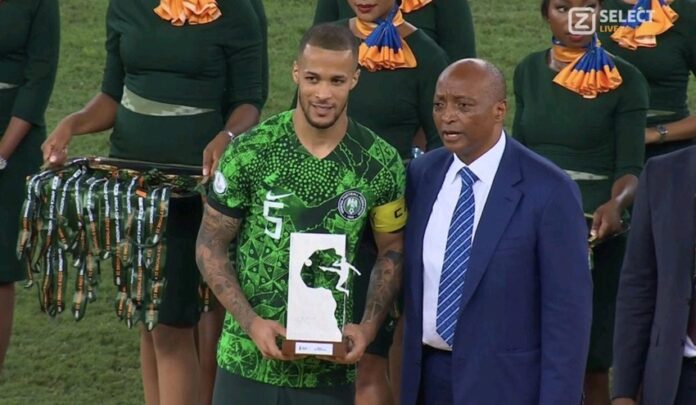
The pinnacle of his international career arrived at the 2023 Africa Cup of Nations in Côte d’Ivoire. Playing through significant pain from a hamstring injury that would have sidelined lesser competitors, Troost-Ekong delivered a heroic tournament. He scored crucial penalties against the hosts and South Africa, then opened the scoring in the final with a towering header that briefly gave Nigeria hope of a fourth continental title. Although they ultimately fell to Ivory Coast, Troost-Ekong was named Player of the Tournament, a rare distinction for a defender. His three goals in that campaign made him the highest-scoring defender in Africa Cup of Nations history, with five overall across his career, surpassing even Stephen Keshi’s mark.
That achievement speaks to a dimension of his game that extended beyond defensive duties. His aerial threat from set pieces and reliability from the penalty spot offered Nigeria an additional weapon. When the team needed someone to step forward in critical moments, Troost-Ekong invariably answered the call. His eight international goals, whilst modest by attacking standards, arrived at crucial junctures and underscored his ability to contribute at both ends of the pitch.
His departure now forces Eric Chelle into urgent reorganisation. The provisional squad lists 13 centre-backs, but injuries to Benjamin Fredrick and others have already strained options. Chelle must trim to 28 players by December 11 whilst identifying a new partner for Calvin Bassey or Semi Ajayi. Chemistry in central defence requires time to develop, and throwing together an untested pairing weeks before a major tournament carries obvious risks. Troost-Ekong offered a guarantee of commitment that transcended fluctuations in club form. Even during periods when his club minutes diminished, he consistently elevated his performance when wearing the national colours. Finding someone who can replicate that dedication presents a formidable challenge.
The leadership void may prove equally difficult to fill. Wilfred Ndidi, who has served as vice-captain and worn the armband on interim occasions, emerges as the natural successor. The midfielder brings considerable experience and maintains a calm presence, though his style differs markedly from his predecessor. Troost-Ekong was a vocal commander who constantly issued instructions and held teammates accountable. Whether Ndidi or other senior figures such as Alex Iwobi can replicate that level of authority remains uncertain. The defence particularly requires someone who can organise, communicate and maintain standards under pressure.
Teammates have been swift to acknowledge the gap left behind. Iwobi noted that Troost-Ekong had not been playing as regularly as he might have wished in recent months, which may have influenced his thinking. Victor Osimhen and other younger stars regarded him as a mentor who bridged the gap between the older generation of John Mikel Obi and Ahmed Musa and the current crop of talent. His presence helped with discipline and ensured standards remained high during international camps. Without that steadying hand, the squad must find new ways to police itself.
The broader implications extend to Nigeria’s tournament prospects in Morocco. Group C opponents Tanzania, Tunisia and Uganda will test a reconfigured defence that lacks the experience and organisation Troost-Ekong provided. Tunisia’s tactical discipline and the counter-attacking threats posed by Tanzania and Uganda demand cohesion at the back. Chelle’s squad is blessed with attacking talent in Osimhen, Ademola Lookman and others, but a leaky defence can undermine even the most potent forward line. The opening match on December 23 against Tanzania will offer the first indication of whether the new defensive arrangement can hold under competitive scrutiny.
Troost-Ekong’s legacy transcends the medals and individual honours, though those remain impressive. An Olympic bronze from Rio 2016, a third-place finish at the 2019 Africa Cup of Nations sealed by his late winner against South Africa, and that memorable silver medal campaign in 2023 mark a career of consistent achievement. Yet his broader contribution lies in proving that foreign-born players could anchor the national team with complete commitment. He was one of the players who inspired a generation of diaspora talents and showed young Nigerians abroad that the green jersey could become part of their identity.
The Nigeria Football Federation issued a statement describing him as a “dedicated, selfless and humble leader” whilst pledging support for his future endeavours. The Confederation of African Football hailed him as a symbol of perseverance and national identity.
In his farewell message, Troost-Ekong insisted this was not a final goodbye, pledging continued support for Nigerian football through community work and perhaps mentoring younger players. His foundation already aids development programmes in Akwa Ibom State, blending sport with social impact. The Super Eagles will travel to Egypt on December 10 for a training camp before facing the hosts in a friendly four days later, then onwards to Morocco. They will carry forward the blueprint he helped establish through steady defence and bold leadership, but they must now write the next chapter without his guiding presence.

Jude Obafemi is a versatile senior Correspondent at THEWILL Newspapers, excelling in sourcing, researching, and delivering sports news stories for both print and digital publications.