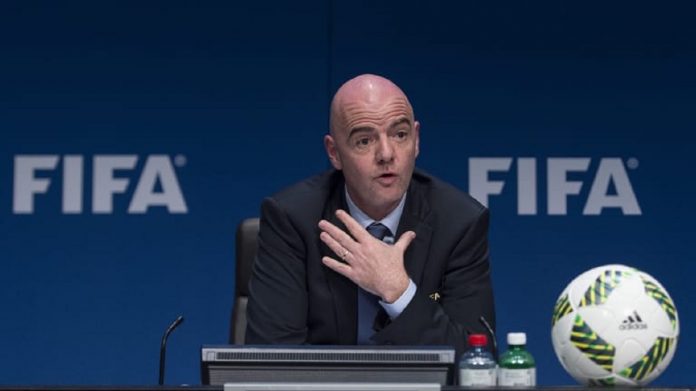
December 21 (THEWILL) – FIFA President Gianni Infantino believes FIFA’s proposals to hold World Cup events every two years have widespread support among national football associations.
Infantino made the announcement during the international football governing body’s worldwide summit on Monday, when a FIFA-commissioned research revealed that if the ideas are adopted, the game will enjoy a major financial boost.
It was predicted that the entire benefit would be $4.4 billion in the first four years of a new worldwide calendar, rising to $6.6 billion if each confederation likewise switched its regional tournament to a Biennial format.

The men’s and women’s World Cups are held every four years, although this may soon change with the progress being made in the push for a change of that quadrennial system that has persisted from the beginning.
Infantino said: “Not only is it feasible from a sporting point of view, but the economic return is very strong, meaning more money can be invested, re-invested, into football development all over the world.
“This is quite an important project to bridge the gap between those who have and those who don’t have. At the end of the day, everyone will benefit. Everyone will have additional possibilities to play and additional revenue as well.”
Despite this, FIFA’s intentions have been rejected by the powerful European and South American confederations, UEFA and CONMEBOL. As THEWILL previously reported, however, there is support from Asia, Africa, and the CONCACAF region, which includes North and Central America as well as the Caribbean.
FIFA released studies showing that over the first four years of a biannual World Cup period, solidarity support for each of its 211 national associations increased from $6 million to “potentially” $25 million.
Many organisations would welcome such a hike, given its revolutionary potential, and Infantino declared at the summit that “If I was going to a vote tomorrow, probably the majority would vote in favour of World Cups every two years.”
At this stage, Infantino has not indicated when such a vote might take place.
Former Arsenal manager Arsene Wenger, now FIFA’s Head of Global Development and Infantino’s right-hand man on this issue, has played a part in the organization’s ambitions.
Wenger claimed that the biennial World Cup suggestions had instilled “fear” within the football establishment, the type of fear which he wanted to be cleared by reason:
“We face opposition, but what I regret is that 90 per cent of this opposition is emotional and not facts and not analysis. And we have to get over this fear because most of the emotions we face are based on fears: fear to lose control of your own competition.
“There is a demand from the young fans; there is a demand in society for meaningful events.
“If we don’t create them, another sport will create them. We have an opportunity to give countries an opportunity to improve, and I think it’s worth it to fight for it. It is 211 countries that make that decision. We will accept that decision.”
Infantino, who was on stage alongside Wenger, said he had faced “a lot of opposition”, and but also “a lot of voices in favour”. “FIFA is a global organising body and for this reason we have to combine these points of view.”
The possibility of international football becoming a stronger presence on the calendar has sparked considerable pushback from Europe’s big-money leagues, with a number of elite managers raising concerns about player burnout.
Infantino made an odd attempt to calm fears that the Olympics will be harmed by pointing out that the Olympics are currently held every two years — winter and summer editions.
The summer Olympics attracts by far the largest spectators, therefore any confrontation with international football for that multisport showcase would be unwanted.
Infantino stated that FIFA is confident in the World Cup’s attractiveness, even if the competition is held more frequently in the future. Since 1930, the men’s tournament has been held every four years, with the exception of 1942 and 1946 due to World War II.
“The prestige of a competition like the World Cup will not be undermined by playing more frequently,” the FIFA president insisted.

Jude Obafemi is a versatile senior Correspondent at THEWILL Newspapers, excelling in sourcing, researching, and delivering sports news stories for both print and digital publications.