-
Nigeria committed an estimated ₦17.36 trillion to defence and security between 2021 and 2025, while the sector again received the highest allocation of ₦5.41 trillion in the 2026 Federal Budget.
-
Despite the unprecedented spending, insurgency, banditry, kidnapping, oil theft, and other violent crimes have continued to spread across the country, raising fresh concerns over the effectiveness of Nigeria’s security investments.
-
Analysis shows personnel costs dominate security spending, while intelligence, technology, and preventive security remain underfunded.
-
Urgent sweeping reforms, including stronger legislative oversight, transparent security spending, intelligence-led policing, community-based security initiatives, and greater investment in education and economic opportunities to tackle the root causes of insecurity.
Aug 03, (THEWILL) — Nigeria committed an estimated ₦17.36 trillion to defence and security between 2021 and 2025, yet violent attacks, kidnappings, insurgency, banditry, oil theft, and other forms of criminality continued to spread across the country, raising fresh questions over whether record security budgets are delivering value for money and making Nigerians safer.
Fresh scrutiny of the country’s security spending has followed the release of a new analysis by BudgIT Foundation, titled “Nigeria’s Security Crisis and the Politics of Budgeting: Spending More, Securing Less,” which examined security allocations over the last five years and found what it described as a widening disconnect between rising expenditure and security outcomes.
The analysis showed that security allocations rose from ₦1.50 trillion in 2021 to ₦6.57 trillion in 2025, representing more than a fourfold increase in four years.

Altogether, Nigeria spent an estimated ₦17.36 trillion on defence and security during the period, while the sector again received the largest allocation in the 2026 Federal Budget, with ₦5.41 trillion.
The findings come against the backdrop of President Bola Tinubu’s assurance while presenting the 2026 Appropriation Bill that his administration would invest in security with “clear accountability for outcomes” because security spending “must deliver results.”
However, the continued spread of insecurity despite rising allocations raises questions about whether the country’s security financing framework is producing the expected results.
Rising Budgets, Worsening Security
The report paints a troubling picture of Nigeria’s security environment, where virtually every geopolitical zone continues to grapple with one form of violent conflict or another despite years of increased government spending.
THEWILL reports that Boko Haram and its splinter groups remain active in the North-East more than 15 years after the insurgency began, while armed banditry has expanded across much of the North-West.
Kidnapping-for-ransom has evolved into a nationwide criminal enterprise, farmer-herder conflicts continue to claim lives across the Middle Belt, oil theft and piracy remain entrenched in the Niger Delta, while separatist-related violence persists in parts of the South-East.
According to BudgIT, human and economic costs have continued to mount, with millions displaced from their homes, schools forced to close in conflict-affected communities, farmlands abandoned, food production disrupted and businesses facing increasing operational risks.
Rather than shrinking, the report observes that insecurity has expanded geographically during the same period that security allocations have reached unprecedented levels.
Where the Money Is Going
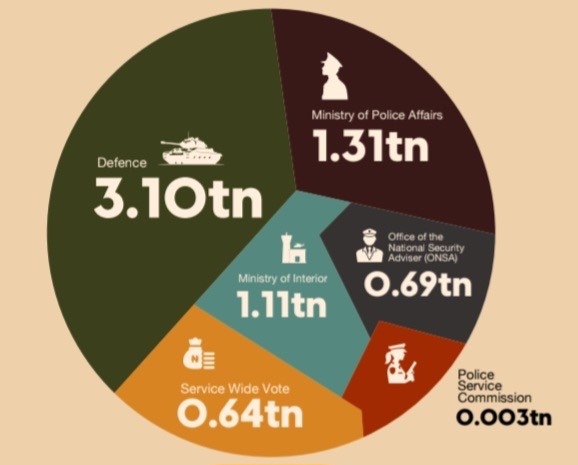
An examination of the ₦6.57 trillion security budget for 2025 shows that the Ministry of Defence received the largest allocation of ₦3.10 trillion, followed by the Ministry of Police Affairs with ₦1.31 trillion, the Office of the National Security Adviser (ONSA) with ₦1.11 trillion, the Ministry of Interior with ₦690 billion, while the Service-Wide Vote accounted for ₦640 billion.
Beyond the size of the allocations, BudgIT argued that the composition of the spending raises more fundamental concerns. Its analysis shows that ₦4.07 trillion, representing nearly 62 per cent of the 2025 security budget, was allocated to personnel costs, while only ₦1.50 trillion, or about 22.8 per cent, was earmarked for capital expenditure covering equipment, surveillance systems, intelligence infrastructure, and operational technology.
According to the report, the figures suggest that Nigeria is spending significantly more on maintaining its security workforce than on strengthening the technological and intelligence capabilities required to combat increasingly sophisticated security threats.
The report further noted that the country’s security architecture remains heavily dependent on military deployments, with comparatively limited investment in intelligence gathering, community policing, early warning systems, border surveillance, and other preventive security measures.
Questions Over Accountability
The BudgIT analysis also raises concerns about transparency and accountability in Nigeria’s security financing, describing the situation as a “security accountability crisis.”
Among the issues highlighted is the spending pattern of the Office of the National Security Adviser, which the report said had utilised 277.28 per cent of its approved capital budget by mid-2024 after receiving ₦201.09 billion against an appropriation of ₦72.52 billion.
While recognising that aspects of defence spending necessarily require confidentiality, the report argues that security-related expenditure should still be subject to effective public finance controls and institutional oversight.
It points to limited disclosure around procurement processes, emergency contracting, and off-budget spending, warning that excessive secrecy can weaken accountability and reduce public confidence in how security resources are managed.
Beyond the direct loss of lives, the report links insecurity to wider economic and social consequences. It argues that persistent violence has reduced agricultural productivity by forcing farmers off their land, contributing to food shortages and rising inflation.
Businesses have also faced higher transportation, insurance, and operating costs, while investor confidence has been affected by growing security risks.
The analysis further notes that prolonged school closures in conflict-affected communities have deepened educational setbacks and increased the vulnerability of unemployed youths to recruitment by criminal and extremist groups.
According to BudgIT, these socio-economic consequences underscore the need to view security not only as a military challenge but also as a development issue.
Rather than advocating increased spending alone, the report noted that Nigeria’s security strategy requires fundamental reforms centred on accountability, transparency, and prevention.
Among its recommendations are stronger legislative oversight of security expenditure, periodic reporting on the utilisation of security funds, independent audits of major defence procurement, and stricter regulation of emergency procurement processes.
It also advocates greater investment in intelligence infrastructure, surveillance technology, cybersecurity, border security, and community policing, while urging the government to shift resources towards preventive measures capable of detecting and disrupting threats before they escalate.
The report further recommends sustained investment in education, employment, rural development, and social protection, arguing that addressing poverty, exclusion, and unemployment is essential to reducing the conditions that fuel recruitment into criminal and extremist networks.
BudgIT concludes that although Nigeria is spending more on security today than at any point in its democratic history, improved funding alone cannot resolve the country’s security crisis without stronger institutions, better oversight, and a more strategic deployment of public resources.
Nigeria has steadily increased funding for defence and security in response to persistent threats posed by terrorism, banditry, kidnapping, communal violence, oil theft, and separatist agitation.
Between 2021 and 2025, cumulative allocations to the sector reached an estimated ₦17.36 trillion, according to BudgIT, while security again received the largest allocation in the 2026 Federal Budget with ₦5.41 trillion.
The latest analysis adds to the ongoing debate over whether rising security expenditure should now be matched by stronger accountability mechanisms and measurable outcomes, especially as many communities across the country continue to face persistent security challenges.

Felix Ifijeh is a journalist with years of professional reporting experience. Known for his keen news sense, compelling storytelling and commitment to accurate, impactful reporting, he has built a reputation for turning leads into clear, engaging, and well-structured reports that resonate with readers. His work reflects deep newsroom experience and a commitment to accurate, impactful journalism.