November 04, (THEWILL) – From modest beginnings to international recognition, Nigerian athletes have written remarkable chapters in world sports over decades. Now, another sporting revolution quietly builds momentum across the nation through Sambo, a martial art that combines wrestling, judo, and boxing techniques. Within months, Nigerian competitors have transformed from newcomers to medal-winning athletes on continental and global platforms.
The seeds of this transformation took root at the 13th African Games in Ghana, where Sambo featured during demonstration events. That initial appearance created the foundation for numerous achievements throughout 2024, including strong results at the African Championships and World Beach Sambo Championships.
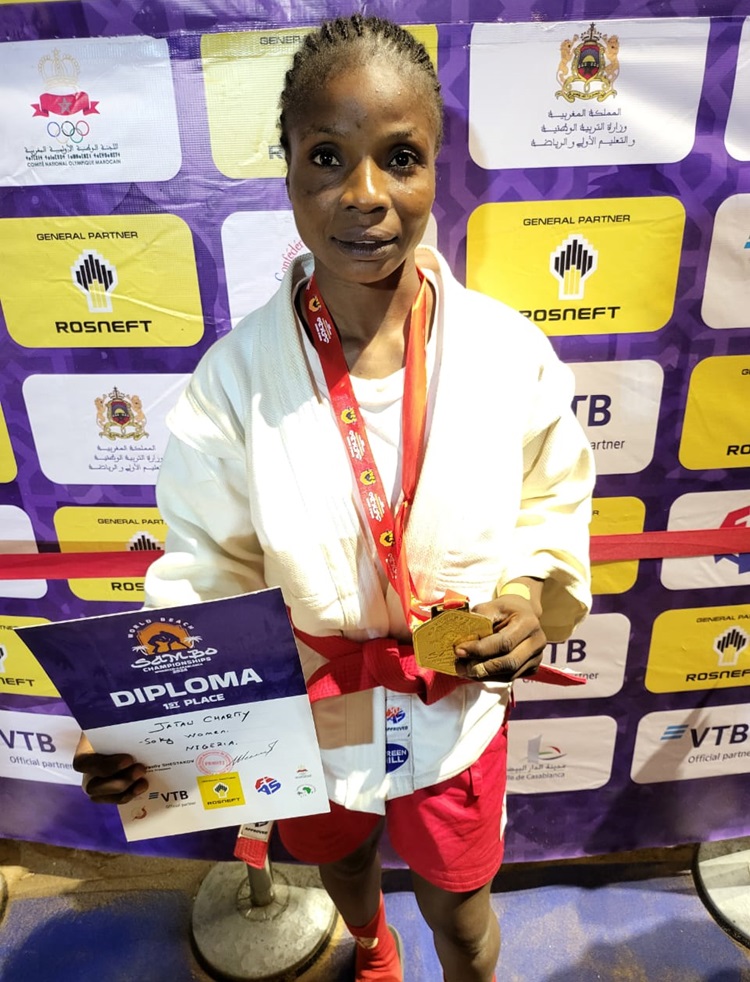
Charity Jatau leads this sporting advancement, winning gold at the World Beach Sambo Championships in Morocco and proving Nigeria’s ability to compete at elite levels. Jatau’s victory over defending champion Oksana Kobeleva showed that Nigerian athletes could defeat established competitors on the global stage. The significance of her achievement becomes clear when considering she defeated the previous year’s world champion without knowing her opponent’s credentials beforehand.

“When I went into the bout, I did not know this. I did not specifically find out anything about my opponents in advance, I just watched how they performed at the tournament. And I built my own tactics based on what I saw,” Jatau explained. This tactical approach paid dividends in the final moments of the match, despite increased pressure when officials awarded her opponent activity points.
The national team continued its strong performance at the 18th African Sambo Championships in Egypt, where three members won five medals. This result validated Nigeria’s potential and earned recognition from continental authorities. The team’s success in Egypt, featuring Jatau alongside Fatima Ogbonyomi and James Chegwam, proved Nigeria’s growing talent pool. Ogbonyomi claimed silver in the women’s 65kg division, while Chegwam matched his African Games performance with another medal in the men’s 58kg category.
Nigeria now prepares for its most significant challenge – the 2024 World Sambo Championships in Astana, Kazakhstan. The tournament, scheduled for November 6-10, will include athletes from 79 nations, marking another milestone in the country’s development. The competition will take place at the renowned Zhaksylyk Ushkempirov Martial Arts Palace, where Nigerian athletes will test their skills against the world’s finest competitors.
The Nigerian team heading to Kazakhstan includes Samuel Oladele Kekere, who will compete in the tournament’s first-ever blind Sambo category. Kekere’s participation shows Nigeria’s dedication to inclusive sports development, making the country Africa’s only representative in this groundbreaking division. His eligibility received official confirmation from Roman Novikov, Chairman of the FIAS Commission for Athletes with Disabilities, who verified Kekere meets all criteria for the SVI-1 classification.
Technical preparation remains a priority for the team. Lagos State coach Gbenga Montana leads the training efforts, focusing on developing comprehensive skills beyond basic techniques. Jatau acknowledges the need for continued growth: “I need to study Sambo techniques in detail. What I do now is mostly judo techniques. But I understand that at a higher level, it will not be enough to win.”
A committed leadership team drives these accomplishments. Sheriff Hammed, Vice President of the Sambo Association of Nigeria, presents a complete vision for developing the sport. “Our plan for Sambo will bring benefits to the sports industry in Nigeria and participants,” Hammed explains. His strategy includes facility development, youth engagement, and educational opportunities.
The association’s president, Evangelist Loveth Howell, supports this forward-thinking approach. “We want to inspire future generations,” Howell states. “We are creating opportunities for others to follow.” Under their guidance, the sport continues to attract new participants and build structures for long-term success.
Financial limitations persist. Many athletes must fund their own participation in international competitions. The recent World Beach Sambo Championships in Morocco demonstrated this challenge when budget constraints allowed only one athlete to participate despite having three qualified competitors. “Currently, the participation is self-sponsored, and we are seeking collaboration from government and private organisations,” Hammed noted.
These obstacles have not reduced Nigeria’s determination. The country started grassroots development programs, shown by the recent judo and Sambo clinic in Osun State. This programme, backed by UK-based certified Sambo coach Rotimi Okeniyi, teaches technical knowledge and provides essential training equipment to young athletes. The three-day event brought together participants from multiple states, creating a platform for knowledge sharing and skill development.
The strategic focus extends beyond competition results. Nigeria plans to convert existing sports facilities into multi-purpose venues suitable for Sambo training and competition. This practical approach maximises current resources while planning future expansion. “International global practice now shows us that a sports facility can be multi-purpose and adaptable,” Hammed explained, emphasising the importance of efficient resource utilisation.
The World Championships in Kazakhstan represent more than another competition for Nigeria. The tournament offers a chance to strengthen Nigeria’s position in global Sambo and potentially qualify for the 2025 World Games in Chengdu, China. Success at this level could establish Nigeria among the leading Sambo nations worldwide.
Moving from African Games participant to World Championship competitor within one year shows Nigeria’s capability to become significant in international Sambo. Through grassroots programmes, improved facilities, and international competition experience, Nigeria moves toward excellence in this sport.
Charity Jatau leads the national team toward Kazakhstan with a clear purpose: “I want more people in Nigeria to learn about Sambo.” Each competition brings Nigeria closer to that goal, transforming the nation into a notable competitor in Global Sambol Arena.
Jude Obafemi is a versatile senior Correspondent at THEWILL Newspapers, excelling in sourcing, researching, and delivering sports news stories for both print and digital publications.