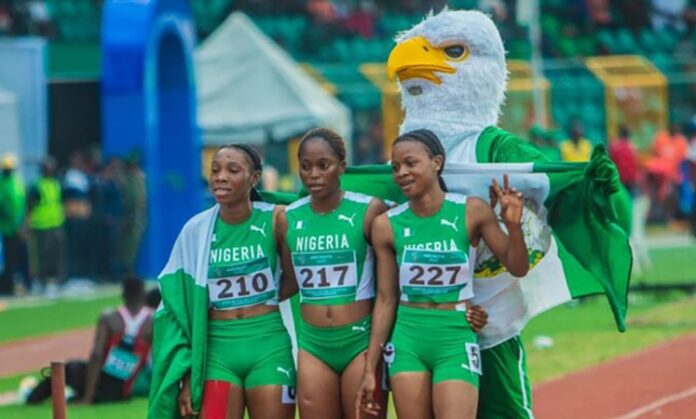
July 21, (THEWILL) — The third Confederation of African Athletics (CAA) U18/U20 Combined Championships concluded successfully in Abeokuta on Sunday after five days of spirited competition that showcased the continent’s emerging athletic talent.
Held at the MKO Abiola Sports Arena in Ogun State, the championships brought together 937 athletes and officials from 43 African nations, with Nigeria stepping up as host after Algeria’s withdrawal due to undisclosed reasons.
The path to Abeokuta was marked by several venue changes. Initially awarded to Madagascar during the CAA Council Meeting in Douala, Cameroon, in June 2024, the event was later reassigned to Oran, Algeria. However, by May 2025, Algeria could no longer host, prompting Nigeria to emerge as a capable replacement.

Drawing on its recent experience organising the Gateway Games 2024 and the 22nd National Sports Festival, Nigeria maintained the original July 16-20 dates and delivered a world-class event that welcomed delegations from across the continent.
The championships featured 85 events across two age categories, with Nigeria fielding the largest delegation of 132 participants. South Africa followed with 100 participants, while Ethiopia sent 69 delegates and Kenya 67. Other strong contingents came from Ghana, Morocco, Cameroon, Senegal, and Uganda, creating a diverse and competitive field that reflected the growing strength of African youth athletics.
From the outset, Nigeria, South Africa, and Kenya engaged in a fierce battle atop the medal standings. The host nation’s relay teams proved to be the competition’s standout story, delivering breakthrough performances that energised the audience at the stadium.
On day four, Nigeria secured four gold medals, highlighted by a championship record in the U18 women’s sprint medley relay. The quartet of Rosemary Nwankwo, Miracle Ezechukwu, Hafsoh Majekodunmi, and Chioma Nwachukwu blazed to victory in 2:08.16, surpassing Nigeria’s own record from 2015.
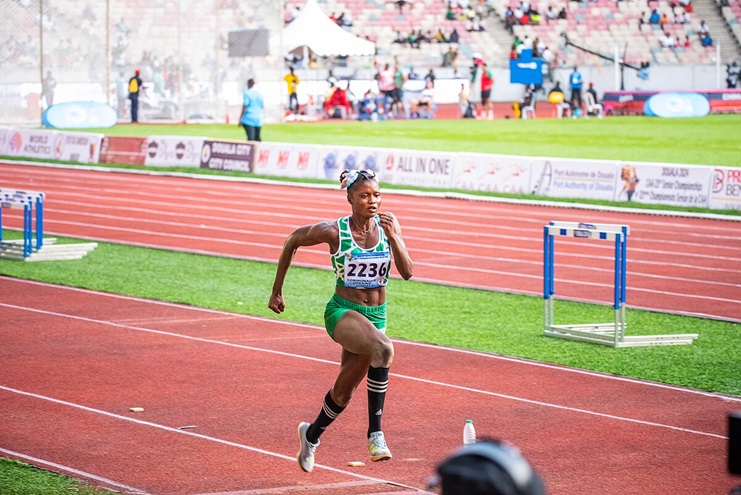
The same day saw the U20 women’s 4x100m team of Lucy Nwankwo, Success Oyibu, Anita Enaruna, and Chioma Nweke claim gold in 45.58 seconds, while the U20 men’s relay squad executed flawless baton exchanges to overcome Zimbabwe and Botswana.
Individual brilliance emerged alongside the relay dominance. Prestina Ochonogor produced the championships’ most spectacular field event performance, soaring 6.71 metres in the U20 women’s long jump to erase Ese Brume’s decade-old championship record of 6.33 metres. The leap represented both her season’s best and third-best career mark, highlighting the upward trajectory of African youth athletics.
Nigeria’s dominance extended to the sprints, where the U18 girls achieved a historic clean sweep in the 100m final. Miracle Ezechukwu won gold in 11.88 seconds, followed by Rosemary Nwankwo in 11.96 seconds and another Nigerian teammate. In the 400m, Chioma Nwachukwu delivered a commanding performance, clocking 52.47 seconds ahead of compatriot Hafsoh Majekodunmi’s 54.43 seconds for a Nigerian one-two finish.
While Nigeria celebrated on home soil, their competitors demonstrated why African youth athletics continues to strengthen. Kenya’s Clinton Owatinya emerged as a standout performer, topping the U20 men’s 100m heats with a personal-best 10.37 seconds before claiming gold in the final with 10.42 seconds. South Africa maintained their traditional strength, with Mukona Manavhela recording the fastest time in U18 men’s 100m heats at 11.38 seconds, and their relay teams consistently challenging Nigeria’s dominance.
Burkina Faso celebrated a breakthrough moment when Zango Salisa captured gold in the U18 women’s triple jump with 12.79 metres, while South Africa’s Natro Ler won the U18 high jump by clearing 2 metres. These were all testaments of the competition’s continental reach and competitive depth.
Nigeria’s successful hosting showed remarkable organisational capacity, particularly given the late venue change. The Local Organising Committee, supported by the National Sports Commission, ensured comprehensive logistics covering security, transportation, accommodation, and catering. A dedicated protocol team at Lagos’ Murtala Muhammed International Airport facilitated smooth delegation arrivals, while the upgraded MKO Abiola Sports Arena provided modern facilities that met international standards.
The event’s success built upon Abeokuta’s recent experience hosting the Gateway Games, which welcomed over 15,000 athletes and officials. National Sports Commission Chairman Mallam Shehu Dikko described the championships as a celebration of youth, unity, and Africa’s sporting spirit. The presence of cultural troupes and engagement with local traditions added vibrancy while fostering continental unity.
The accompanying CAA Congress on July 14-15 tackled critical issues facing African athletics, particularly talent retention. CAA President Hamad Kalkaba Malboum stressed the importance of consistent junior championships in providing opportunities for young athletes to compete and remain in Africa rather than representing other nations internationally.
Athletics Federation of Nigeria President Tonobok Okowa, who also serves as CAA Vice President, expressed confidence in the event’s role as a development platform. The championships followed successful editions in Abidjan (2019) and Ndola (2023), establishing a crucial pathway for African youth toward global competitions including the Olympics and World Championships.
While complete medal tallies remain pending, Nigeria’s relay gold medals and field event records suggest a highly successful home campaign. South Africa reportedly led the overall medal count, with Kenya securing six medals including three gold, maintaining the traditional competitive balance between Africa’s athletics powerhouses.
The event faced some challenges, including a road accident involving Tunisian athletes, though quick intervention by the CAA and AFN provided necessary support. Despite such setbacks, the championships reinforced Nigeria’s emerging role as a continental sports hub while exhibiting the remarkable depth of African youth talent.
For athletes like Ezechukwu, Ochonogor, and Owatinya, the championships represent stepping stones toward international prominence. Their record-breaking performances, combined with the event’s organisational success, signal a bright future for African athletics and Nigeria’s capacity to host major sporting events.
The 2025 Abeokuta championships ultimately achieved their primary goal: providing a platform for Africa’s next generation of athletic stars while demonstrating the continent’s growing organisational sophistication and competitive strength in youth athletics.

Jude Obafemi is a versatile senior Correspondent at THEWILL Newspapers, excelling in sourcing, researching, and delivering sports news stories for both print and digital publications.