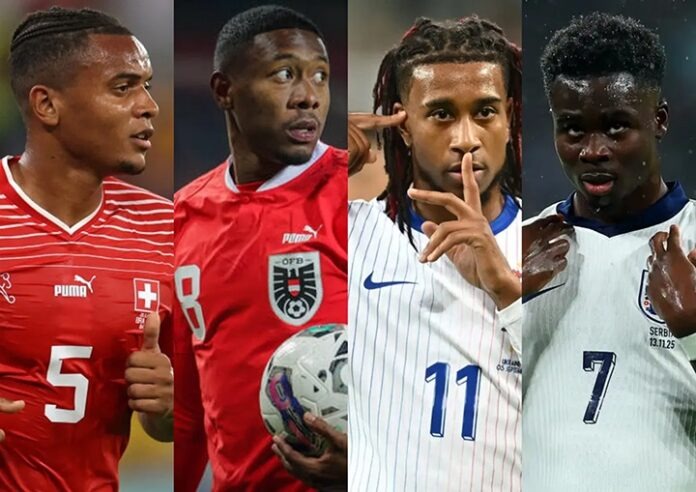
June 07, (THEWILL) — There is a cruel irony at the heart of Nigeria’s football story in 2026. The Super Eagles will not be at the World Cup, which is scheduled to kick off on Thursday, having been eliminated in heartbreaking fashion by DR Congo on penalties last November. Yet the Nigerian influence will be everywhere this summer in Dallas, Toronto and across every stadium designated to host the month-long event.
Some of the most exciting football players expected to participate in this tournament have something in common: They have Nigerian blood. Their parents come from various parts of Nigeria, but they will wear the colours and bear the flags of other countries which tell different stories shaped by birth certificates, youth academies and decisions made long before they were old enough to fully understand the import.
ENGLAND’S NIGERIAN CORE
No English football player of African descent fits the image better than Bukayo Saka. Born in Ealing, London, to Nigerian parents, the Arsenal winger is now one of the first names on England’s national team sheet and the most coveted by Nigerian football fans who have never stopped dreaming of seeing him play for the Super Eagles some day.

Once asked why he chose the Three Lions, Saka was disarming in his honesty:
“It’s like when you lived with your stepfather since a young age, then your biological father appears when you are already grown up. You cannot just say I am going to my biological father who was never there for you.” Bukayo Saka, Own Goal Nigeria, 2021
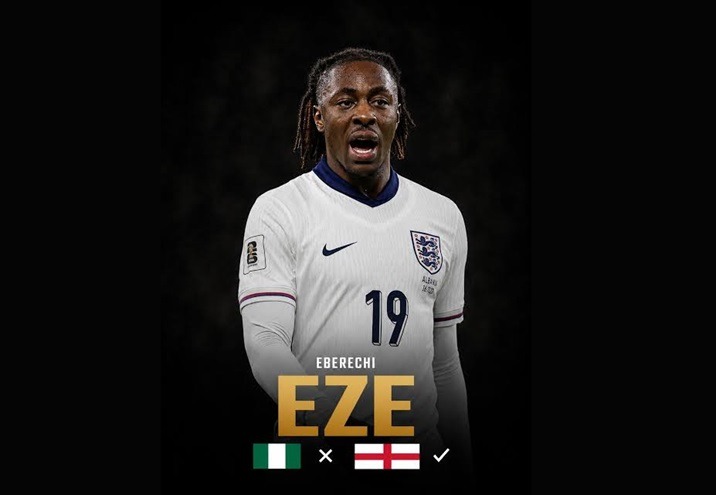
It is a metaphor that stings and one that football administrators in Abuja should be required to read. Saka did not reject Nigeria out of indifference. He chose England because England was there first, and stayed there. Eberechi Eze and Noni Madueke tell a similar story. Both players were eligible for Nigeria. They developed through the FA’s youth system. All three are now full England internationals. Together, the three form a generation of attacking talents with Nigerian roots that could have given the Super Eagles one of the most potent forward lines on the continent.
MUSIALA, ALABA, AND THE WIDER PICTURE
Germany’s Jamal Musiala was perhaps the most-watched dual-nationality decision in recent memory. Born in Stuttgart to a Nigerian father and a German mother and having spent his formative years in England, he eventually chose Germany. He has since become the face of German football’s future. The DFB got their man. Nigeria did not come close.
Austria’s David Alaba represents the longest shadow. The Vienna-born defender, whose father hails from Ogun State, earned over a century of international caps and captained his country for over a decade. His 2026 story is one of painful injury, an ACL rupture in December 2023, a meniscus tear and further calf problems that reduced him to just 102 minutes for Real Madrid before his contract expired this summer. Whether he features meaningfully for Austria at this World Cup remains uncertain. But for fifteen years, his talent belonged to them, not Nigeria.
France’s Michael Olise committed to Les Bleus despite Nigerian eligibility. Switzerland’s Manuel Akanji, whose father is Nigerian and who has become one of Europe’s most reliable centre-backs at Manchester City and Noah Okafor complete a picture that stretches across the continent.
WHY IT KEEPS HAPPENING
David Doherty, founder and CEO of Pathway Sports, put it plainly when Saka’s decision first made headlines: “England, Germany and Spain cannot nurture these players over the years in a working, planned structure and system for Nigeria to come and claim ownership for what we never added one single support to from the onset.”
It is a diagnosis, not an excuse. Most of these talents were spotted when they were 8 or 9 years – old by foreign clubs and national associations. They represented England Under-15s and Germany Under-17s long before anyone in Abuja made a phone call to them. Nigeria, in too many cases, showed up late if at all.
NIGERIA’S WINS AND WHAT THEY PROVE
The full picture is not one-sided. Nigeria has successfully attracted dual-nationality players who chose the green and white: Alex Iwobi, Calvin Bassey, Ola Aina, Joe Aribo and Ademola Lookman who announced himself to the world with a hat-trick for Atalanta at Euro 2024 before cementing his Super Eagles commitment. Each choice was a victory and each proves the same thing: when players feel genuinely wanted from early, the decision can go Nigeria’s way.
THE REAL CHALLENGE
The NFF’s task is structural, not just diplomatic. Diaspora scouting, consistent youth engagement and early pathway programmes remain underdeveloped relative to the scale of Nigerian talent scattered across Europe and the Americas. Meanwhile, England, Germany and France have spent decades engineering systems that identify, nurture and lock in dual-heritage players before they are old enough to consider alternatives.
Nigeria can compete for these players. The Lookman example proves it. But competing requires infrastructure, investment and the kind of long-term vision that turns good intentions into results. Until that exists, another generation will grow up abroad, wear foreign colours at the biggest tournaments on earth and leave Nigerian football to wonder what might have been.
The talent has never been the problem. It never was.

Olumide Atiba