
Nigeria’s Divine Oduduru, who was expected to bring a new wave of glory to the country in track and field, recently fell from grace after he was hit with a provisional ban with the potential of a six-year ban for doping. This news comes as a blow to the nation, especially now that it has returned to athletics glory.
The Athletics Federation of Nigeria had received commendation for sensational outings at the World Athletics Championships in Oregon and the 2022 Commonwealth Games in Birmingham. Sadly most of this progress and international goodwill has been dented by another doping case with Nigeria as the subject of focus. And it concerns a promising athlete with what was deemed a bright future.
Oduduru was once hailed as one of Nigeria’s most promising talents. Born on October 7, 1996, he became a sparkling talent at the senior level after moving to the United States of America for educational purposes. He did enough to become a force to be reckoned with on the track. Specialising in the 100m and 200m dash, Oduduru boasted impressive personal bests of 9.86 seconds and 19.73 seconds, respectively. Notably, his 200m time is a Nigerian national record. With his pace, he easily dominated age category competitions, taking home two championships at the African Youth Athletics Championships and five African Junior Champion titles in the sprints. He also won the 200m silver medal at the 2014 World Junior Championships.

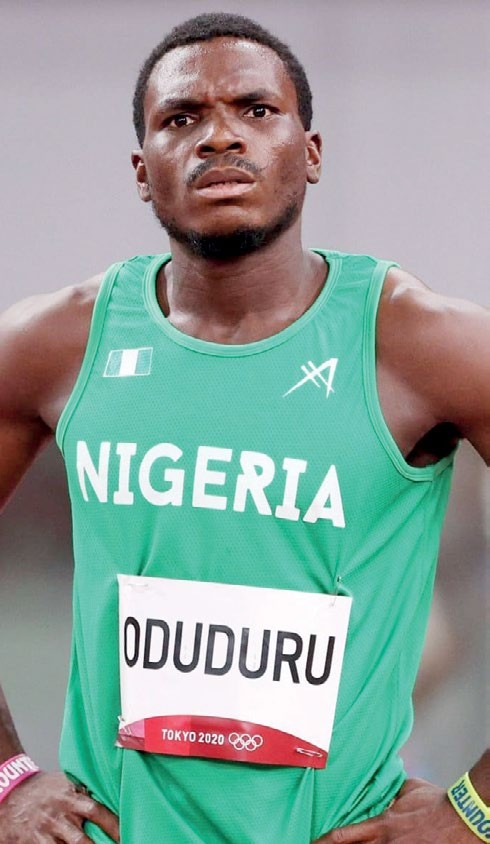
Representing Nigeria as a senior athlete, Oduduru competed at the 2014 Commonwealth Games and 2014 African Championships in Athletics. He went on to earn 200m silver medals at the 2015 and 2019 African Games, as well as the 2018 African Championships. In addition to being a two-time Nigerian national champion, Oduduru is a four-time NCAA champion for the Texas Tech Red Raiders. He is sponsored by Puma, and until his recent ban, he was poised to continue making waves in the world of track and field. In view of his talents, Oduduru was expected to compete in several competitions, including the WA Championships in Oregon, the Commonwealth Games in Birmingham, and the Africa Senior Athletics Championships in Mauritius. However, he had been absent from the athletics scene since his unceremonious outing at the Tokyo Olympics, where he failed to qualify for the semi-finals in both the 100m and 200m.
The reasons for his absence were initially attributed to injuries. However, it later emerged that the Athletics Integrity Unit (AIU) had been investigating him for two potential Anti-Doping Rule Violations (ADRVs) stemming from an investigation based on information provided in a criminal charge against US-based “naturopathic” therapist Eric Lira. Lira had been accused of supplying performance-enhancing drugs to athletes before the Tokyo 2020 Olympic Games, which were delayed until summer 2021 due to the Covid-19 pandemic.
The AIU’s statement revealed that the alleged violations against Oduduru were based on evidence gathered from its investigation and the text of conversations found on the mobile phone of Oduduru’s teammate, Blessing Okagbare. Okagbare, who was identified as “Athlete 1,” was banned from athletics for 10 years for similar ADRVs. The AIU later increased her ban to 11 years following further charges brought against her.
Oduduru was identified as “Athlete 2” in the criminal charge against Lira. The AIU’s findings indicate that he had been using performance-enhancing drugs to enhance his athletic performance. The AIU suspended Oduduru with immediate effect, and he now faces a six-year ban from athletics, which could significantly impact his career as an athlete.
The doping charges against both athletes could lead to a loss of confidence in the country’s sporting prowess. With a definitive statement still expected from the AIU, it is not clear what the future holds for Oduduru or whether he will contest the AIU’s allegations. However, the suspension and the possibility of a six-year ban will significantly impact his career as an athlete. It will also signal a sad end to what was once a promising career for a young athlete who was expected to be a shining light in Nigerian athletics.
The fall from grace of Divine Oduduru is a significant blow to Nigeria’s athletics, as he was seen as a beacon of hope for the future of the sport in the country. Any way the issue is looked at, what is obvious is that it represents a huge loss for Nigerian sports. It also serves as a harsh reminder of the importance of fair play and the consequences of doping in sports.
Nigerian sports authorities have expressed their disappointment with the situation, with some calling for more stringent measures to curb the prevalence of doping in the sport. The AIU and other sports organisations have also reiterated their commitment to ensuring that athletes who cheat are caught and punished, as part of their efforts to maintain the integrity of sports. The Athletics Federation of Nigeria (AFN) has taken decisive action in the wake of Oduduru’s suspension vowing to crack down on doping in Nigeria’s athletics community. It is a late but needed response to a series of doping scandals that have plagued the nation’s athletes. The latest scandal follows the suspension of 2022 Commonwealth Games gold medalist Grace Nwokocha and young high jumper David Aya, both of whom were implicated in doping-related cases, as THEWILL reported.
Professor Ken Anugweje, head of the AFN’s Anti-Doping and Integrity Unit, stressed that the federation had always prioritised clean sports and will not rest until doping is eradicated from Nigerian athletics.
Nigeria is classified as a Category A country by the Athletics Integrity Unit, which means that countries in this category perform well in athletics but are at high risk of doping. Anugweje outlined a range of measures implemented by the AFN’s Anti-Doping and Integrity Unit to prevent doping, including regular testing of athletes before and after major competitions, educating athletes about the dangers of doping, and imposing appropriate sanctions for violators.
He emphasised that taking performance-enhancing drugs is both cheating and hazardous to athletes’ health and that the AFN was dedicated to promoting clean sports and safeguarding the well-being of athletes.
The fight against doping, he noted, encompasses three key areas: preventing doping through education and information, detecting doping through testing, and deterring doping through punishment.
Anugweje also pointed out that Oduduru’s case is part of an ongoing investigation into the drug case involving Okagbare, and that most of the AIU’s doping-related announcements in relation to Nigerian athletics have come from the AFN’s Anti-Doping and Integrity Unit.
It remains to be seen how the situation will unfold for Oduduru and for Nigerian athletics. What is clear, however, is that the fall from grace of the once-promising athlete serves as a cautionary tale for all those who seek success through unfair means. It also highlights the need for sports organisations and authorities to remain vigilant in their efforts to detect and punish doping in sports, and to ensure that the playing field is level for all athletes.

With two of Nigeria’s top athletes facing doping charges, it will be challenging to convince the rest of the world that Nigeria’s athletics program is clean and fair. Nigeria’s athletics programme must learn from this setback and work harder to ensure that its athletes compete fairly and cleanly.
It must also take steps to address any issues that may be contributing to doping in the sport, such as lack of education and access to proper training and equipment. The success of the country’s athletics programme depends on its ability to produce clean, fair, and talented athletes who can compete at the highest levels of the sport. The suspension and potential ban of Oduduru, while disappointing, can serve as a wake-up call to the programme and a reminder of the importance of upholding the integrity of the sport.

Jude Obafemi is a versatile senior Correspondent at THEWILL Newspapers, excelling in sourcing, researching, and delivering sports news stories for both print and digital publications.