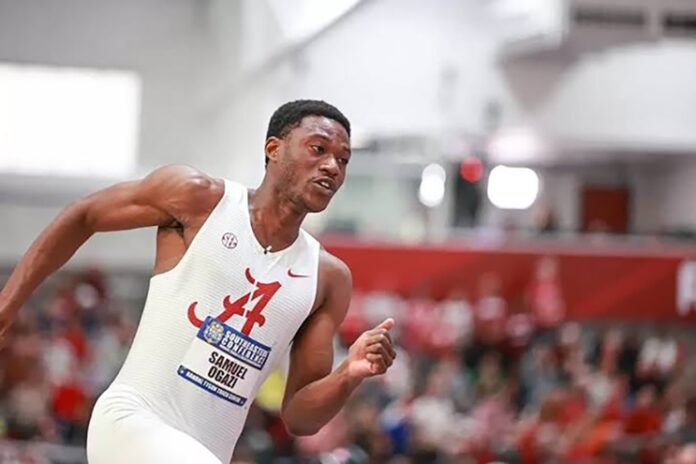
June 22, (THEWILL) – On a cool evening in Eugene, Oregon, USA Samuel Ogazi, a 19-year-old Nigerian sprinter, stood at the starting line of the men’s 400-metre final at the 2025 NCAA Outdoor Track and Field Championships. The Hayward Field stadium, a hallowed ground for track athletics, buzzed with anticipation.
Ogazi, representing the University of Alabama, carried the weight of a nation’s hopes, aiming to end a 26-year drought for Nigeria in this event. When the gun fired, he exploded from the blocks, his fluid stride and tactical pacing carrying him to a commanding victory in 44.84 seconds, the only sub-45-second time in the race. This triumph marked him as the first Nigerian to win the NCAA 400-metre title since Clement Chukwu in 1999. It was a historic moment for Nigerian athletics.
Ogazi’s path to victory began in Kaduna, northwestern Nigeria, where he grew up in a modest environment, far from the world’s elite tracks. Discovered at the 2019 Kaduna School Athletics Championships by coach Sani Mohammed, he initially competed in the 200 metres, showing early promise with a personal best of 22.09 seconds at the 2021 National Sports Festival. His transition to the 400 metres came in 2022, a pivotal year when he joined Nigeria’s 4×400-metre relay team at the World U20 Championships in Cali, Colombia. His talent earned him a scholarship to the University of Alabama, where he trained under coach Dan Wiley, a mentor who helped refine his raw speed into disciplined race-craft.

By 2023, Ogazi had claimed gold in both the 200 metres and 400 metres events at the African U18 and U20 Championships in Ndola, Zambia, and the Commonwealth Youth Games in Trinidad and Tobago, setting the stage for his collegiate career.
The road to the NCAA title was not without challenges. Ogazi began 2025 with an injury sustained during his first-ever 300-metre indoor race, forcing him to skip the indoor season entirely. His recovery demanded patience and faith, supported by his coaches and teammates at Alabama. He credited their encouragement for his return to form. His perseverance paid off at the Southeastern Conference (SEC) Outdoor Championships in Lexington, Kentucky, where he won the 400-metre title with a time of 44.58 seconds, the fastest by a Nigerian male in 37 years and a new Alabama school record.
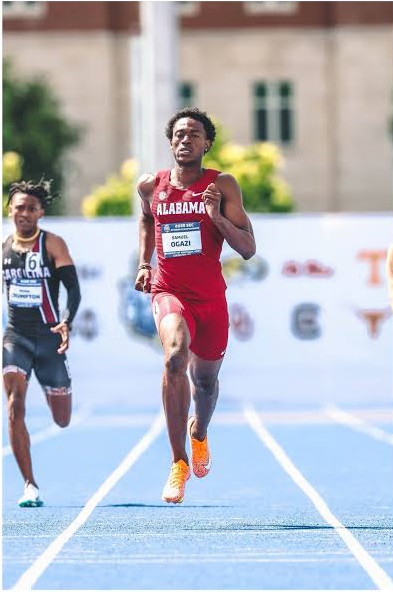
At the NCAA Championships, Ogazi’s dominance was evident from the semi-finals. He clocked 44.77 seconds, the fastest time across all heats, leaving competitors like DeSean Boyce (45.15 seconds) and Auhmad Robinson (45.35 seconds) trailing. The final, contested in cold, unfavourable weather, tested his adaptability. Ogazi executed a measured race, conserving energy through the first 200 metres before unleashing a powerful surge in the final 100. His time of 44.84 seconds outpaced Gabriel Moronta (45.47 seconds) and William Jones (45.53 seconds), securing the gold and immortalising his name alongside Alabama’s legendary Kirani James, the 2012 Olympic champion and the last Alabama athlete to win the NCAA 400-metre title.
The race itself was a study in control and execution. Ogazi’s long, fluid strides contrasted with the compact, aggressive styles of his American rivals. William Jones of Southern California, who took silver, and Jordan Pierre of Arkansas-Pine Bluff, who earned bronze, were formidable opponents, each with personal bests under 45.5 seconds. Yet Ogazi’s tactical approach, staying relaxed through the backstretch and accelerating off the final curve, gave him a full second’s lead at the finish. His time, though slower than his personal best of 44.41 seconds set at the 2024 Paris Olympics, was remarkable, given the chilly conditions, which he noted were unfamiliar to him.
This victory capped a breakout year for Ogazi, who had already made history at the 2024 Paris Olympics as the first Nigerian male to reach the 400-metre final since Innocent Egbunike in 1988. In Paris, he ran a personal best of 44.41 seconds in the semi-finals, finishing seventh in the final against a field that included Olympic champion Quincy Hall and Grenada’s Kirani James. His NCAA win, however, carried a different weight, representing not only personal redemption after a second-place finish at the 2024 NCAA Championships but also a milestone for Nigeria. The country’s athletics history, rich with sprinters like Egbunike and Favour Ofili long sought a new standard-bearer in the 400 metres. Ogazi’s performance, coupled with Ezekiel Nathaniel’s national record-breaking 47.46 seconds in the 400-metre hurdles at the same meet, signalled a resurgence of Nigerian talent on the global stage.
Ogazi’s mindset before the race reflected his maturity. At just 19, he approached the NCAA final with a blend of confidence and humility, drawing inspiration from his faith and his connection to Nigeria. So far, he has acknowledged his ambition to break the 44-second barrier, a feat no West African has yet achieved. His ability to stay composed under pressure was evident in his strategic racing, a skill honed through months of training with Alabama’s track team. Coach Wiley’s emphasis on pacing and mental preparation helped Ogazi navigate the high-stakes environment of the NCAA Championships, where American collegiate athletes dominate. The celebrations that followed the Ogazi victory were heartfelt. Ogazi, draped in the Nigerian flag, stood on the podium as the first Nigerian in over two decades to claim this title.
The significance of Ogazi’s win extends beyond the track. For Nigeria, battling limited sports infrastructure and funding, his success highlights the potential of its youth when given opportunities abroad. His scholarship to Alabama, a powerhouse in collegiate athletics, provided access to world-class coaching and facilities, a stark contrast to the dusty tracks of Kaduna. His victory also underscores the growing influence of African athletes in American collegiate sports, with Nigerians like Nathaniel and Kayinsola Ajayi making waves at the same meet. Ajayi, for instance, ran a blistering 9.92 seconds in the 100-metre semi-final, cementing his status as one of Nigeria’s fastest sprinters.
Looking ahead, Ogazi’s career holds immense promise. His NCAA title positions him as a contender for the 2025 World Athletics Championships where he will build he aims to build on his Olympic experience. The 2026 Commonwealth Games and 2028 Los Angeles Olympics loom as major targets, with analysts projecting he could challenge the sub-44-second barrier, a mark that would place him among the all-time greats. His versatility, shown through relay performances and earlier 200-metre success, adds depth to his prospects. Yet challenges remain, maintaining fitness, securing sponsorships, and competing against a stacked global field that includes American stars like Quincy Hall and Jamaica’s Sean Bailey.
For Nigeria, Ogazi’s triumph is a call to action. The Athletics Federation of Nigeria must capitalise on this moment to invest in grassroots programmes, ensuring talents like Ogazi are nurtured at home before seeking opportunities abroad. His story, from a school meet in Kaduna to the NCAA podium, speaks to the power of determination and opportunity. Standing on that podium in Eugene, with the Nigerian flag aloft, Ogazi represented not just his own ambition but the dreams of a nation eager to reclaim its place in global athletics.
Jude Obafemi is a versatile senior Correspondent at THEWILL Newspapers, excelling in sourcing, researching, and delivering sports news stories for both print and digital publications.