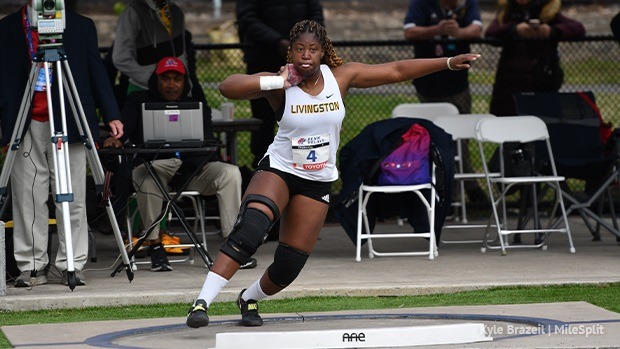
March 02, (THEWILL) — In the space of a single weekend, the African women’s shot put record fell twice, each performance extinguishing the last before it could properly settle. By the time Jessica Oji stepped out of the circle at The Armory in New York on March 1, she had rewritten continental history in just her third competition wearing a Nigerian vest. She is 18 years old, a freshman at the University of Pennsylvania, and her story is as much about geography, ambition and the restless global movement of talent as it is about the mechanics of throwing a heavy ball with exceptional force.
For more than two decades, Vivian Chukwuemeka’s mark of 18.43 metres, set in Walnut, California, in April 2003, had stood as the high-water mark for African women in the event. Chukwuemeka was a formidable figure: she won gold at the 2002 Commonwealth Games in Manchester and claimed three consecutive All-Africa Games titles between 1999 and 2007. That her record survived for over 20 years speaks both to her excellence and to the structural difficulties that have historically constrained the development of women’s field events on the continent. As she observed in 2008, consistent progress required sustained access to coaching, facilities and international competition, none of which were reliably available to African throwers.
Then, within 24 hours, the record moved not once but twice. On 28 February, Miné de Klerk of South Africa threw 18.48 metres at the Big Ten Indoor Championships in Geneva, Ohio, surpassing Chukwuemeka’s longstanding mark by five centimetres and setting a new South African national standard in the process. De Klerk, a senior at the University of Nebraska competing in a field headed by her own teammate Axelina Johansson, who won with a meet record of 19.47 metres, had become, however briefly, the most successful female shot putter in African history. That tenure lasted less than a day. The following afternoon, Oji launched the shot to 18.50 metres on her final attempt at the Ivy League Heptagonal Championships, claiming the gold medal and the continental record simultaneously, and contributing crucial points to Pennsylvania’s second consecutive women’s team title.

The margin between Oji and De Klerk, just two centimetres, belies the competitive intensity of the moment. Both athletes are products of the American collegiate system, that vast engine of athletic development which has long served as an incubator for international talent far beyond the United States’ own borders. De Klerk, who hails from Welkom in South Africa, developed under the structured coaching environment at Nebraska. Oji built her foundation through secondary school competition in Livingston, New Jersey, where she won the 2025 Nike Outdoor Nationals in the shot put and was named a Gatorade Player of the Year, before bringing that talent to Penn. Their rivalry, conducted thus far on American soil, is already generating the kind of competitive friction that pushes a discipline forwards.
Oji’s route to representing Nigeria involved deliberate choices and administrative patience. Raised and trained in the United States, she nonetheless identified with her parents’ Nigerian heritage when considering international representation, and she applied to make the switch. World Athletics confirmed her eligibility on February 3, and her debut under the Nigerian flag came at the Tiger Paw Invitational in Clemson, South Carolina, on February 14, where a throw of 17.74 metres earned her second place and immediately established a Nigerian under-20 record. The transition illustrates a wider pattern: diaspora athletes choosing to compete for ancestral nations, injecting fresh momentum into federations that have often struggled to convert domestic potential into international results.
There is an important footnote to her record. In January 2026, Oji had already thrown 18.45 metres at the Penn Elite meet, a mark that ranked second in the entire NCAA for the season and exceeded Chukwuemeka’s African record by two centimetres. Because the throw occurred before her eligibility switch was finalised, it could not be ratified as a continental record. That quirk of timing makes the Heptagonals performance the more significant: achieved under full eligibility, before certified officials, at a prestigious conference championship, it carries no asterisk.
The 18.50 metres she has now thrown sits in illuminating context. The winning mark at the 2024 African Championships in Douala, Cameroon was 18.17 metres, meaning Oji’s throw would have won that competition by a comfortable margin. The world record, set in 1987, stands at 22.63 metres, indicating the considerable distance still to travel before African women close the gap on global leaders. Yet trajectory matters as much as absolute distance. Oji improved her personal best by 78 centimetres between her season’s opening throw of 17.72 metres in December 2025 and her record-breaking effort in March, a rate of progression that very few freshman throwers can match at any stage of athletic history.
At 18, she already leads the world under-20 rankings by more than two metres. Analysts point to the efficiency of her glide technique as a particular asset, one that modern biomechanics analysis can only refine further, and she has years of physical development ahead of her. The NCAA Indoor Championships, where she and De Klerk may meet again before the indoor season closes, will offer the next measure of how far that development might take her.
For Nigeria, the symbolism runs deeper than a line in the record books. The country has historically found its international athletics success in sprints and jumps, with throwers like Chukwuemeka honoured as celebrated exceptions. Oji’s emergence offers a rare opportunity to broaden that base, and the hope within the Athletics Federation of Nigeria is that increased visibility will attract greater investment in domestic field event infrastructure. Whether that promise is realised will depend on decisions made far from any throwing circle.
What the weekend of February 28 and March 1 demonstrated, without ambiguity, is that African women’s shot put is entering a new era, driven by two young athletes training thousands of miles from the continent whose history they are jointly and rapidly remaking.

Jude Obafemi is a versatile senior Correspondent at THEWILL Newspapers, excelling in sourcing, researching, and delivering sports news stories for both print and digital publications.