
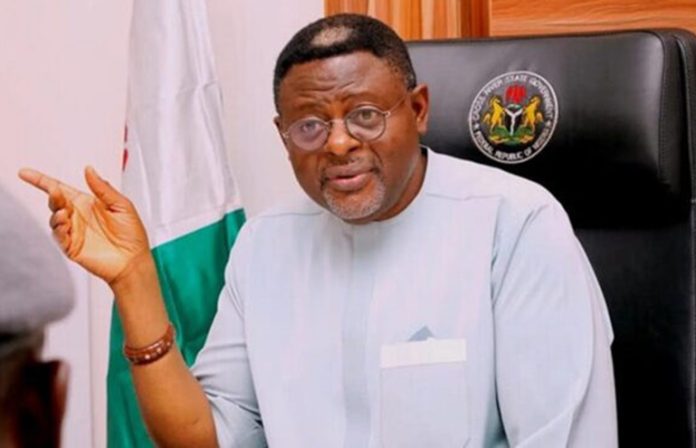
June 06, (THEWILL) – Governor Bassey Otu has taken a bold step towards open governance by presenting the approved 2025 budget to civil society organisations, media professionals, and other non-state actors in Cross River State.
The disclosure, facilitated by the Department of Budget, reinforces the administration’s commitment to transparency, fiscal responsibility, and public engagement.
Presenting the state’s first-quarter fiscal performance, the Special Adviser to the Governor on Budget, Mr. Otu Otu-Ita, revealed that Cross River generated ₦55.5 billion in revenue and spent ₦33.46 billion in the period under review.

He explained that 35% of the expenditure was channeled into capital projects, while overhead costs and debt servicing took up 50% and 25% respectively.
Otu-Ita said the high figures for overhead and debt servicing were due to inherited financial obligations but assured that the state government was focused on prudent resource management.
“We have not borrowed a kobo this year. The state is managing its resources prudently, guided by Governor Bassey Otu’s principle of responsible governance,” he said.
He also highlighted the implications of the state’s debt servicing burden, calling attention to the strain it places on development.
“Twenty-five percent of our spending goes to debt servicing — imagine what that could achieve in education, healthcare, or infrastructure. It’s a delicate balancing act, and we are committed to getting it right,” he said.
Executive Secretary of the Budget Transparency and Accountability Network (BTAN), Mr. Kingsley Eworo, commended the administration’s openness but called for the urgent reactivation of the Open Government Partnership (OGP) Steering Committee to deepen reforms.
OGP representative in the state, Ms. Ukeme Ekong, echoed the call, urging the government to move beyond budget visibility to meaningful stakeholder collaboration.
“The 2025 budget is already online — that’s a great step. But we must go beyond visibility. We need deeper collaboration between government, civil society, and the media to ensure accountability is not just a principle but a practice,” she said.

