Africa’s representation at this year’s World Cup in Qatar has been a mixed bag of unexpected results, disappointing displays and Morocco’s extremely stingy defense. While all five countries of Morocco, Cameroon, Ghana, Senegal and Tunisia, went into the first ever World Cup to be hosted on Arabian soil with the first ever lineup of coaches who are indigenous to the countries they are representing, there were concerns about how far they will go given the groups into which they were drawn.
There was already a precedent of African countries reaching the quarter-finals and with Senegal drawn in perhaps the easiest group – Group A which had national teams from the host country Qatar, Netherlands and Ecuador, Tunisia had to battle reigninÅÇg champions France, Australia and Denmark in Group D while in Group F, Morocco was faced with the challenge of title contenders Belgium, north American leaders Canada and Croatia, who finished as runners-up in the last World Cup Russia 2018, with Cameroon in Group G alongside Cup favourites Brazil, Serbia and Switzerland and finally, Group H had Ghana drawn with Cristiano Ronaldo’s Portugal, Ghana’s nemesis at South Africa 2010 Uruguay and the senior men’s team of the Korea Republic.

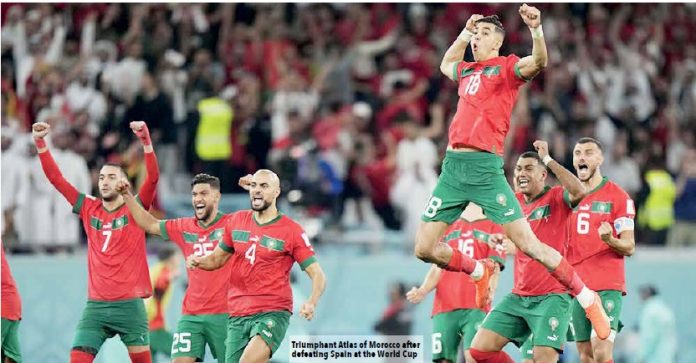
Of these teams, Morocco faced a most difficult task and could have been contented with a runners-up place in Group F but they did not think of themselves as inferior and when on Thursday last week coach Luis Enrique was fired after Spain’s defeat against Morocco in the World Cup Round of 16, it was a justification for the persevering mentality of the Moroccans. They had beaten the Spaniards on penalties after a goalless draw on Tuesday in an upset result after Enrique’s squad failed to turn their dominance into a victory. Spain were favourites to progress instead of Morocco as the Europeans got off to a good start in Qatar, routing Costa Rica 7-0. However, the exhilaration of that goal-fest died soon after as La Roja could not win again. Their next last three matches saw them drawing 1-1 with Germany and losing 2-1 to Japan before being knocked out by Morocco.
By advancing, Morocco became the fourth African side to ever make it to a World Cup quarter-final, and they are the first Arab team on the continent to do so evoking the world’s biggest party at the Education City stadium in Doha on Tuesday night. And now, they are bidding to become the first African side to reach a World Cup semi-final. They have come this far by being very conservative at the backline, reaching this stage by overcoming European giants such as Spain and Belgium on the way. With the advancement, the party and celebration of Moroccans was understandable. The vast majority of the 44,000-strong crowd was overwhelmed by emotion after Morocco defender Achraf Hakimi sealed victory with a cheeky panenka penalty kick. Their fans and supporters poured out into the streets of Casablanca, Rabat, Marrakesh, and practically every capital city in Western Europe to celebrate that even their monarch King Mohamed VI joined the jubilant crowds. As they danced, hugged and cried in the dressing room, coach Walid Regragui made an extremely important declaration in his post-match press conference.
The manager, who was handed the team after they had already qualified for Qatar to complete a total of five indigenous coaches for the first time ever, said: “At some point in Africa, we have to be ambitious and why not win the World Cup, even if it’s going to be hard.” It was a very significant statement and was instructive as to the mindset that has brought Morocco this far.
The choice of Regragui by the Moroccan Football Federation to manage the Atlas Lions at Qatar was a no-brainer for those conversant with football competitions on the continent. If there was confidence in any homegrown talents to improve on the coaching of Vahid Halilhodzic, the 46-year-old Regragui fitted the bill. He had the experience to organise a winning team through the rigours of an international competition and the marathon of a local league. The 69-year-old Halilhodzic who took charge of the North Africans in August 2019, led the Moroccan team to the quarter-finals of this year’s TotalEnergies Africa Cup of Nations in Cameroon and then secured World Cup qualification in March following a 5-2 aggregate win over DR Congo before the disagreements that led to him amicably parting ways with the Moroccan team.
Regragui possessed the record to match the confidence reposed in his capacity to take this team progress to a level befitting their participation in Qatar. He was born on September 23, 1975 in Corbeil-Essonnes, France meaning he was eligible to represent Les Bleus but he elected to stick with his country of origin, Morocco.
As a right-back, there was not much in terms of standout records from his playing career. In between representing the Moroccan national team, he was a player for Racing Santander, Toulouse, Grenoble, and AC Ajaccio. In the summer of 2009, Regragui transferred from Moroccan club Moghreb Tétouan to Grenoble for the last move of his active days as a player before making the switch to football management.
In September 2012, Regragui started working as an assistant football coach for Morocco’s national team. On October 1, 2013, Rachid Taoussi was fired as head coach, and, as assistant, Regragui’s contract was also terminated. He accepted a head coaching position at Fath Union Sport for the 2014/2015 season on May 8, 2014 and, by mutual accord, he left the team on January 22, 2020 after leading the team to life the Moroccan Throne Cup in the 2013/2014 season and the Botola Pro trophy in the 2015/2016 campaign.
Regragui was named the Wydad AC head coach on August 10, 2021. He guided Wydad AC to its third CAF Champions League championship in May this year, defeating reigning champions and African football powerhouse Al Ahly in the final as only the second Moroccan manager to win the African Champions League after Hussein Ammouta’s triumph with Wydad in 2017. It is this winning mentality he has brought to the team as they progress in Qatar.
His declaration of daring to have an African country challenge for the World Cup is a sign of a paradigm shift in how African nations approach the World Cup, and it is fitting that it came from Regragui, who represents a paradigm-shift in African coaching as part of the inaugural CAF Pro Licence class of 2018 – the very first group of coaches who secured football’s highest coaching diploma entirely on the continent. He represents everything that is right in African football: He’s young, competent, cosmopolitan, fearless and a pan-Africanist at heart. It reflected as they maintained a startling record of no opposition player scoring against them so far in the entire 390 minutes of football they have played in Qatar.
When Morocco faces Portugal, the players will represent not just the ambitions and dreams of the Moroccans but also the African continent – without going into the debates of their Arabic leanings and African links. What they are reaping at the moment is the benefit of sustained investment in football. Mohammed VI, the king of Morocco, who congratulated Regragui over the phone following the victory against Spain, had a bid for the 2026 World Cup rejected after witnessing his father’s dream of his nation becoming the first in Africa to host the World Cup come to an end after three unsuccessful bids. However, a sizable investment in the nation’s football infrastructure is obviously paying off. One example is the impressive Mohammed VI training complex in Maâmora, which cost $65 million to construct. Their coach reflects this is his comments. He said: “We are trying to be a powerhouse in Africa. The continent is moving forward, Morocco has made a lot of effort. I arrived in 2013 and since then I have seen the stadiums evolve, the federation has made enormous efforts, his majesty has invested a lot of resources. Now, we must not fall asleep, we must continue.”
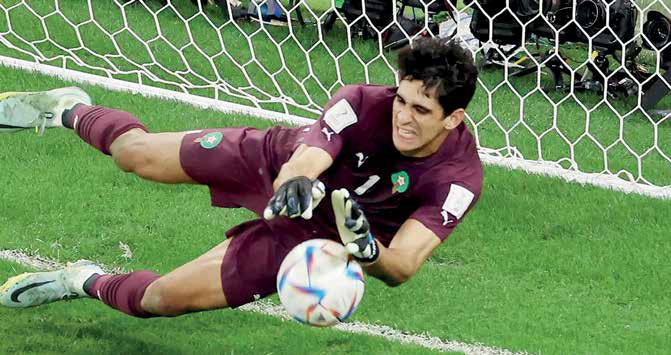
Although other African representatives have not lived up to expectations of football fans in the continent, the Qatar World Cup has been, by far, the most successful tournament ever on the pitch for these teams. The 24 cumulative points out of their 15 group stage matches that all African teams amassed overtook the previous record of 15 points set in the 2002 tournament. Although Tite fielded a heavily tweaked side after his squad was already through to the next round, it is still on record that Cameroon became the first African nation to beat Brazil at a World Cup tournament. In addition, Tunisia scored a victory over reigning champions France, while the Morocco squad became the first African nation to win a group, with seven points to their name. Regragui was able to bring his side to this threshold by defending stoutly and by taking advantage of the good reflexes of their goalkeeper Yassine Bounou. It was clear throughout the match against Spain with the Atlas Lions proving resilient against La Roja’s ball possession and attempted goals.
It has been 36 years since Morocco last qualified for the round of 16. The Atlas Lions’ qualification spread joy and happiness across Morocco, with Moroccans from all walks of life celebrating both the head coach and players and Africans beaming with pride for the progress of the team and African football.
The success of Morocco at the World Cup will help grow the size of the fan base for African football. Already Africa’s coaches are getting their time in the limelight especially after Aliou Cisse won the Africa Cup of Nations for Senegal and qualified them for Qatar. There are others coming through such as Algeria’s Djamel Belmadi, Tunisia’s Radhi Jaidi and South Africa’s Benni McCarthy, providing other examples of the new African coaching prototype. It is a progress that will be helped by this Morocco’s squad display irrespective of how their Qatar journey finishes.

Jude Obafemi is a versatile senior Correspondent at THEWILL Newspapers, excelling in sourcing, researching, and delivering sports news stories for both print and digital publications.