October 22, (THEWILL) – Ejowvokoghene Divine Oduduru was once the bright, young hope of Nigerian athletics. The sprinter burst onto the scene as a teenager, breaking national youth records and winning medals at junior championships. His rapid rise continued as he set new senior national records, claimed NCAA collegiate titles in the United States, and represented Nigeria at the Olympic Games. He was poised to become Nigeria’s next sprint superstar, following in the footsteps of legendary compatriots like Davidson Ezinwa and the late Sunday Uti.
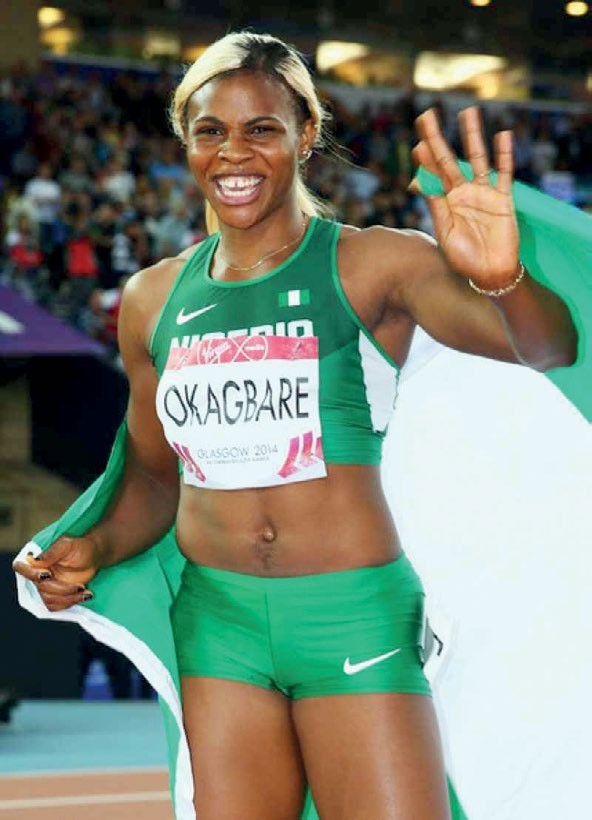
However, Oduduru’s once promising career now lies in ruins, after he was handed a six-year ban last week for doping offences. It is a spectacular fall from grace for the 27-year-old, who insists he is innocent despite overwhelming evidence linking him to a wider doping ring involving his disgraced teammate, Blessing Okagbare.
Many in Nigerian athletics circles reacted with shock and disappointment at the news. However, there were also some who recalled warning signs and rumours that had long dogged the sprinter’s rise to success.

Oduduru grew up in Ughelli, a small town in Nigeria’s Delta State. He was introduced to athletics by a local coach, David Etsebiminor, who recognised his natural running talent, which he regularly displayed while racing friends on the streets. His big breakthrough came when he won sprint doubles at the Nigerian youth and junior championships, setting new national age-group records in the process.
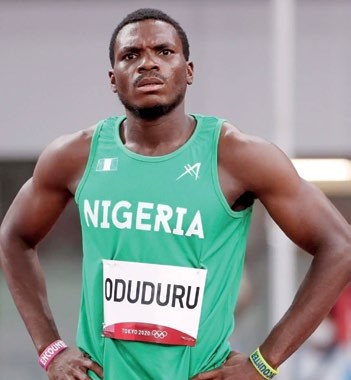
More junior titles followed at continental level, marking Oduduru out as a future star. He had success as a youth sprinter for Nigeria, winning gold in the 100m and 200m at the 2013 African Youth Championships. He made the final of the 200m at the 2013 World Youth Championships and won gold in that event at the 2013 African Junior Championships. He defended his 200m title and also won the 100m and 4x100m relay gold at the 2015 African Junior Championships. In his early senior career he won silver in the 200m at the 2014 World Junior Championships and led Nigeria’s 4x100m relay team at the 2014 Commonwealth Games. Injuries sometimes kept him from defending his titles but he bounced back to win silver in the 200m at the 2015 All-Africa Games.
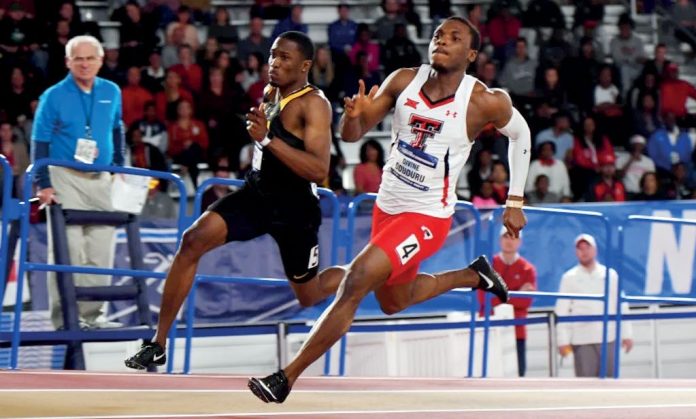
Yet, it was his move to the United States on a college scholarship in 2017 that really accelerated his development. At Texas Tech University, under the expert guidance of veteran NCAA coach Wes Kittley, Oduduru went from prospect to champion.
In his first NCAA outdoor season, he finished second in the 100m and won the 200m final. The following year, he went one better by claiming the sprint double at the NCAA Indoor Championships in record-breaking times. Outdoors, he retained his 200m title and broke the revered 20-second barrier. Another NCAA 200m gold came in 2019, as Oduduru clocked a blistering 19.73 seconds – the fastest ever time run by a Nigerian. He also took home the 100m title in 9.86, the fastest time in the world at that time in the sprint season.
Back home, he was ratified as national 100m and 200m record holder. With his chiselled physique, broad smile and humble demeanour, Oduduru was both a sponsor’s dream and an icon for Nigeria’s aspirational youth. His NCAA success brought prestigious individual honours like the Bowerman Award nomination for the best collegiate athlete in the United States.
With such rapid progress, an Olympic medal seemed within reach. However, behind Oduduru’s rise, shadows were gathering. At the 2018 Commonwealth Games, his name was linked by media to a Nigerian team hit by doping violations that eventually saw eight athletes banned. Oduduru denied any wrongdoing and no evidence implicated him at the time.
The following year, documents leaked during the Russian doping scandal showed Oduduru had recorded suspicious blood values in 2017, prior to his breakthrough NCAA season. His results did not trigger an anti-doping rule violation but they did raise eyebrows. Oduduru labelled the allegations a “distraction” and said he was committed to clean sport. His denials were backed by former chairman of the Delta State Athletics Association, Solomon Ogba, who cautioned against “casting aspersions.” With no proof of wrongdoing, Oduduru’s career continued on an upward trajectory.
Behind the scenes, the gentle giant from Delta State had forged a close bond with his compatriot Blessing Okagbare – the record-breaking sprint star and senior figure in Nigerian athletics. Okagbare acted as a mentor to Oduduru, then an impressionable 21-year old navigating a path on foreign soil.
In hindsight, it was a fateful relationship. Last February, Okagbare was banned for 11 years for doping violations following an investigation triggered when US police charged her therapist Eric Lira with supplying performance enhancing drugs to athletes, including at the Tokyo Olympics. Okagbare had denied any wrongdoing but messages and financial records revealed her deep involvement with Lira in obtaining and using prohibited substances over several years.
The same evidence trail has now caught up with her protege, Oduduru. Phone records show Okagbare requesting injections and oral medicines from Lira for Oduduru. Photographs on Okagbare’s phone revealed packages containing vials of human growth hormone and insulin growth factor 1 that were sent on for delivery to Oduduru.
When investigators from the Athletics Integrity Unit (AIU) raided Oduduru’s Florida apartment last August they found two boxes labelled Somatropin, identified as human growth hormone. Also discovered were three vials of insulin growth factor and erythropoietin. Oduduru denied opening or using any prohibited substances but conveniently claimed he had disposed of other packages sent to him by Lira.
This implausible tale has now ended Oduduru’s career. His six-year ban for using and possessing banned substances was announced last week by the AIU, who presented overwhelming evidence of his doping with the help of his now infamous teammate Okagbare.
In a flat statement, Oduduru continued to deny any wrongdoing and signalled his intention to appeal. It is unlikely that he will produce evidence to overturn a ban that rules him out until just before his 33rd birthday. The AIU concluded his violations were aggravated by being part of a wider doping ring orchestrated by Okagbare and Lira. They also noted his complete lack of remorse for behaviour that has irrevocably damaged the reputation of Nigerian athletics.
Oduduru’s fall from grace is a lesson to all athletes that cheating eventually gets found out at the highest level. It is also a sad episode for Nigeria, where he was a rare talent capable of rekindling memories of sprinting glory on the track.
His family and those early mentors who set Oduduru on the path to success must now wonder if avoiding the fateful partnership with Okagbare might have seen Oduduru fulfil his potential without resorting to the menace of doping.
There will also be anger and soul-searching within Nigerian athletics circles. Oduduru is not the first high profile athlete from the country to recently test positive but he is by far the most successful male track star to be banned. Questions will be asked about why warning signs were not heeded earlier and what more can be done to prevent doping.
Oduduru’s case is strengthened by evidence uncovered in criminal proceedings against his supplier Eric Lira in the United States. The extra-territorial reach of American law enforcers continues to prove crucial in tackling the scourge of doping in global sport. Their vigilance exposed Okagbare and has now ended the career of her young sidekick Oduduru.
With his ban now confirmed, Oduduru’s achievements and record will be questionable. The NCAA titles, national records and Olympic appearances will be considered to have been attained dubiously. Once the heir apparent to Nigerian sprinting royalty, he will now serve as a cautionary tale for those dreaming of following in his footsteps.
The question now is whether Oduduru can salvage his reputation after this spectacular fall from grace. Perhaps, but only if he shows true remorse and reveals all details of his doping past to the relevant authorities. Until then, he will remain Nigeria’s Icarus of the track – a prodigious talent who flew too close to the sun before crashing down in the most saddening fashion possible.
Jude Obafemi is a versatile senior Correspondent at THEWILL Newspapers, excelling in sourcing, researching, and delivering sports news stories for both print and digital publications.