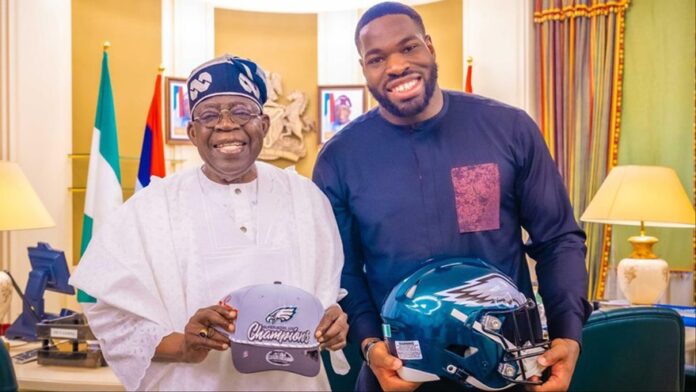
March 09, (THEWILL) – Morotoluwa Ojomo, a Nigerian-born athlete, visited President Bola Ahmed Tinubu on February 28, following his Super Bowl victory with the Philadelphia Eagles. This meeting, held at the State House in Abuja, marked a significant moment for Nigerian sports.
Ojomo’s journey from Lagos to the National Football League (NFL) highlights the potential of Nigerian athletes on the global stage. His plans to establish a sports academy in Nigeria aim to inspire and develop future talent.
To examine the importance of his visit, the role of the Nigerian Government in sports development and the potential for Nigeria to benefit from its diaspora athletes to strengthen its sporting system. This goes back to where it all began.

Ojomo’s story begins in Lagos, where he was born in 2001. His family moved to the United States in 2009 when he was seven years-old.
Growing up in Texas, he developed an interest in American football, a sport not widely played in Nigeria. He attended the University of Texas, where he played 50 games over five seasons, recording 95 tackles and five sacks. His performances earned him recognition and in 2023, the Philadelphia Eagles selected him in the seventh round of the NFL Draft.
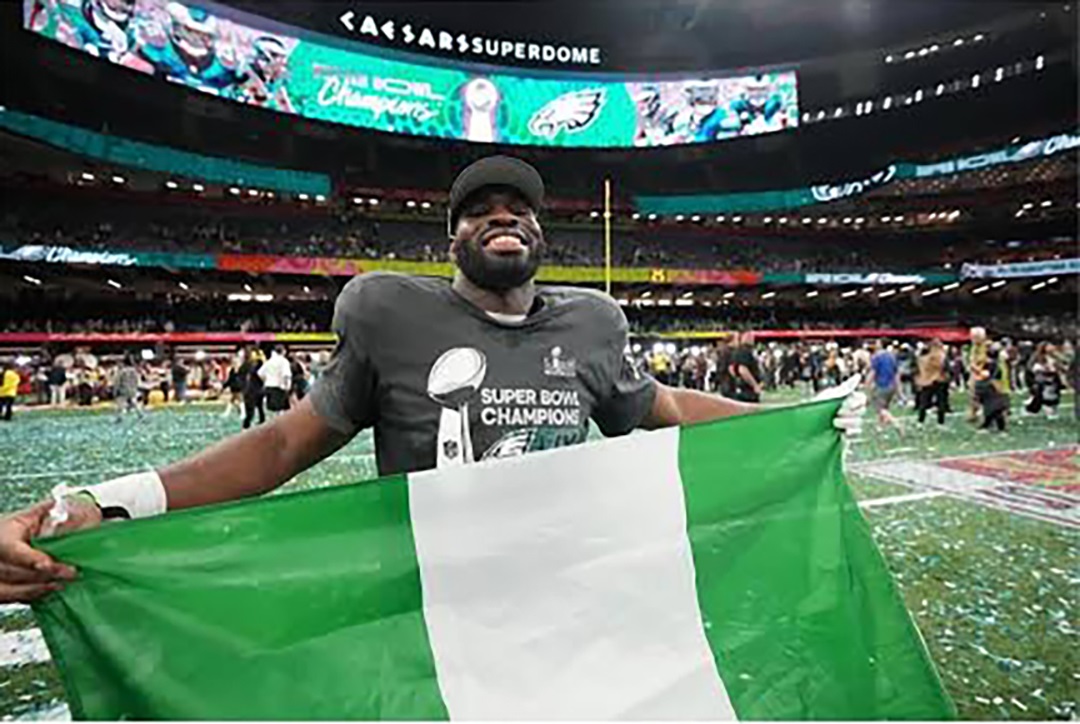
On February 9, Ojomo contributed to the Eagles’ 40-22 victory over the Kansas City Chiefs in Super Bowl LIX, held in New Orleans. He recorded two tackles, including one for a loss, helping his team to their second Super Bowl title. After the win, he displayed the Nigerian flag, a gesture that caught attention back home.
The visit to President Tinubu came less than three weeks after the Super Bowl. Ojomo arrived in Nigeria on February 25, accompanied by his parents, Ololade and Bimbo, and his sister, Modele. The meeting at Aso Rock included Abike Dabiri-Erewa, Chairman of the Nigerians in Diaspora Commission (NIDCOM), who facilitated the visit. Tinubu welcomed Ojomo warmly, praising his determination and focus. He noted that Ojomo’s success demonstrated what Nigerians could achieve worldwide. The President urged him to mentor young athletes in Nigeria, suggesting that his experience could help develop talent locally. Ojomo presented Tinubu with a signed Eagles helmet and a Super Bowl champions hat, symbols of his achievement and his connection to Nigeria.
This encounter was more than a ceremonial event. It highlighted the growing influence of Nigerian athletes in international sports, particularly in the NFL, where over 30 players of Nigerian descent have competed in recent years. Ojomo’s visit brought attention to the potential for collaboration between Nigeria’s government and its diaspora. Tinubu’s comments reflected an interest in engaging with successful Nigerians abroad to benefit the country. Lagos Governor Babajide Sanwo-Olu had earlier congratulated Ojomo on February 10, calling him a Lagos-born talent and noting that his success inspired pride across Nigeria. The involvement of both state and federal leaders suggested a unified effort to celebrate and possibly build on Ojomo’s accomplishments.
Ojomo shared his vision during the visit. He plans to establish a sports academy in Nigeria focused on American football, with the goal of providing opportunities for young people. He believes the sport offers a pathway to education, including high school and university degrees, as well as a chance to compete globally. He also aims to promote flag football, a non-contact version of the game, with an eye toward qualifying Nigerian teams for the 2028 Olympics, where the sport will debut. Ojomo told reporters that the most important thing was giving our youths an opportunity to get into American football. It was a pathway to make Nigeria bigger on a worldly view. His own journey supports this idea. He credits his Nigerian upbringing for the determination that led to his NFL success, saying, he would not be here without Nigeria.
The Nigerian Government’s role in sports development remains a critical factor. Tinubu’s administration has stated its commitment to human capital development, with a massive 2025 budget intended to prioritise economic stability and youth empowerment.
However, sports funding has historically been inconsistent. Football, which Americans call “soccer”, dominates the sporting landscape in Nigeria, receiving the bulk of attention and resources. American football, by contrast, has little presence, with no established leagues or infrastructure. Ojomo’s academy could introduce the sport to a wider audience, but its success depends on government support. Tinubu’s encouragement of Ojomo suggests an openness to new ideas, yet past governments have struggled to turn words into action.
Sports facilities across Nigeria often lack maintenance, and grassroots programmes are limited.
Collaboration with the private sector could address some of these gaps. Ojomo’s initiative might benefit from partnerships with businesses or international organisations, reducing the burden on public funds. His status as an NFL champion gives him credibility to attract investment. However, challenges remain.
Establishing an academy requires land, equipment, and trained coaches, all of which involve significant costs. Bureaucratic delays and corruption could also slow progress. Ojomo acknowledged these difficulties indirectly acknowledging that the grass is not greener where you go; it is greener when you water it. His position implies a need for effort and investment to make his vision work in Nigeria.
Nigerians in the diaspora offer a valuable resource for sports development. Athletes like Ojomo, along with others, such as C.J. Uzomah and Charles Omenihu in the NFL, or stars in basketball and athletics, demonstrate the talent pool available. Over 60 percent of Nigeria’s population is under 25, providing a large group of potential athletes. A structured programme to identify and train young talent, with guidance from diaspora professionals, could transform the country’s sporting future.
NIDCOM’s involvement in Ojomo’s visit indicates that the Federal Government recognises this potential. Dabiri-Erewa praised his commitment to uplifting Nigerian youth and announced plans to honour him, suggesting official backing for his efforts.
Still, turning this potential into results requires a clear strategy. Nigeria could create a formal initiative to connect diaspora athletes with local programmes, offering mentorship, training camps, or funding. Ojomo’s academy could serve as a pilot project, testing how such collaboration might work. Other countries, like Jamaica in athletics, have benefited from engaging their overseas talent. Nigeria’s challenge lies in moving beyond individual success stories to build a system that produces consistent results.
Ojomo’s focus on education alongside sports aligns with this goal, as it addresses the need for long-term development rather than short-term gains.
Cultural factors also play a role. Football’s dominance in Nigeria reflects its accessibility and popularity, requiring minimal equipment compared to American football. Introducing a new sport demands awareness campaigns and community support. Flag football, which Ojomo hopes to promote, could help here, as it needs less gear and poses fewer injury risks. If successful, it might pave the way for broader acceptance of American football. The 2028 Olympics provide a target, but building a competitive team in three years is ambitious without immediate action.
Indeed, Ojomo’s plans, while admirable, risk being a one-off effort without systemic change. Nigeria’s sports ecosystem has long suffered from underfunding and mismanagement. The government’s 2025 budget, while large, faces scrutiny over whether it truly prioritises youth and sports. For Ojomo’s academy to succeed, it needs more than goodwill—it requires resources and a clear policy framework. Tinubu’s administration must decide if it will treat sports as a serious investment or a secondary concern.
Still, the visit’s impact extends beyond Ojomo’s personal story. It raises questions about Nigeria’s ability to capitalise on its talent, both at home and abroad. If the government and private sector support his academy, it could inspire other diaspora athletes to contribute. A single Super Bowl champion cannot transform Nigerian sports alone, but he can start a conversation. Tinubu’s call for Ojomo to mentor youth reflects a desire for progress, yet words must lead to deeds. The meeting on February 28, could be remembered as a turning point—or just another photo opportunity.
Ojomo’s journey from Lagos to the NFL offers a powerful example. His success, paired with his intent to give back, challenges Nigeria to think bigger. The country has the population, the talent, and now a champion willing to lead. Whether it can build on this moment depends on action, not promises. Ojomo believes Nigeria can grow its own grass greener. The question is whether its leaders and people will water it together. His visit to Tinubu marks a chance to start that process, one step at a time.

Jude Obafemi is a versatile senior Correspondent at THEWILL Newspapers, excelling in sourcing, researching, and delivering sports news stories for both print and digital publications.