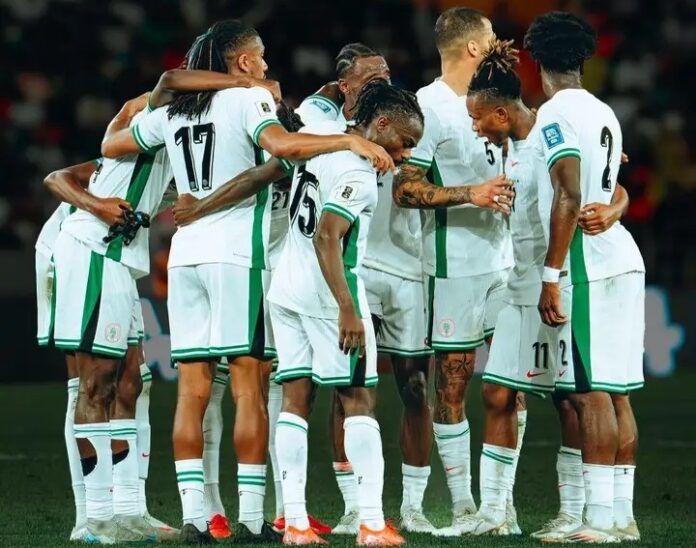
November 16, (THEWILL) — The floodlights at Rabat’s Stade Prince Héritier Moulay Hassan illuminated far more than a football match on Wednesday evening. Nigeria’s 4-1 victory over Gabon, secured after extra time in the CAF semi-final playoff, represented a triumph not merely of skill but of resilience against a backdrop of financial grievances, diplomatic controversy and mounting national expectation.
The Super Eagles entered the contest carrying burdens that extended well beyond the tactical challenge posed by Pierre-Emerick Aubameyang and his Gabonese teammates. Before the fixture, players had boycotted training sessions to demand long-overdue bonuses and allowances, some reportedly stretching back to 2019 and encompassing payments owed from Africa Cup of Nations campaigns and previous qualification efforts. Captain William Troost-Ekong later confirmed the dispute had been resolved, yet the episode underscored the administrative strains that continue to shadow Nigerian football despite the nation’s talent-rich squads.
Such off-field tensions might have derailed a less determined side. Instead, they seemed to galvanise Eric Chelle’s men, though not without considerable strain. The Malian coach, who assumed control earlier this year, deployed a high-pressing 4-3-3 formation designed to exploit Gabon’s midfield vulnerabilities through width and pace. On paper, Nigeria held every advantage: ranked 41st globally against Gabon’s 77th, boasting some of Europe’s top quality throughout the spine, and carrying the weight of a nation desperate to end an absence from the World Cup finals that stretches back to 2018.

Yet football’s capacity to confound expectation was evident from the opening exchanges. Whilst Nigeria dominated possession and created numerous opportunities, profligacy threatened to undermine their superiority. Victor Osimhen, so often the difference-maker, squandered two clear chances in the first half, including a chance from six yards that drew audible frustration from the Nigerian bench. The Galatasaray striker’s struggles epitomised a broader pattern: Nigeria accumulated 10 shots to Gabon’s four, yet lacked the clinical edge required to convert dominance into goals.
The defensive structure, anchored by Wilfred Ndidi’s tireless work in midfield and Benjamin Frederick’s composed presence alongside Troost-Ekong in defense, largely nullified Aubameyang’s threat. The ex-Arsenal legend, seeking one final World Cup appearance at 37, found himself isolated as Ndidi registered four interceptions to break up Gabonese counters. Nevertheless, vulnerabilities emerged as the match wore on, particularly from set pieces where Nigeria’s concentration proved imperfect. Against the run of play, Akor Adams seized on a poor Gabon backpass in the 78th minute and slotted home to give Nigeria the lead.
However, those earlier mentioned weaknesses on the Nigerian side were brutally exposed in the 88th minute when Mario Lemina’s volley from a corner, capitalising on goalkeeper Stanley Nwabali’s misplaced clearance, hauled Gabon level and forced extra time. For Nigeria, the goal represented both a tactical lapse and a test of mental fortitude at the moment when qualification appeared within grasp.
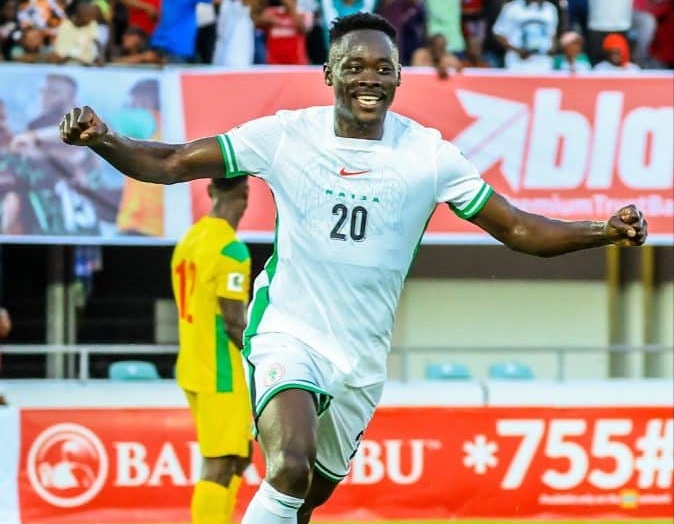
Extra time, however, revealed the gulf in physical conditioning and squad depth. Substitute Chidera Ejuke restored Nigeria’s lead within five minutes of the restart, curling home from the edge of the box with technique that belied the mounting fatigue around him. The goal shifted momentum decisively, allowing Nigeria’s superior fitness to overwhelm Gabon’s ageing midfield. Osimhen, having endured earlier frustrations, finally delivered when it mattered most, powering home a shot from Frederick’s pass in the 102nd minute before adding a second eight minutes later following Chidozie Awaziem’s through ball.
The 4-1 scoreline offered vindication for Chelle’s tactical adjustments, particularly his decision to push full-backs higher and exploit Ejuke’s pace against tiring legs. Yet it also highlighted concerns that may prove costly against sterner opposition. Nwabali’s distribution errors and the defensive uncertainty at set pieces provided sobering reminders that qualification demands more than periodic excellence.
The victory’s significance extends beyond tactics and scorelines. In Nigeria, where football serves as a rare unifying force amid economic pressures, President Bola Tinubu hailed the team’s “courage and precision” as embodying “the spirit that rises and prevails”. Confidence polls showed support for qualification jumping from 40 per cent before the match to 65 per cent afterwards, though the bonus dispute highlighted the federation’s ongoing struggles to provide adequate support for its players.
Sunday’s final against the Democratic Republic of Congo presents a formidable obstacle. DR Congo defeated Cameroon through Chancel Mbemba’s stoppage-time header, demonstrating both patience and the ability to capitalise on fleeting opportunities. Their disciplined approach, built around set-piece proficiency and swift counter-attacks, poses precisely the sort of challenge that exposed Nigeria’s weaknesses against Gabon. Chelle’s side must show greater defensive concentration from the opening whistle whilst converting superiority into goals before late drama beckons.
Victory would secure passage to March’s intercontinental playoff in Mexico, where Africa’s representative faces teams from Asia, Oceania, South America and North America for just two places at the expanded 48-team tournament. For Nigeria, it would mark a seventh World Cup appearance and evoke memories of the 1994 quarter-final run that remains the nation’s finest hour. Defeat, conversely, would compound the disappointment of recent years and raise fresh questions about the federation’s capacity to nurture the talent evident in emerging players like 20-year-old defender Fredrick.
The controversy over match officiating, including Nigeria’s rejected protest against the appointment of a South African referee and Beninese assistants, has faded into irrelevance following the result. What matters now is whether the Super Eagles can channel Wednesday’s extra-time resolve into 90 minutes of controlled excellence. Qualification demands endurance, certainly, but it requires something more: the ability to deliver when expectation weighs heaviest and errors carry the severest consequences. Nigeria have shown they possess such qualities. On Sunday, they must prove it again.

Jude Obafemi is a versatile senior Correspondent at THEWILL Newspapers, excelling in sourcing, researching, and delivering sports news stories for both print and digital publications.